95.TAMILNADU (10). POOMPUHAR, PUDUCHERY, ALAMPARAI.

In the last post (No. 94) I made an error by omitting a place we visited lying between Karaikal and Cuddalore. Poompuhar cannot be ignored.

The southern Coromandel Coast mostly within the territory of Tamilnadu state is thick with history.This history is not only of the European colonization but goes back to the ancient times when many places along the coast were centres of international trade. One such place which is said to have flourished from 200 BC onward is Poompuhar. The seaside town which was once the second capital of the Chola dynasty and a major centre of international trade with both eastern and western people. Silk appears to be a major item of exports from here. The ancient port as destroyed and is now found by the archaeologists submerged off the coast for up to 5 Kms. Erosion of land or a Tsunami have been cited as possible causes.

There are no archaeological remains on the shore. A small maritime museum displays a few objects, not very impressive.

  The beach is a major attraction and the tourism department of the state seems to have made efforts to promote the destination.

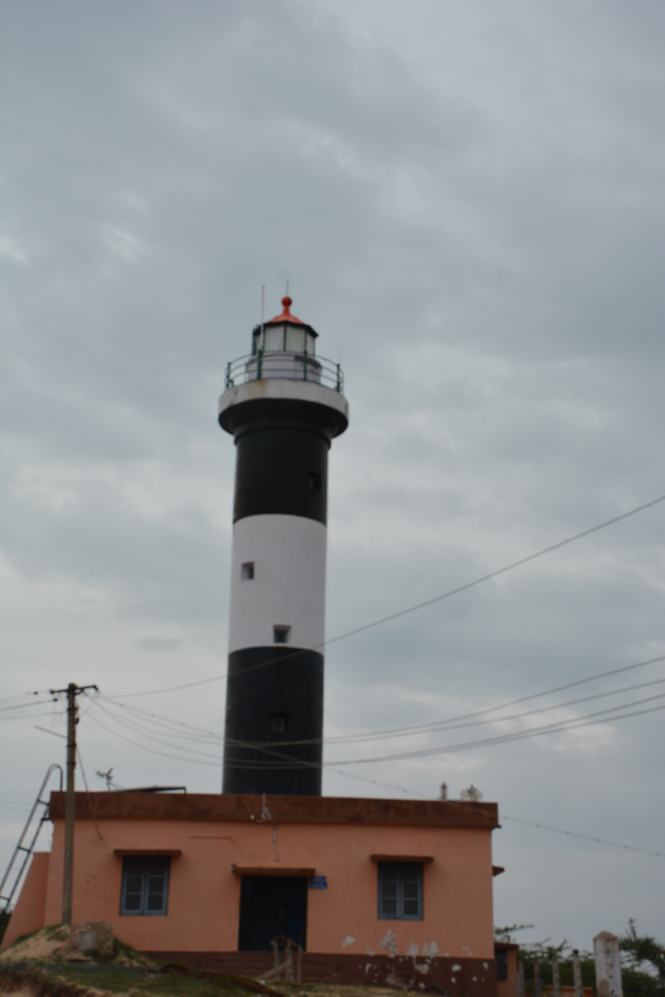
 Poompuhar has a lighthouse which resembles the one at Mallipatnam in design and the colours.

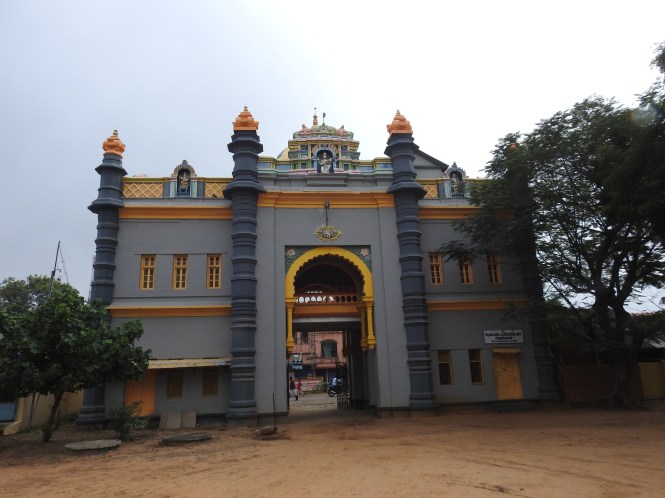
 There are a couple of temples, quite nice. We did not go into the details. One is of Godess Kamakshi.

One impressive feature of the Poompuhar beach is the fish trading activity. This is of two types. Fresh fish is sold fried in the several small kiosks. Apart from fish Crabs and Prawns are also sold. The tourists seem to be providing the client base.

 The second one is sale of dried fish. This appears to be economically more important. This market has a vast variety of dried fish in sizable quantities. I cannot imagine a tourist carrying dry fish in his bags on his way back home. It is seriously smelly. The market must be for tradesmen dealing in fish for other parts of the State or the local consumers.


 XXXXXXXXXXXXXXXXXXXXXXXXX

 Our next stop after Cuddalore is Pondicherry or Puducherry as it is now renamed. The former French colony was established in the year 1674 and this status lasted till 1954. This is about 280 years and much less than the 450 years’ rule of the Portuguese in Goa. The Portuguese were the First-In-Last-Out of the European colonialists in India. They appeared on the Kerala Coast at the beginning of 16th century and left Goa in 1961, which gives them a time-frame of four and half centuries, without making any significant impression on this sub-continent. Of course this is not the subject matter of this blog. Let us move on.   One feature of this French territory and also the other three in the country is that they are highly fragmented parcels of land. (There are other two- Chandranagore in present day in W bengal and Musulipatnam in Andhra Pradesh- French territories that did not last till 1954).

 One has to pass through other territories (which were earlier British possessions) to reach another part of the same geographical entity. This situation still continues and is more relevant from the point of view of the liquor trade. When you enter Puducherry from the south, you drive a bit and re-enter Tamilnadu, drive a bit more and get back into Puducherry and so on until you drive past the last little parcel of land and drive into Tamilnadu. It is not at all easy to understand which part of political India you are in. The only determining indicators are the liquor shops on Puducherry territory. In Tamilnadu territory you will not find them. They cannot compete with the prices in the Puducherry territory.

Here is the Google map:

Screenshot_2017-04-12-22-08-03

The only other way to assure yourself that you are in Puducherry is to find a policeman with a red flat cap. They are found only in Puducherry and nowhere else in this country.

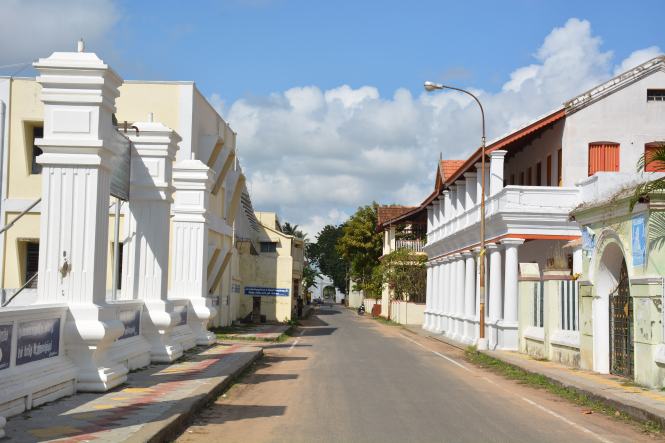
Puducherry town smells of Europe. The neatly arranged streets with European names and the design of the buildings distinguishes it from the rest of Tamilnadu.

The buildings:

 The Streets:

The Street Names:

 The old lighthouse near the beach, the Café and the statues makes it look older.

We had a long walk on the beach, north to south in the evening avoiding the main tourist circuit. But then Puducherry  is all about tourism. Wherever we went along the seashore it was Tourists , the European tourists. They sustain the place’s existence as an independent entity. The same cannot be said of the other three parts of the Union Territory.

X X X X

Early morning the next day we drive northwards with an intention to make the night halt at Mahabalipuram. The territory between Puducherry and Mahabalipuram is very interesting. It has water on both sides. There is a huge lagoon separated by a narrow stretch of land through which the East Coast Road passes. It is early February and there are still some migratory birds seen here in the lagoon.  Before the halt at Mahabalipuram we visit another seaside place.

Kadapakkam is not a famous place but is worth visiting. It has the potential to develop as a tourist destination. It has a pretty beach, a beachside early 18th century fort, a lighthouse and temples, of course.

We leave the East Coast Road and and drive eastwards to come to the Lighthouse. The lighthouse is located quite far from the seashore.

Very close to the lighthouse is a temple of Lord Vishnu.

DSCN2067

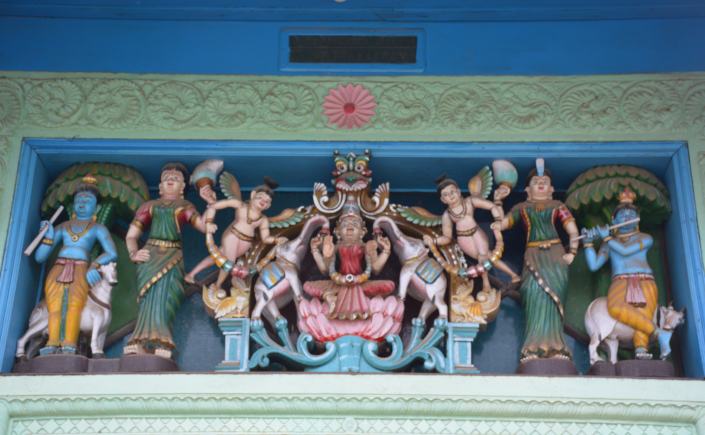
It has these figurines which are found at many other Tamil temples. Are they the guardians of the temples?


The beach is along the shallow waters of the lagoon. The place also has an active fishing community.

The area we are visiting used to be a seaport in historical times, probably even before the Fort was built. It used to be known by the names of Idaikazhinadu (the name of the region), Alamparva and Alampuravi. Recorded history starts from the rule of the Nawabs of Arcot under the Mughals. The Muslim kings built this 15 acre fort between 1736 and 1740. During the early colonial period the fort came under the control of French as well the English. The trade in Ghee, Salt and cloth because of which the place prospered seems to have declined in the later years and that led to its eventual abandonment. It is said that the fort was in a much better condition before the 2004 Tsunami.

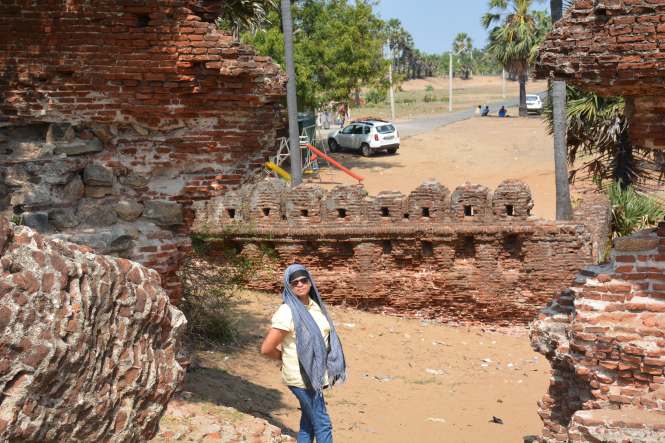
And  the fort. It is being looked after (or not looked-after) by the Tamilnadu Government Department of Archaeology.  I think although the fort is not great in terms of antiquity, it deserves to be looked after.

DSCN2074


Having said that I am aware of the difficulties involved. The sheer size of the place, the salty and sandy terrain, the winds and the heat makes it a difficult task. The masonry work which has crumbled will be a challenge to restore.

It is to the credit of the villagers that the fort is free of trespassers. We did not see any squatters except a few goats and no encroachments.


There is an excellent motorable road up to the fort and that is another reason the tourism angle should not be ignored. Going  by the lack of plastic waste, not many people seems to be visiting the place.
DSC_7322

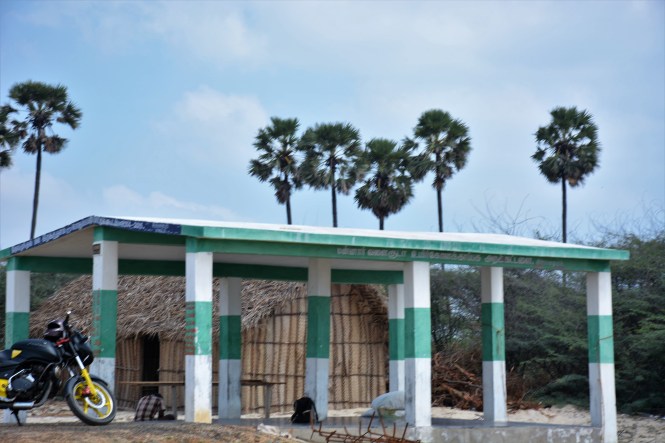
If you are at Alamparai at mid-day, it is extremely hot outside and the only shade is provided by the Palm tree. What will you do?

DSCN2071

Call the barber and have a shave!!


Text by Suryakiran Naik

Pictures by Suryakiran Naik & Veena Naik


94.TAMILNADU (9).TRANQEBAR & CUDDALORE

We leave behind Karaikal with a French past and move towards Tharangambadi with a Danish history. It is only 15 or so kilometres drive and we encounter this on the road.

A man is herding ducklings, very young, on the road as if they were goats. Normally such young chicks are carried in baskets. This looks very strange and we follow this procession for quite some time but could not communicate with the person. The language barrier was impregnable. This scene will remain in our memory for long.

The plight of the ducklings will be clearer in this video:


Error
This video doesn’t exist


As we enter the Tharangabadi town which is within the district of Nagapattinam, we see a memorial column erected on the main street. The first reaction is that it should be a Danish monument. No. it is not. It is a column erected in honour of Rao Bahadur Ratnaswamy Nadar by his friends and admirers. This guy must have been a merchant and the inscription omits to mention debtors and creditors.


DSC_6987

Rao Bahadur Ratnaswamy Nadar Memorial Column.

We move on after withdrawing money from the Indian Bank branch near this monument. The bank has a huge crowd. Most of the people are here to borrow money against gold and not exchanging the old notes for the new.

Tharamgabadi earlier known as Tranquebar was a Danish Colony or Trading Post depending upon how you interpret it. The Danes (from Denmark, not to be confused with Dutch from Holland, as many people do) were never a major colonial power but they had small enclaves on all the continents. The Asian venture was mainly for the spice trade. They appeared at this place headed by a naval commander by the name of Ove Gjedde in the year 1620 and made a deal with the local ruler Raghunatha Nayak of the Thanjavur Nayak Kingdom. This lasted for 225 years when in 1845 the Danes ‘sold’ the place to the British. The colonial history of India is replete with such incidences wherein the Europeans bought and sold ‘colonial possessions’. Apart from the trade the Danes brought the Lutherans here to compete with other Christian denominations.

To their credit the Danes have not forgotten their tryst with the colonial history and are maintaining the Tranquebar heritage town in Independent India.

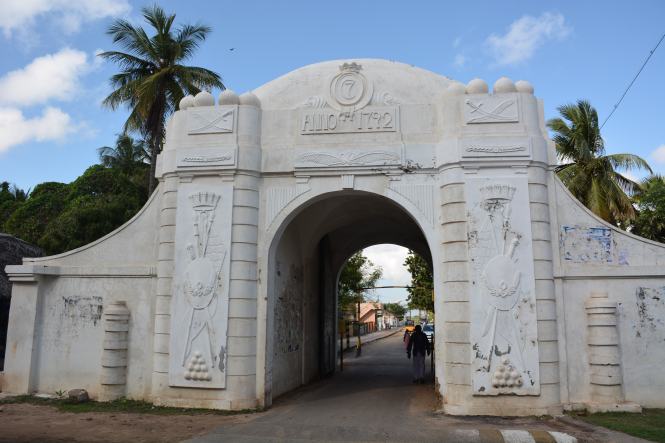
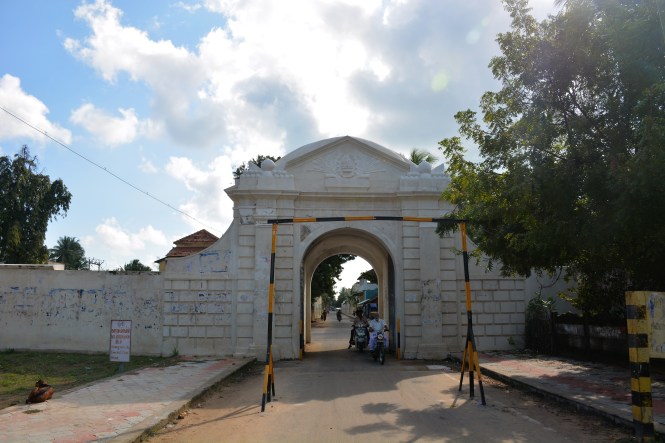
DSC_6996

Entrance to Tranquebar

 The picture below will give an indication that someone drove a truck through this narrow gate and damaged the 18th century masonry.

DSC_6990

The small settlement with a small fort and church have been well maintained. The renovation work is still going on and a museum has been set up.

DSC_7036

The main street leading to the Fort and the beach.

Tranquebar has a pretty beach as well, although the port and the harbour where the Danes landed is not to be seen.

At many places on the Tamilnadu coast one can see these ’embankments’ against the sea eroding the land. I hope the sea does not enter from and here and come out somewhere on the Karnataka coast on the east.

We are a bit early to reach the place. The Museum has not opened. We move around the settlement and return for the opening of the Museum. This place is maintained by the Archaeology Department of Tamil Nadu State. It provides useful information about the trading activities of the Danes. All of their ships visiting the place are duly recorded.

Here are the exterior views of the Fort:

And some of the displays inside:

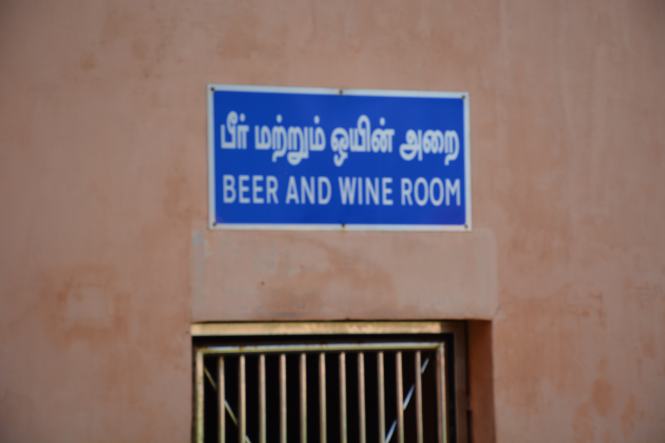
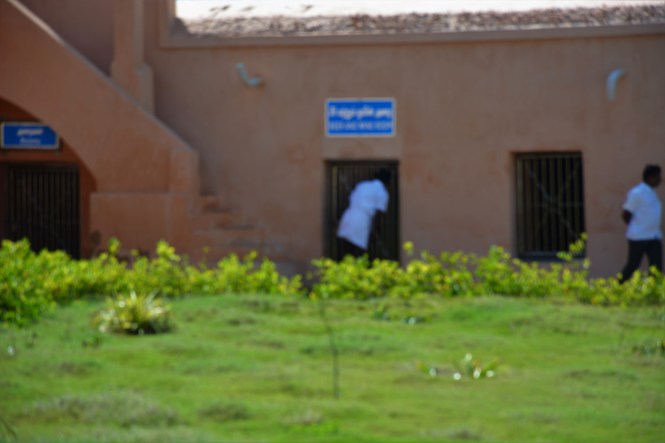
The fort appears to have been well planned, even a room was provided for storing Wines and Beers. Very thoughtful of the Danes.

DSC_7097

Anna is checking the room to see if any bottles have been left behind.

DSC_7102

 On the wildlife side the fort is the bastion of Rose-ringed Parakeets who roam freely.theynhave made appropriate holes in the walls for their activities.

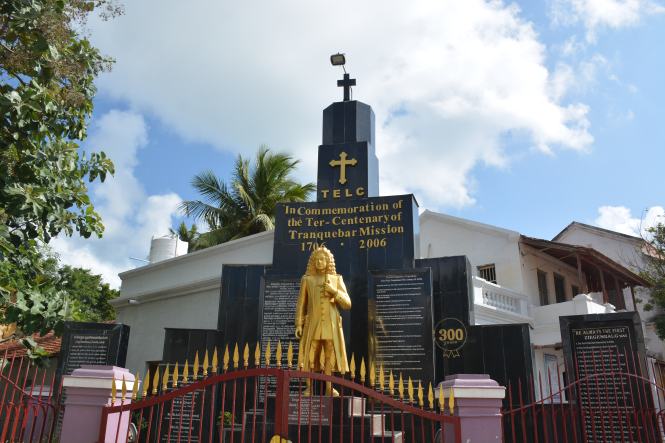
 There is something to be said about the Lutheran missionary who was active in this place as he is credited with many ‘firsts’. They were the first Protestant Missionaries in Inda.In 1713 they produced the first Almanac in India and to top it all they produced the first book in English language to be printed in India in 1716.

DSC_7020

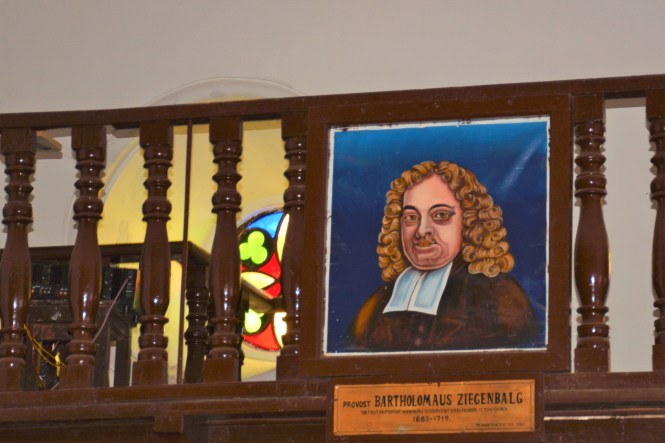
 Bartholomaeus Ziegenbalg headed the first Protestant Mission in India and was active at Tranquebar from 1706 to 1719 when he died there.

DSC_7058

 The church built by him is well designed interiors with the congregation divided into three segments all facing the pulpit which appears to be an improvement on the ‘theatre’ type of sitting arrangement.

 Good Bye Tranquebar. We are moving on to another part of history.

X    X   X  X

 Our travel plan for this and the next was a bit flawed. We missed something on the way which we will always regret. We missed the Pichavaram Mangroves, one of the world’s largest mangrove forests.

We pass the towns of Sirkazhi and Chidambaram on the way to reach Cuddalore another historical costal town. We put up at a hotel with Air-Conditional rooms.

DSC_8321

In the field of complexities of the colonial world this place takes the cake. It had English Slave Traders, Dutch, French, British, Marathas, Muslim kings from Mysore and just about everybody in the fray at various times. It had its share of naval battles as well. The rivalry of English and French related to Pondicherry also spilled over into Cuddalore which is just 23 Kms. away.

Elihu Yale a Christian slave trader operated from here from here from 1653 AD. He made enormous amount of money some of which was spent in creating the famous Yale University in the United States. Surprised?

Shivaji the Maratha King acquired the fort at Gingee, 90Kms by road now (I don’t know the distance on horseback at that time). Cuddalore fort was also within the ambit of Ginjee fort and became a part of Maratha empire. In 1690 after Shivaji’s death his son Rajaram fought the Moguls from Gingee and it even the capital of Maratha empire for a few months. The Moguls laid a long 7-year siege of the territory but ultimately Chattrapati Rajaram escaped. During this siege, C Rajaram wanted to sell the fort at Cuddalore to the highest (European) bidder. Here the slave trader Yale who was by then the Governor of Madras skilfully negotiated the purchase. In a bizarre agreement, it was agreed that the sale would be inclusive of ‘surrounding villages’. To decide the ‘surrounding villages’, it was agreed that the British would fire cannons in all directions and the boundary will be decided on the basis of where the cannonballs landed!!!!!. This is how the British empire was built.

 For all this history, there is hardly anything left behind in material terms. The fort seems to have been raised by the French when they came into possession. There is a structure which can hardly be called a Fort.

Here is the front view:

And the garden along the riverside. The cross is artistic, should be French.

DSC_8329

The river (or the creak) flowing by the side.

The rear-side looks more respectable though not quite for the kind of history it has.

The Silver Beach not far from the Fort is another feature of the town whoch otherwise has many industries.

A Church on the way to the fort is worth having a look at.

There are temples of course but we are late for the visit after all this history and tired after driving, so we retreat to our Air-conditional room. Tomorrow we have to in Pondicherry.

Text by Suryakiran Naik

Photographs :Suryakiran Naik & Veena Naik

suryakiran.naik@gmail.com

93.TAMILNADU (8). NAGAPATTINAM, NAGORE & KARAIKAL


Velankanni to Nagapattinam is a short distance. Nagapattinam to Nagore is shorter still. They in fact are twin towns. From Nagore people go to Karaikal to have their drink. That makes the entire belt from Velankanni to Karaikal one single continuous stretch of coast, closely interlinked.

Velankanni has Christian miracles, Nagore has Islamic miracles and in-between there are plenty of Hindu miracles. No miracle worked when thousands of people died in the 2004 Tsunami. Probably the only real miracle in the area is the difference in the prices of liquor. Just cross the bridge from Nagore into Karaikal and it is reduced by almost 50%. Thank the French for this miracle. We will look at this ‘French Connection’ a little later.

The port town of Nagapattinam was badly affected by the Tsunami. It is trying to get back to its earlier position. It is quite interesting to note that if a port loses its pre-eminence another one quickly jumps in and takes the place. Velankanni was a great port before Nagapattinam gained importance and so one.

Nagapattinam looks like a shrunk town. Something which was important once but no longer. The Tamil Nadu Hotel, the government run property is no longer functional. We drive up north and find a reasonable place to stay between Nagapattinam and Nagore. The seaside is separated from the town by a railway line which runs close to the sea and runs into the port.

There is a Lighthouse at Nagapattinam which perhaps was very important once when the trade was brisk.

The beach is somewhere between Nagapattinam and Nagore. They charge you Rs. 50/- to park a car. The beach is one of the dirtiest I have seen and has more plastic waste accumulated than sand. Otherwise it is a pretty good beach.

There is not much else to do in the town. We go back from the beach and sleep. Early next day morning we visit the dargah at Nagore. Before that we have breakfast at this roadside eatery somewhere on the Nagapattinam- Nagore road.

I am making a note of this  eatery as a representative sample of such places all over coastal Tamilnadu and Rayalseema in Andhra Pradesh where this ‘tiffin’ cuisine is served. Probably the dough/batter is made at home by one of the elderly ladies and that makes it different. It is probably the tastiest and safest food in the world at the price it is sold. Only thing these guys should imporove on is the cleanliness. That would not cost them a great deal to affect the prices.

Our post-breakfast encounter is with a Dargah and I wish I should have had a heavier breakfast of eggs and meat to face the onslaught of this place on my senses.

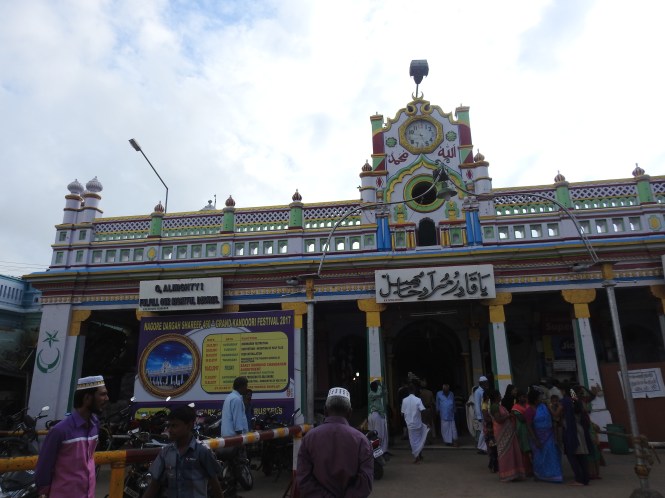
The Dargah at Nagore is a miracle by itself.  It is said that Saint whose resting place this is performed numerous miracles during his lifetime and continues to help people with miracles even now. The principal set of miracles performed here at this time is blessing childless women with child/children.  In effect Nagore Dargah is India’s biggest Infertility Clinic.

DSCN1862

The Saint who came from the North blessed many a women with children. Among them were Kings. I am quoting here from a book written by a prominent authority on the subject Dr. A S Mohamed Rafee (Nagore Rumi) in his book The Ocean of Miracles: Life of Qadir Wali’,  (Kathavugal, Chennai, 2014).

‘The Queen became very happy over the recovery of the king. She bent down and touched the feet of the saint in gratitude. And she was wise enough to request the saint to bless her for a child’ ,

which the saint promptly did.

The saint seems to have performed this miracle quite often in this area. He was a celibate.  According to the Wikipedia article :

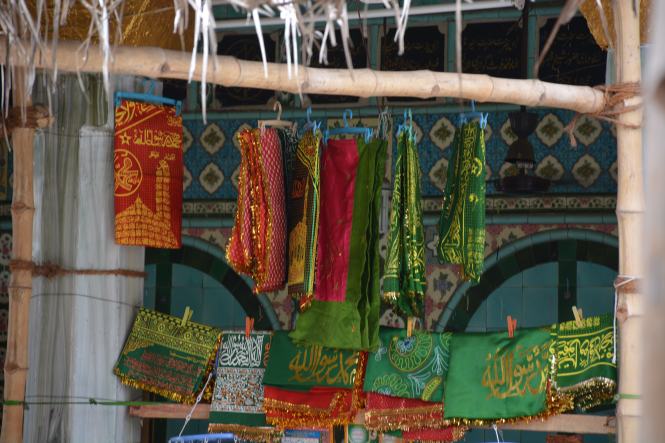
Since Shahul Hamid was a celibate, he is offered a Sehra (head dress), and not the customary flowers as at other dargahs.

This Sehra is a major source of income for the traders in and around the Dargah compound.

DSC_6903

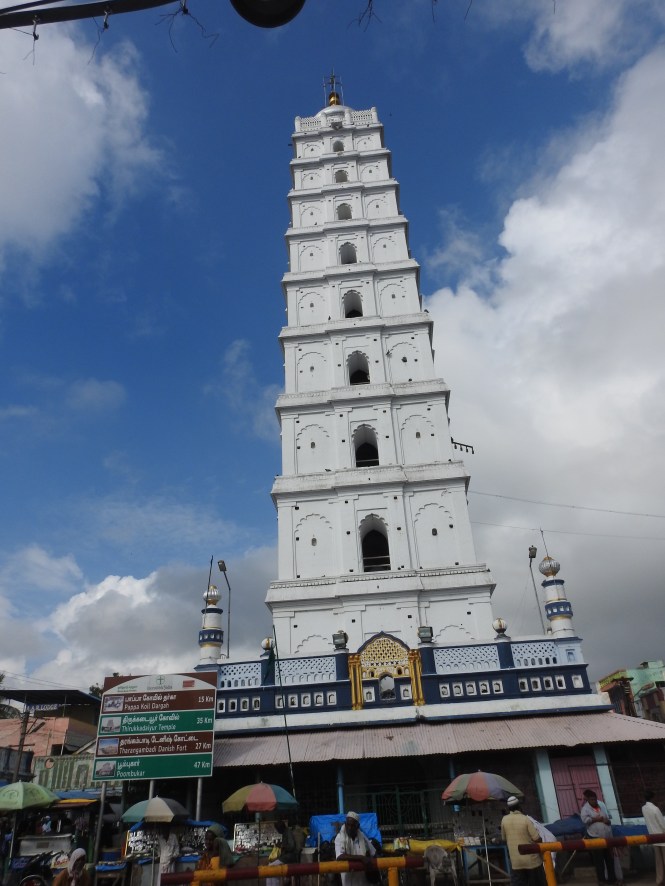
The site of the dargah has 4 minars the tallest of which stands at  40 meters and was financed by a Hindu king. This fact is told to you several times to drive home the ‘secular’ nature of the shrine. You will also be told that majority of the people visiting the Dargah are non-muslims. That , I believe, does not reduce the content of stupidity.

DSCN1865

Some external pictures:

Let us have a look at the Holy Man who has been laid to rest here after performing innumerable miracles. he is variously known, according to the authoritative source quoted earlier. Nagore Rumi: (page 5).

  1. Abdul Qadir
  2. Qadir wali
  3. ganja sawai
  4. Ganja Baksh
  5. Nagore Meeran
  6. Meeran Sultan
  7. Shahul Hameed
  8. Nagore Andavar
  9. Nagore Andagai
  10. Baadusha Nayagam
  11. Nagore nayagam.

I am deeply suspicious of a person having more than two names. Only people with criminal records have large number of names.

Giving the benefit of doubt to this guy as the names were  given by others and not by himself as he was busy blessing queens and commoner women with children.

Let us go back and find out where he belonged to and I will again seek the help of Nagore Rumi. This is for a reason: this book is well-written in faultless English and in legible type and generally well presented as compared to all local Islamic literature in English that I have collected on my journey along India’s coast.

Kabir, the great Saint-poet, according to Nagore Rumi predicted this to Sultan Sikandar Lodhi:

‘In every century a true slave of God will appear. We all know this. This time we will come from the Islamic community and he will be born in the lineage of Prophet Muhammad. he will be born in Ajodhya , which was the ancient home of the Men of God India. many miracles will continue to happen around the baby to be born. he will be one of India’s greatest Saints. He will show the right path to those who go astray. Even after his physical disappearance, his shrine will be the last sanctum of those who aspire for knowledge’.

I know Kabir well. I can guarantee you Kabir never said this. Kabir was a wise man, not a commercial advertisement writer. And even if Kabir said this, he was totally wrong. His shrine is not ‘sanctum of those who aspire for knowledge’, it os the sanctum of those who aspire for children and wealth.

In any case there is no denying that this man was born, in the year 1504 AD to, according to Nagore Rumi to a couple described as:

Syed Hasan Guddus came in the 22nd generation of Prophet Mohammad …………….he married a woman named Fatima, the daughter of Hamiduddin who also came in the lineage of Prophet Mohammad’

This makes this saint all the more venerable.

Here is an important extract of the Wikipedia article about the administration of this dargah. This will give some indication about the financial importance of this shrine.

There is a hereditary Khalifa, from among the descendants of saint Yusuf. He performs all the religious duties of the dargah. A central parliamentary committee deputed to verify the implementation of the Wakf Act of 1995 was informed in 2008 that the Nagore Dargah was not administered as per the provisions of the Act. The committee found that it is against the spirit of the provisions of the Act as the dargah is a surveyed and notified body under the Tamil Nadu Wakf board. The administration and maintenance of the dargah was henceforth governed by a committee which operates under a scheme decreed by the Madras High Court.[24][33][34]

Now who are these ‘hereditary khalifa(s)? when the saint was celibate.  Again I am seeking help from Nagore Rumi. He throws a lot of light on this. The saint appointed an heir from a noble family from Lahore. Nooruddin ( a descendent of Hazrat Abu Bakr) and his wife Zohra (who was a descendent of Hazrat Husain ) were childless. The Saint agreed to bless the couple with children under the condition that the eldest one will be adopted by the Saint and will be his Heir. The couple agreed. The son was duly born and was named Syed Mohamad Yusuf. The descendents of Yusuf are now sitting on this treasure trove.

In the picture below you see a man keenly watching you. He is the one who will persuade you to go inside the Dargah even if you don’t want to:

DSC_6891

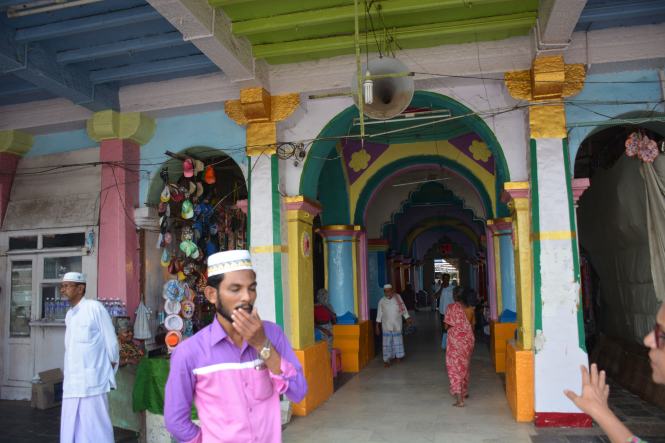
Once you are inside you will be subjected to various rituals -plenty of them and at each stage you will be asked ( virtually forced) to donate money for ‘feeding the poor’. They don’t ask in hundreds, they want the money in thousands. For each and everything there is a demand for money. It is shop, most certainly not a dargah.

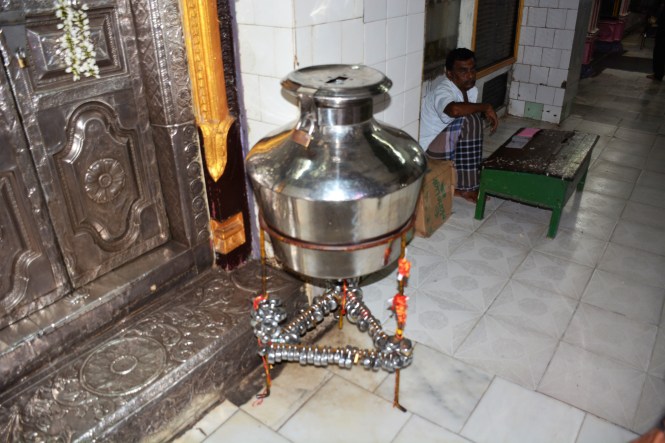
If you want to make a wish, you put in a lock here and put the key in the container.

DSC_6893

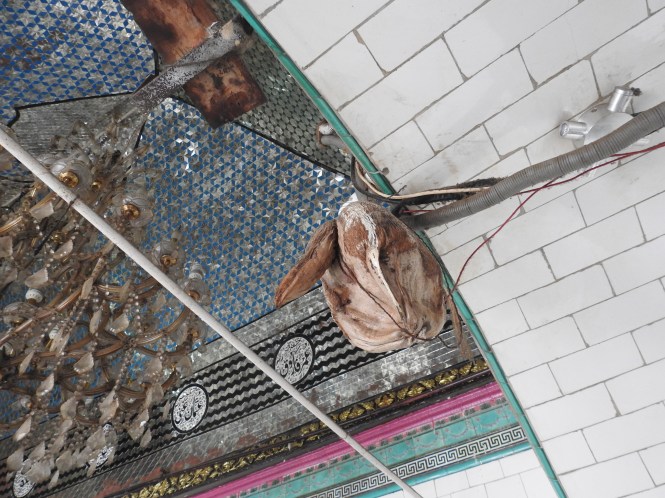
Here is a Coconut hanging which has a curious shape.I don’t know if this is a miracle attributed to the saint. I believe there is no mention of Coconuts in the Holy Koran.

DSCN1875

There are superstitious beliefs all over this country. There are superstition-supporting institutions in all major religions and they are making brisk business.  The USP of this shrine like many others in the country is that the saint helps you to beget children.

One interesting aside of this Dargah is that it has ‘branches’ in  Singapore and Malaysia. May I remind you that this place is a Dargah-the place where the Saint has his grave. This must be a rare instance of a grave having ‘branches’ like the banks have.

‘XXXXXXXXXXXX

KARAIKAL

The French were given a drubbing by the English in their quest for the colonial possessions in India. They were badly defeated but still managed to cling on to small pockets on India’s shores. Very complex geographically, the four French ‘territories’ are located inside three different Indian states. Mahe in Kerala, as I have highlighted in an earlier post is practically a pub for the surrounding areas of Kerala which has imposed severe restrictions on alcohol. Karaikal is a very convenient drinking spot for the area I am talking about in this post. Pondicherry has some size and landmass and Yanam in Andhra Pradesh does not have any identity to separate it from the surrounding Telugu culture. Overall there is no distinction between these small parcels of land – of language or culture or any other factor except the history and even that is not very strong. We made it a point to spend at least one night in each of these ‘pockets’ to get a feel of the place. This Union Territory does not appear to have a reason to continue. The reorganization of the states was done on linguistic basis and if this criterion is applied to this Union Territory, it should cease to exist promptly.

During the travel which is the subject matter of this Blog I tried to ascertain factors and reasons which justifies the continuance of this fragmented ‘Union Territory’ over three states. I could find only one – Liquor Lobby. May be another one would be the IAS Lobby as these four pieces of land sustain quite a number of senior civil servants enjoying themselves.

I tried very hard to find the French Connection in all four places. Barring Pondicherry which (politically is a bastion of AIADMK which rules in Tamilnadu) has some weak French institutions, there is none. There is no influence on the language, culture, cuisine. At least I could not find any. Perhaps the last 60+ years have wiped out all the influences. The same applies to Daman & Diu. These places are merely drinking joints for the people of Gujarat. They involve an enormous cost to the Taxpayers.

There is another aspect of these territories which is intriguing. The French government considers many of the people in these territories as French citizens. Whenever there is a presidential election in France, these guys travel to the French consulate in Chennai to vote. I will not be surprised if the very same people come back and vote for the members to Indian parliament. Somewhere somehow some people in the Indian bureaucracy (apart from the liquor lobby) are benefitting from this fraud and are keen to continue it.

We need to have some photographs, dont we? Probably the only place where we could find some action is the Karaikal Beach and the adjoining harbour. I am ignoring all religious places irrespective of faith as I have developed a nausea for them- they are simply too many. ‘Faith’ is strangulating  the people of this country and nobody has faith in anyone.

We found a beautiful sunset at the beach.

The sunset is accompanied by the music created by a huge flock of Rosy Pastors or Rosy Starlings who migrate from Europe. In this case, I will not be surprised if they have come from France.

The decoration the vendors make out of vegetables and fruits on this beach is fantastic. ( We could see it bettered much later on Odisha coast).

DSC_6971

The beach has Lighthouse which we first thought was operational. As the sun set we realized that it was.

Karaikal is supposed to be separated from Tamilnadu by the river Arasalar. However if you have a look at the Google map of the region you will find a creek with a bridge on it and the dividing line running through it.  If you want to know where the real boundary lies, look for the liquor shops. They are profuse and blatant on the Karaikal side. I am sure nobody buys the stuff on the Tamiulnadu side. One can see the fishing harbour on the Karaikal side and I am just wondering if the other shore is in Tamilnadu or Karaikal.

DSCN1886

I guess it is Karaikal as the first bridge which is divided by a line on the Google map is a few hundred meters beyond. Anyway this does not matter except in one important aspect- Liquor prices.

Text by Suryakiran Naik

Pictures by Suryakiran Naik & Veena Naik

92.TAMILNADU (7). Pudukkottai, Sarabendrajanpattinam, Point Calimere, Velankanni.

Having done with the short visit to Chettinad region, we get back to our main programme of travel along Indian coast. Obviously, we need to get back to the seashore and for that we drive along the small coastline of two districts- Pudukkottai and Thanjavur. The latter is steeped in history. Most of this history is housed at Thanjavur which is not on the coast. We decide to skip it and stick to what is available on the coast.

DSC_6600

In the village at Arimalam-Keelanilakottai area in Pudukkottai district is an old fort in pretty bad condition. It has split into two, the middle portion being used for constructing a temple. There is not much information available about this fort and its significance. According to the Wikipedia article it was constructed in the 16th or 17th century. It is currently used for painting hoardings indicating that it is not within the control of the Archaeology department.

In between the two parts of the dilapidted fort one can see a colourful temple. Devotional music is played from the temple and is heard everywhere in the vicinity. It appears to be dedicated to God Vishnu.

Our next stop is the small seaside town of Sarabendrajanpattinam. Historically this used to be a part of the kingdom ruled by a Maratha dynasty based at Thanjavur or Tanjore. King Sarfoji II of this dynasty built a monument at this seaside place which is indicative of the way our pre-British rulers bent and knelt to please the British.

DSC_6623

This massive and beautiful monument was built in 1814 to commemorate the British victory over Napoleon!!!

Serfojee Rajah or Raja Serfoji II Bhonsle appear to have owed much to the British who were responsible for his education. Serfojee II was proficient in 4 Indian and 6 European languages including Latin. The 4 Indian languages did not include Marathi, the language of his forefathers.

The king is credited with widespread reforms and support to education and arts.

It has all the trappings of a fort including a moat and considerable money must have been spent to erect it as the construction is of high quality and the entire monument is fully intact 202 years later.

Mallipatnam lighthouse is in the vicinity of the monument and can be viewed from it.

DSC_6656

DSC_6638

The place is popularly known as Manora after the word used for this tower which in turn is derived from the Arabic word ‘Minar’, meaning tower. The king is reported to have started a shipyard at this place but nobody seems to be knowing about it now.

We drive on, on the narrow coastal road but in the beautiful countryside and make a brief stop at a Ayyanar shrine on the way.

DSC_6662

This part of  southern culture appears to be overrun by the Vedic gods and religion. These shrines now have only secondary importance and at many places have mixed up with the Vedic/Puranic deities creating huge confusion.

The icons of Dogs, Horses, snakes etc predominate at such shrines. Particularly visible are the clay horses which are offered to Ayyanar.

XXXXX

We intend to spend the night at Point Calimere which has a wildlife sanctuary. By the time we reach Thopputhurai ,we are tired and decide to stay here and go to Point Calimere early next morning. The distance is only 13 Kms.

Thopputhurai is a very small town and with difficulty we find a clean room to stay. Early next morning we drive to Point Calimere. The gate is closed and will open at 8 and actually opened close to 9. The Forest Departments in many states of India are insensitive to Birding and Birders. Birding is an early morning activity and I suppose they know it. Bureaucratic timings simply do not serve the intended purpose.

Good thing about this place is that one is allowed to drive through the sanctuary. The bad things is there is hardly anything to see here. The migratory birds seems to have returned back to their hometowns because of the excessive heat this year ( 2017). However  we can see some locals.

The sanctuary is also a home to several species of mammals, the most significant of whom is the majestic Blackbuck. It can be viewed very easily here.

The Wild Boar is another species seen.

DSCN1825

And the Mongoose, of course.

DSCN1831

One interesting feature of  this sanctuary is the presence of feral horses. Horses which escaped from some stables in the past have made this place their home and they have adapted well to the environment. I don’t know of any other wild place in the country where horses are found.

DSC_6715

The shallow waters of the small lakes within the sanctuary is home to a variety of shrimp, very pale in colour and people do some manual harvesting.

DSC_6724

A species of wild mushroom was also seen growing in the sanctuary.

DSCN1772

And then there are the lighthouses. This place boasts of three lighthouses, two within and one outside the sanctuary.

A lighthouse was built here by the Chola kings. The sanctuary information board at the gate says that it’s ruins exists within the sanctuary. We did not find them and as there are no guides in this sanctuary, there was no one who could tell us about it. Language is another serious barrier.

The existing lighthouse is a cute little one. It is called Point Calimere Lighthouse.

The one outside the sanctuary but very close by is called Kodikkarai Lighthouse.

DSCN1702

From the Sanctuary we drive straight to our next destination which is Velankanni. We return to Thopputhurai from where we have a choice of two roads. One is the East Coast Road and another one which is smaller but goes closer to the sea. We choose the smaller one with the hope of seeing the countryside.  It is nice to travel and see the ways of the people in the villages. On this stretch of this road we found this plant growing at a few places and we stopped at one to enquire about it. We were told that the small fruit is edible and is used in cooking. So far we have failed to identify its name.

We reach Velankanni for a late lunch. This small town was once a port having trade with ancient Greece and Rome. The port eventually got shifted to Nagapattinam to the north. Velankanni was compensated with the Basilica of Our Lady of Good Health. This is a major Christian shrine in the country and has over 20 million visitors in a year.


The 16th century church became a Basilica in 1962. The Church is credited with many miracles and has a wide following.

You get your wishes fulfilled if you cross a certain distance on your knees.


Velankanni was badly affected by the Indian Ocean Tsunami of 2004 despite the presence of the shrine. A memorial to the victims of the Tsunami has been erected outside the town and is attracting tourists.

DSC_6861


Text by Suryakiran Naik

Photographs by Veena Naik & Suryakiran Naik

91.TAMILNADU (6). Devipattinam, Ammapattinam and CHETTINAD.

We start from Ramanathapuram with two items on the agenda. One is in line with the TheBlueDrive charter which is touring Coastal India and the first two places are within its ambit. Chettinad is not exactly a coastal region but we decide to visit it for the importance the place has.

First thing first. We drive to Devipattinam on the coast of what is called the Palk Strait which separates India and Sri Lanka. The only major attraction of Devipattinam is the ‘Navagraha’ Temple which is located in the sea but connected to the mainland. This appears to be a popular religious destination with the pilgrims to Rameswaram making a stopover here. Nothing spectacular. Just a small temple but of ‘Navagrahas’, the nine planets with sun being demoted to the status of a planet and moon promoted.

We are visiting Ammapattinam as it is a coastal place and it also has a lighthouse. This lighthouse is not on the seashore. It must be among those which are furthest away from the sea. I will update later on this. This also appears to be among the tallest lighthouses in India.

Now we turn north-westwards and towards Karaikudi, the heart of Chettinad. The 75 Kms or so give us some idea of the region.

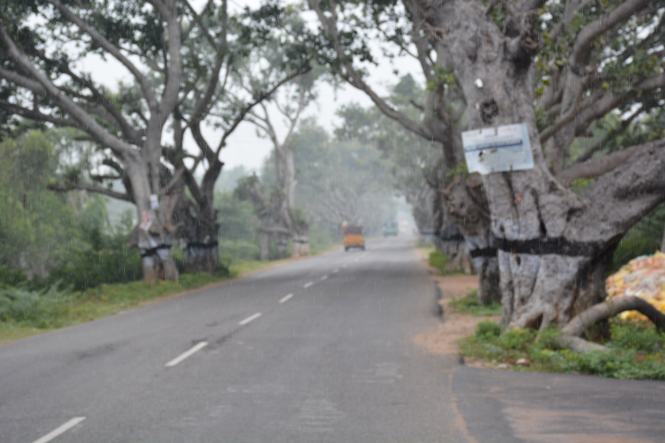
The road has a number of trees cut down to size as they were encroaching on the road.The roadside tree species need to be selected carefully.

DSC_6399

As you drive you cannot miss the large number of Tamarind trees in the region. That perhaps explains the presence of quantity of this fruit in the Tamil cuisine and particularly in the Chettinad cuisine. By the time, we reach Karaikudi it is past lunch time and we look for authentic Chettinad restaurants. We are shocked to know that there are not many. We locate one in the old part of the town and they are sold out on most of the non-veg items. We need to make do with whatever is available. We don’t blame them as we are late. The best place in the world for Chettinad food is Chennai, I know it by experience of 38 years.

What do we do in Karaikudi town? Not much and we are already tired driving all the way from Ramanathapuram with two stops in-between. Most of the attractions of Chettinad are around Karaikudi and not in Karaikudi. All the same this is a well-planned town with broad streets. When the future historians find the buried remnants of this place, they will be all praise for it.

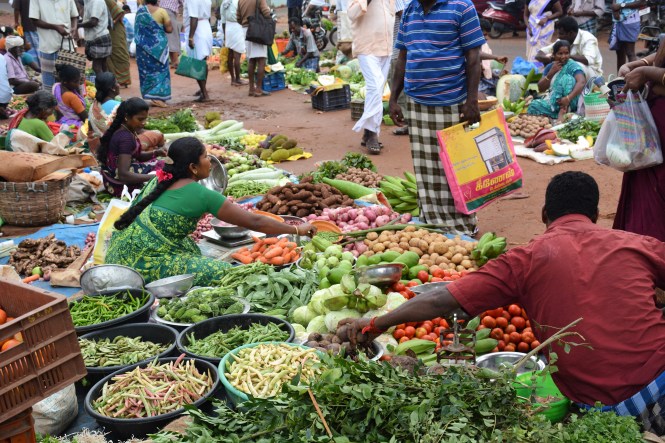
The local vegetable market has a rich variety of greens. Fresh and lovely.

v1

We get up early and move on towards the ‘tourist’ places. We start with the temple of Muruganswami at Kundrakudi. Interesting place and temple. One has to climb up the stairs to meet God which I avoid, not on medical but on moral grounds. Having declared myself an atheist, I have no right (or obligation) to exert myself to meet the God. If the God is found by the way I can allow Him to meet me. My wife is very keen to photograph Muruganswami and his abode here. She also needs exercise. I am having other interests. Here we go.

The Muruganswami Temple pictures by Veena Naik:

The interiors. Photography is not prohibited here.

The idea of Mannequins was conceptualized here.

The landscape from the temple.k5

I am loitering around and find this lovely artwork.

I am not looking for any medicines but I find this Herbal Doctor here offering cure for all diseases, past, present and future. He also displays all the herbs (mostly green in colour) from which he extracts his remedies. I find it very difficult to communicate with him but I manage to gather that he has oils that can be applied to all parts of the body. This fact is communicated to me by gestures made at various parts of the anatomy. My biggest failure is to connect the ‘oils’ extracted to the vegetables displayed.

After this we become more serious and move towards Athangudi. This is the essence of Royal Chettinad, the Heritage place.

DSCN1628

Chettinad – Sivagangai-Ramnad-Pudukottai – area of Tamilnadu gave rise to a unparalleled    Merchand-Banker class of people. They carved out a niche for themselves, not only in the financial world of South India but also in other countries like Sri Lanka, Burma, Malaysia, Vietnam, Singapore and others between the 8th and 17th centuries.

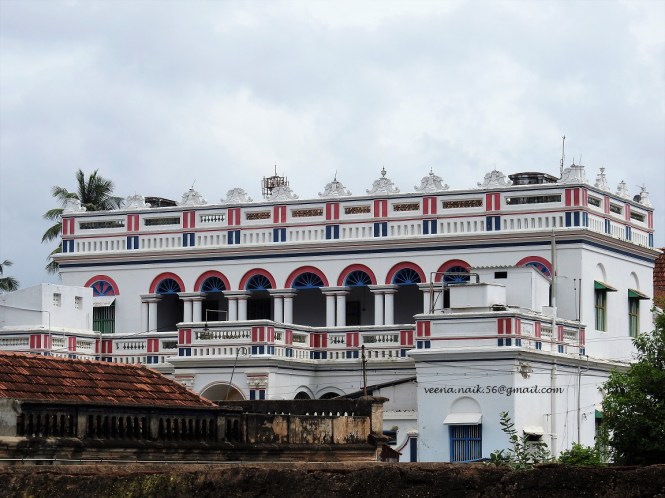
As a consequence of their financial acumen the region of some 96 villages became rich as no other part of the country. The palatial houses bear testimony to this part of India’s history and its riches.

DSC_6578

Chettinad House 1


Some  are maintained well as above and some are not. Most of them charge an entrance fee.

DSCN1625

DSC_6447

It is worth paying the entrance fee to see the rich interiors. There are two things that will strike you inside these houses- the use of teak and the tiles. Let us look at the teak wood first:

DSC_6531

Single-piece Teakwod Pillars

This is a very expensive affair in today’s money. Quite possibly the famous Burma Teak, the best of the Teak . This is explained by the presence of the Merchants/Bankers from this region in Burma under the British regime.

The doors of solid teakwood and the carvings on them are amazing:

Some of these palatial houses have very intricate wooden carvings on the beams and  columns which could be subject matter of  a detailed study.

Let us have a look at the artwork on the exteriors.

DSCN1670

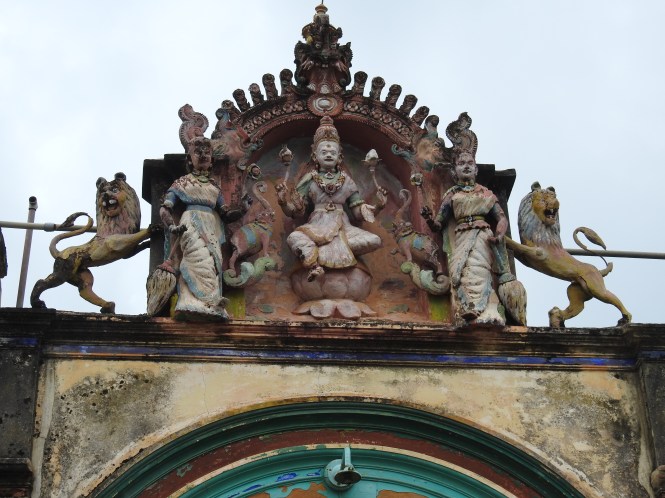
Most of the icons are religious, Lakshmi or Laxmi, the Hindu goddess of Wealth is very prominent everywhere. Given the fact that the Chettiyars were and are rich merchants, this is not surprising. Look at the various depictions of the Goddess in the pictures below at different houses.

Allow me take you back  to the interiors of these houses once again to look at another aspect of Chettinad.

t1

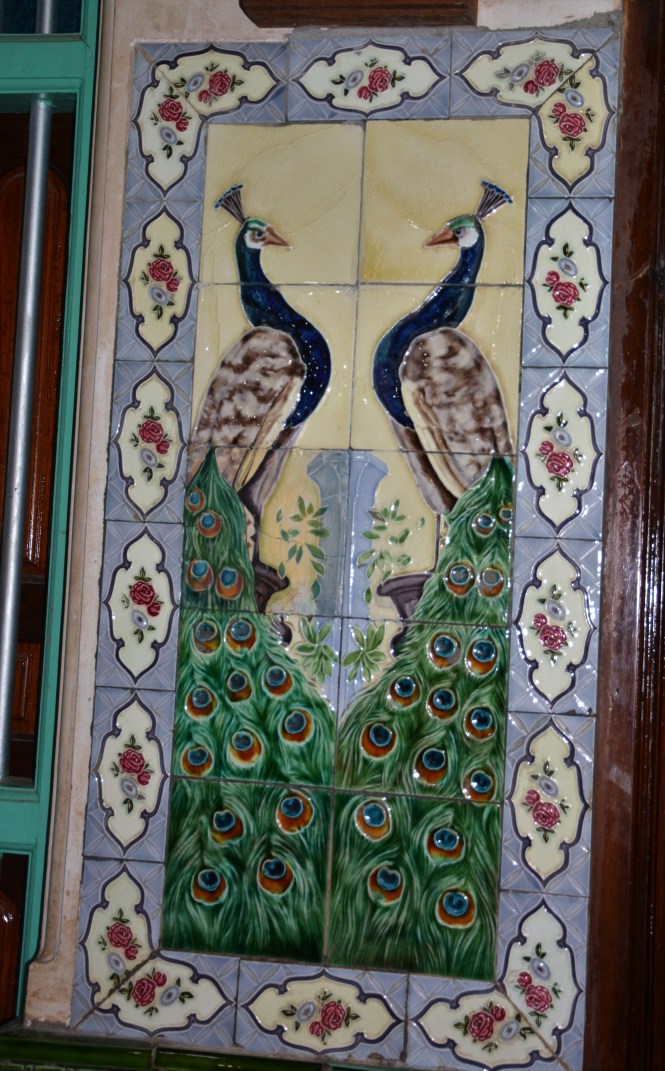
Athangudi Decorative Tile set.

Athangudi tiles is obviously a fall out of the construction of the palatial houses. These tiles were once handmade and used a locally available clay. They are still being made. We even met an architect from Bangalore who had come all the way to select tiles for her clients’ new house.

Here is a set of designs which were used. I am sure most Indians have come across these. The images used here are of the actual tiles used in these houses and they are not ‘new’

Would you mind stepping out and have a look at the tiles on the roof, sir?

The roof tiles are very basic. Surprising. I was expecting some of these houses to have the improved Mangalore tiles. May be it was a time mismatch.

Apart from the houses, the cuisine,the tiles this region also honours another Indian tradition. It is the Saree, of course. There is a handloom industry here or perhaps they bring the sarees from Chennai and sell them here. Does not matter.

It is time to leave Chettinad and drive down south towards the Palk Strait again. There is a small fort we need to attend to on the way.

Thirumaiyan Fort. The 1687  fort built by  the Raja of Ramnad in the Pudukottai district. A lovely 40 acre complex with confusing gates and temples and narrow streets.

DSC_6493

What catches your attention is that the fortress is built on solid granite rocks and has still survived. The foundations need to be investigated.

And here I am wandering in the past, hoping I inherit one of those properties by way of an old will found accidentally in one of those lawyers chambers………………yes. the telephone is ringing. Let me attend to it.

Thanks for reading.

text by Suryakiran Naik

Pictures by Suryakiran Naik & Veena Naik

90.TAMILNADU (5). Mandapam to Dhanushkodi & Ramanathapuram.

Mandapam village is the starting point of a long narrow peninsula which extends close to the Sri Lankan waters. A bridge, in fact two bridges, one for road and one for Rail connect the mainland to the islands beyond Pamban. The road is fantastic. Before you cross the bridge, they charge a toll and in the process, fleece you. They charged us three times the dues and gave us a receipt which we found later to be for lorries. The bridges which are 2 Kms long are a sight to behold. I understand that the bridges are becoming weaker because of impact of excessive photography.

The places as seen from the bridges is another beautiful sight.

5

As you cross the bridge what attracts your attention is the Lighthouse to your left. Nice one and good looking from the height. Picturesque.

4

Rameswaram, located on this island is the main draw of this area. Rameswaram is one of the four ‘dhams’ which are the most sacred places for Hindus. This one is the southern-most. The temple here attracts a large number of pilgrims as well as tourists.

Our engagement with the temples, especially the interiors, have been very limited. It has been inhibited by the dress code to enter and secondly by the fact that most temple do not allow photography inside the temple. People do take pictures with their mobile phones which is prohibited.

9

Inside the temple, within the rule.

16

Apart from being a religious centre, this place is also a major fishing centre. I hope the fishing industry becomes more important than the God industry in course of time.

The details.

Dhanushkodi is a remnant of a town which was wiped out in a 1964 cyclone. Whoever thought of building a town here, complete with a railway line did not consider the possible fury of nature unleashed through the medium of cyclones. The town in the mouths of two open seas and in an area known to be affected by cyclones was a planned disaster. It is being revived.

DSC_6115

There is new road which goes up to Dhanushkodi and beyond. When we visited, it was not inaugurated and therefore not in use although it was well beyond the schedule as appearing on this board.

DSCN1444

There appears to be a lobby of vested interests – the vehicle owners. The vehicles that drive you dangerously along the beach and take you to the ghost town. This is the main income generating industry which will be dead the moment the road is opened for traffic.

Adam’s bridge, Ram Setu , Palk Straits are the various names by which the gap between India and Sri Lanka is known by. It has a number of theories going back to the Epic, Ramayana.

Dhanushkodi is a haunted place. One can describe it only in pictures.

Here are the ruins from 1964.

And some more:

DSC_6137

God,helpless.

DSCN1445

DSC_6136

This boy in Dhanushkodi is persuading the girls not to go to school and to join him at play.

DSCN1452

We finish  this mandatory trip to Dhanushkodi and return to Rameswaram, after visiting a temple on the way. This is an added tourist attraction. Kothandaramar temple is a place fom Ramayana. The signboard explains the significance of the shrine.

The most famous son of the soil in this part of the world is the scientist and former president of India, Dr Abdul Kalam. His family comes from Rameswaram and had trading interests in Dhanushkodi. We made a visit to the place as a mark of respect for the remarkably unassuming public person in recent history of India.


There is a lighthouse at Rameswaram, other than the one we saw whilst crossing the Pamban bridge. This one is right at the seashore. It is not easy to approach. One has to go through several seaside villages till you come there. The evening ride on the narrow village roads is pleasant. Try this place when you are in Rameswaram.

DSC_6220

The other Lighthouse in the area is overlooking the Pamban bridge and is called the Pamban lighthouse.This is the one we saw from the bridge earlier.

DSC_6246

Here you will also find a peculiar type of commemorative pillar. A couple of them are found after you cross the Pamban bridge towards Mandapam. A few of them are found in the area as far north as Kilakarai. The man at the lighthouse informed us that these are memorials for British soldiers serving in that area.

DSCN1483

Rameswaram has this tall tower about which we failed to gather any information.

DSCN1461

Ramanathapurm is a district headquarters and the gateway to the places that we visited above. We had decided to make a halt at this place after we are done with Rameswaram and use it as a pad for travel towards another remarkable region of South India known as Chettinad.

Ramanthapuram was a principality ruled historically by a local dynasty which was touched upon in the previous post in the context of Kilakarai. A palace still exists and we made time to make a visit although it was closed for the visitors at that time. We missed the interiors.

DSCN1521

The 17th century Ramalinga Vilasam Palace was built by the Sethupati kings. The palace interiors have some famous murals which we missed. They are said to depict the Sethupati kings’ battles with the Maratha kings of Thanjavur, among other events in the kings’ lives.

The palace entrance and the temple attached to the palace.

We missed the murals inside the palace but the exteriors are interesting as well.

Text by  Suryakiran Naik

Pictures by Suryakiran Naik & Veena Naik


89.TAMILNADU (4). Tuticorin, Vembar,Periyakulam,Ervadi & Kilakarai

We had stopped at Thiruchendur in the last post. We now drive towards Thoothukodi or what is better known as the port town of Tuticorin.
The coastal road from Thiruchendur to Tuticorin is about 38 Kms. and the area is sparsely populated. Perhaps because of the uncertainty caused by the cyclonic weather. It also appears to be low lying and unsuitable for agriculture as there is ingress of seawater. This makes it suitable for the salt pans and perhaps for some fisheries. One can see a number of salt pans on the road. Salt manufacturers here include Gandhi and Irwin of Gandhi-Irwin Pact fame. Google for more details.


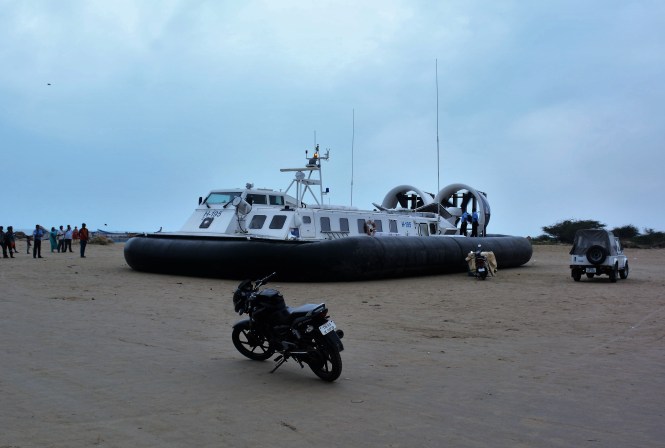
Tuticorin is a port of considerable importance as it is the only major port between Kochi on the west coast and Chennai on the east. It also has some beaches. We landed at the harbour beach to watch the landing of a Naval Hovercraft.

4

The port has spawned a number of industries including a power plant with imposing view on the horizon.

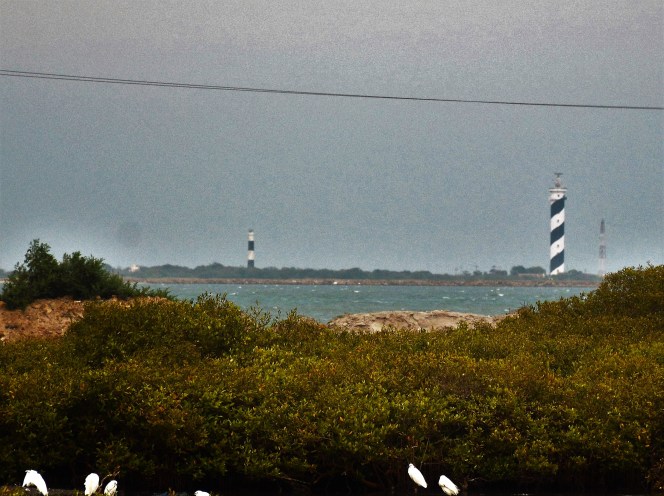
The area around Tuticorin has two light houses within the vicinity of each other. They can be seen together and photographed in one frame. I guess this is not a very common occurrence anywhere.

8

Our day in Tuticorin was a Sunday and without much activity except the visit to another beach. The Shrine Basilica of Our Lady of Snow is an imposing and good-looking monument in the town.

We resume travel the next day morning towards Ramanathapuram.
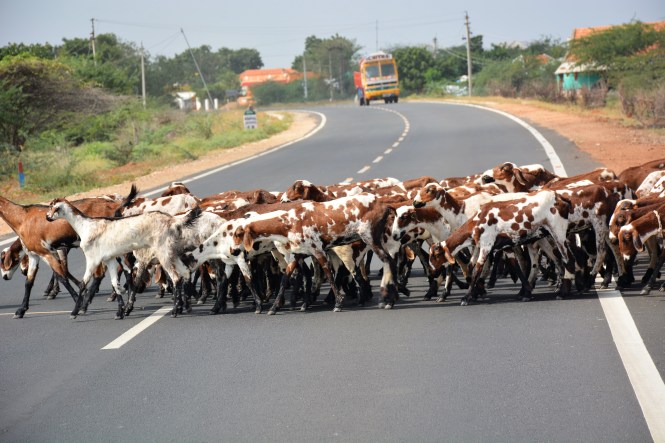
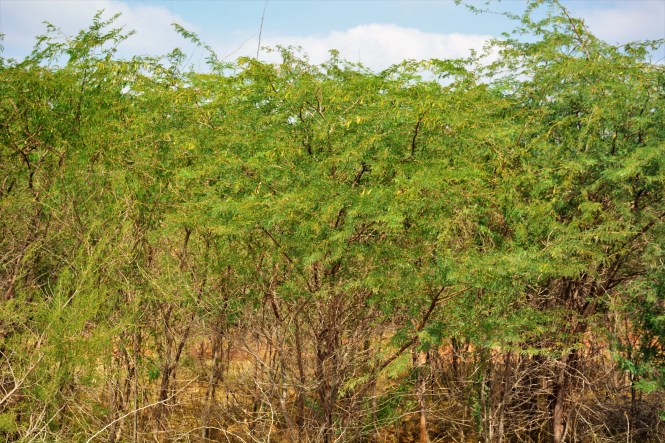
The first stop is a brief one caused by a large herd of goats crossing the road. The area we are driving through is arid and sandy with hardly any agricultural activity. Goat rearing is viable in the presence of a widespread growth of salt-tolerant species of Acasia shrubs.
15

15a

The next stop is to see how this same species of Acasia is burnt down to make coal.

The next stop is at a Tamil shrine, probably pre-Aryan. In the absence of any inscriptions that I can read, I can only make a guess. There was no one to explain what it is and even if I found someone, there would be the problem of finding a language understood by both.

We move on and stop again at this small village on the roadside to witness this practice of using highways to process grain. Here the farmers are using the road which happens to have a cleaner and smoother surface than any in the villages. This practice prevails in many parts of India. At many places the harvest is laid on the road for the passing vehicles to do the process of chaffing. The grain is a coarse millet.


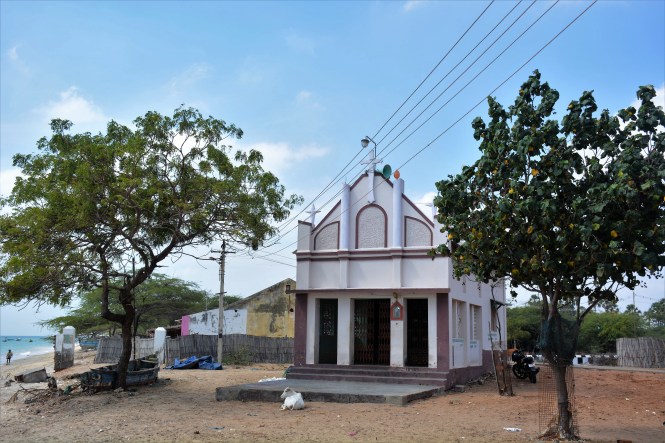
Our next stop is a planned one. It is called Vembar. It is planned because it has a lighthouse. We turn right on the state highway at Surangudi and approach the seaside. The road is a beauty. If you are in the area, please drive along it. Vembar has a beach, a Lighthouse and a nice little Church on the seaside. There could be more in the town which we do not visit.
It is not the visitor’s time at the Lighthouse. Thank you.

Here is the church.
26

And here is the newly built fish auction place.

After a brief stopover, we return back to the road and after a nice little drive return to the seashore again. This time in search of an island called Nallatanni which appears on the google map. The place is called Periyakulam.

80

Periyakulam  fish market

We make inquiries if we can hire a boat and make a landing on Nallatanni.
‘Yes, you can’.
‘Is it inhabited?’
‘No. It is barren’
‘Can you help us with a boat?’
‘Sure, but you will have to get the permit’
‘Permit? From whom?’
‘Forest Department’
‘From where?’
‘Madurai’
‘No, Thank you’.
The above is a transcript of a conversation which involved a few languages and a large number of gestures in sign language.
I know to get that permission will take several months and I will have to fill up forms in Tamil.
I fail to understand what the Forest Department is doing on this island. There is no way one can argue with Government. The grey hair in the picture below are mine.

30

From the looks of it, the island should be a beautiful place. I will not be far off the mark if  I say that this is used as a private picnic spots by the politicians and bureaucracy. That explains the need for the permit. As we go around the beachfront and among the fisher folks, we find that this is a Christian community. The names of the boats make it clear.

And then something strikes me with great force. There are no fishing nets around as one would expect. There are the boats of course, the people are obviously fishermen but then where are the nets?
The island brought us here. Something else is keeping us here. Serendipity is the English word invented for this.
Closer scrutiny of the fishermen’s activities reveal a different method of fishing and one extremely Eco-friendly and viable in the long term. It eliminates waste and catching of very young fish.
This perhaps is not the only place where this method of fishing is practiced. We have done more than half of India’s coast by now but I did not notice is elsewhere. I am sure it is being practiced elsewhere. I sincerely hope so.
What these fishermen do is as follows.
They take long fishing lines and attach hooks of large size (size 14). Baits of large pieces of neatly cut fish are attached to the hooks.

This is a laborious and time-consuming process.
The results are spectacular. All fish caught is of large size. There is no wastage and wanton killing of young fish. The catch brought to shore was uniformly of large fishes-nothing less than 250-400 gms apiece.

Periyakulam experience will always remain in my memory. I am sure it is sustainable and economical otherwise the folks have no reason to adopt it. It can succeed only when all of them in the community adopt it.

Ervadi.

After we are done with this place we take another beautiful road up north-east and join the highway to drive to Ervadi.
Ervadi is known for its ‘Dargah’. Dargah is an institution which is generally reserved for Muslim , more particularly Sufi, saints. Dargah and Tombs need to be distinguished. Dargah has a spiritual-religious connotation. Ervadi is a place which is out and out political. It has nothing to do with saints but the place is still called a ‘Dargah’
Al Qutbul Hamid wal Gausul Majid Badhusha Sultan Syed Ibrahim Shaheed is said to the ruler of Madina in Saudi Arabia and the 18th direct descendant of Prophet Mohammed. He left Arabia somewhere in the 12th century and came to Erwadi. Erwadi was then ruled by the kings or princes from the nearby place called Ramanathapuram. The Sultan demanded that the ruler of the place embrace Islam which the king declined to do. Following the Islamic tradition, the Sultan waged a war and killed the King and established his own kingdom. The descendants of the king in course of time come back and kill the descendant of Sultan, making him a Martyr and Shaheed. This Middle-eastern concept of ‘martyr’ and ‘shahid’ being foreign to the rulers of Ramanathapuram, there are no such entities and monuments at their place. The complexities of history are not something that can be handled in this humble travel blog. Some pictures, however, would not be out of place.

This place is said to cure mentally deranged people. Highly unlikely. It should be creating a lot of people in that class. Until 2001 they used to chain people of unsound mind here ( I guess they were ‘believers’) who died after a fire broke out, most probably caused by a person of ‘sound mind’.

We now drive on to another Islamic place with a very different character and history. If you can look at this place and compare it with the last one we saw, you will find that the unnecessary violence of the former was not at all necessary.
It is not surprising that Islam had reached the eastern coast of India during the lifetime of Prophet Mohammad. This is thanks largely to the commercial contacts between the people of Arabia and India during the pre-Islamic days. The merchants brought Islam to southern parts of India about 500 years before the conquerors came with it in the northern parts of the sub-continent.
Kilakarai or Keelakarai. Does it ring a bell? The claim to hosting the first mosque in India is successfully defended by the Cheraman Juma Palli at Kodungalur in Kerala. We had a brief look at it in an earlier post on this Blog. The generally accepted date of establishment of this Mosque in Kerala is 629 AD. However, it is quite possible and probable that an year before this, in 628 AD a mosque was functional at Kilakarai in Tamilnadu. The Palaiya Juma Palli built in the Dravidian architectural style and almost resembling the south Indian temples in their interiors, still exists in this small seaside town. There are doubts about its continued functioning as a mosque since then but the structure has stood here continuously over the centuries. The Kodungalur mosque was built in the Kerala style of architecture. The Kilakarai mosque was built in the Tamilian temple architecture style. To-day nothing short of the Arabic style would do. Islam has reached its intolerant best.
Arabian merchants, mostly of Yemeni origins have been trading with Indian coast throughout recorded history. They appear to have had a settlement at Kilakarai or whatever name the place was known by at that time, in the Pandian kingdom. They adopted Islam as everyone did those days in Arabia (which includes Yemen). It was logical that they brought it to India and established a mosque here. This was a good 5 centuries before the ‘Dargah’ we saw earlier.
Here are some pictures I took of the place.

The history of the mosque is shrouded in mystery but the generally accepted story is that Bazan ibn Sasan the governor of Yemen ordered its construction. Plausible theory given the fact the place had long standing trade relationship with Yemen and that there was a settler Arab trading population here. The graves of some of the Arabs associated with the Mosque are in the forecourt as seen in the above pictures. The interiors with the Dravidian influence are seen herebelow:

Kilakarai also has a small fishing harbour and a Lighthouse.

We move on towards Ramanathapuram but intend to skip the place. We want to cross the Pamban bridge and get into Rameshwaram for the night halt.
We again take a smaller and narrower road towards our destination keeping close to the seashore and avoiding the better roads away from the coast.
In the process, we come to see some interesting places in the countryside. First we see a cluster of villages very prosperous and a lot of water around. We see the village ponds with a lot of greenery, signifying a lot of water resources.

And then we come to places, closer to Ramanathapuram and the highway which look green but have a significant problem of lack of potable water. We could see a number of women with plastic containers walking long distances to fetch water.

This has been a long post and covering a longer distance than the normal. Allow me to stop it here and resume with Pamban in the next.

Text by Suryakiran Naik
Pictures by Suryakiran Naik & Veena Naik.

88.TAMILNADU (3). Thiruchendur

With the sweet combined smell of various flowers at Thovalai flower market still in our nostrils we proceed towards Thiruchendur. This place’s claim to fame is on the basis of an old temple to Lord Murugan. That makes it a major Hindu pilgrimage place in Tamilnadu. I say Tamilnadu and not India because Lord Murugan has not manged to have a large following outside the state of Tamilnadu. His brother Lord Ganesha’s marketing department has been more successful, giving him an all-India presence and penetration. One should always learn from one’s brothers. Or, perhaps the brothers had an agreement not to compete in each other’s territory. Who knows?

Before we reach Lord Murugan’s abode by the seaside, we come across a few other interesting places.

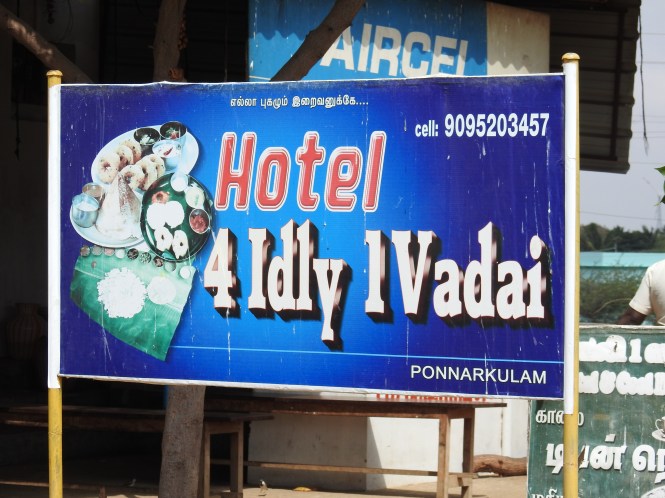
We cross Ponnarkulam with its famous Restaurant ‘4 Idlys & 1 Vadai’

1

We come to Kundakulam. As we do not have any expertise in the field of Nuclear Power, we are refused entry to the power plant.

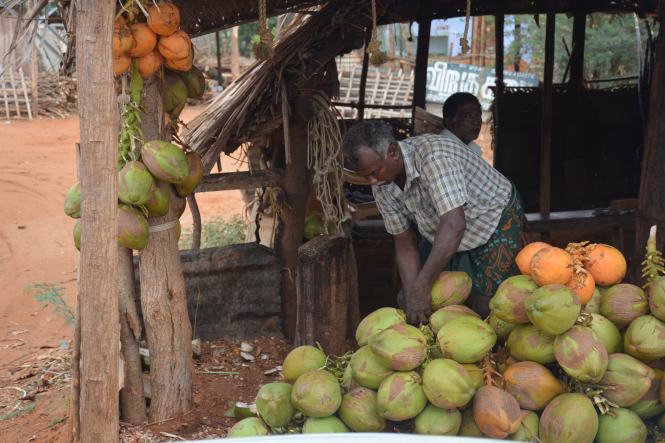
We gulp down the insult with sweet green coconut water at the road junction and continue on our way.Anna selects the best coconuts for us considering the fact that we have come from far-away place.

2

As I mention the green coconuts, let me make a couple of observations here. Between the Green Coconuts of the various states of India there are important differences, the main one being one of retail pricing. In Gujarat, the price ranges from Rs 10 to Rs. 40/- and on this I, have commented in an earlier post. In Kerala there is a remarkable consistency in pricing. Here there is a clear case of price-fixing. This would have invoked the Anti-Trust laws in US. The price of the green coconut at all places in the God’s Own Country is Rs. 30/- as if fixed by God himself. I could not find anyone charging more or less. And we consumed this every day and sometimes twice a day as we travelled. In Tamilnadu, there is no unity among those selling. The price varies from Rs. 20/- to Rs. 30/- . The range becomes wider in Andhra Pradesh, but about that later.

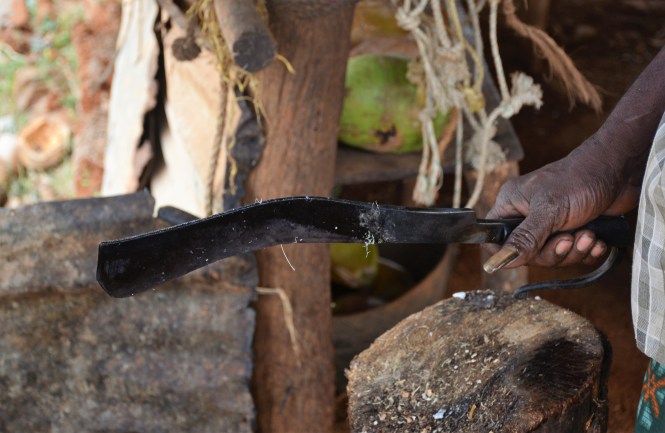
The other difference is the blade, the instrument for cutting the coconut changes. Here is the Tamilnadu version of it. You will find something different in Kerala. Unfortunately, I do not have a picture.

3

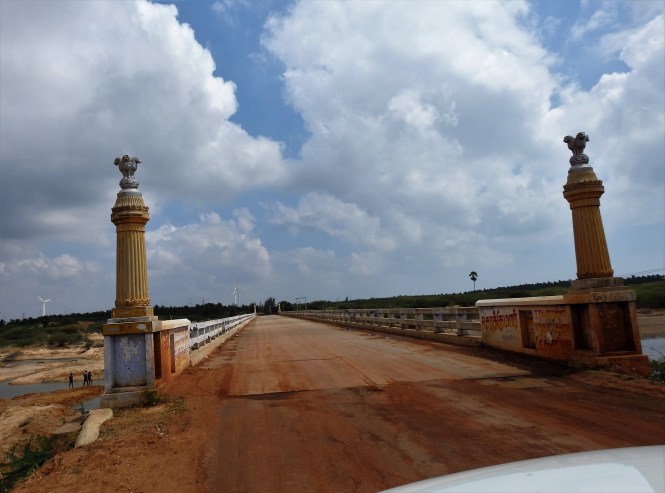
We find the bridge below with the Ashokan Pillar, the official emblem of Republic of India on both sides of the bridge. This appears to be a practice in South India. We noticed this in Karnataka and here in Tamilnadu but not in Kerala.

dscn1226

Ashok Stambha on bridge

Manapad -Kulasekharapatnam are a couple of place where make a brief halt. I don’t know which is which. These are seaside towns with an illustrious history of trading, in the distant past, with the Arabs as well as Europeans, not to speak of the next door neighbour Ceylon, now Sri Lanka. Marco Polo the famous Venetian traveller has recorded this town in his writings. I need not add that he visited the place although he has not left any traces behind.

The approach to the town is in a bad condition. Plastic waste burning all around. Marco Polo would not have approved of this.

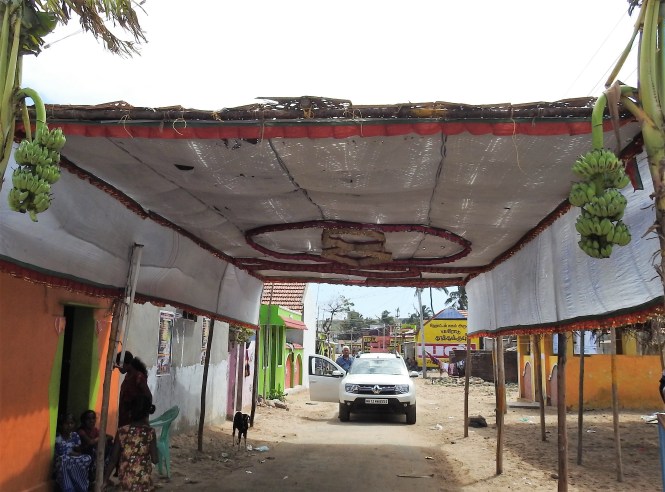
We head to the famous Holy Cross Church at Manapadu which is very visible form the highway. To reach this place we had to pass a narrow road and one of the homes was preparing for a marriage ceremony later on in the day. We had to drive through the ‘Mandap’ prepared for the wedding. I am sure Marco Polo had also to go through this situation, the only difference being Marco Polo did not have a car. I wonder how he managed his travels.

dscn1237

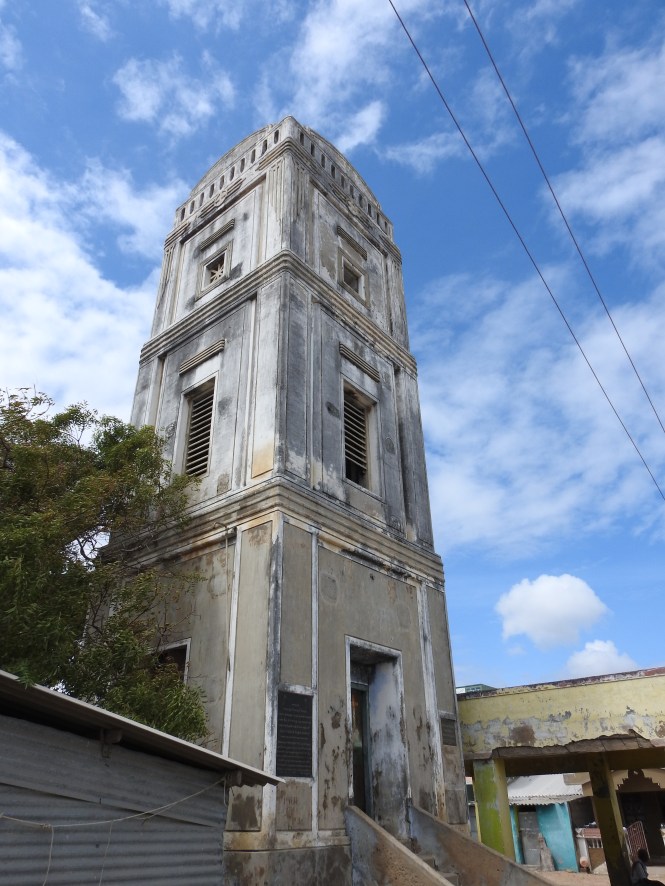
At the turning to the church we could see this curious structure.

dscn1230

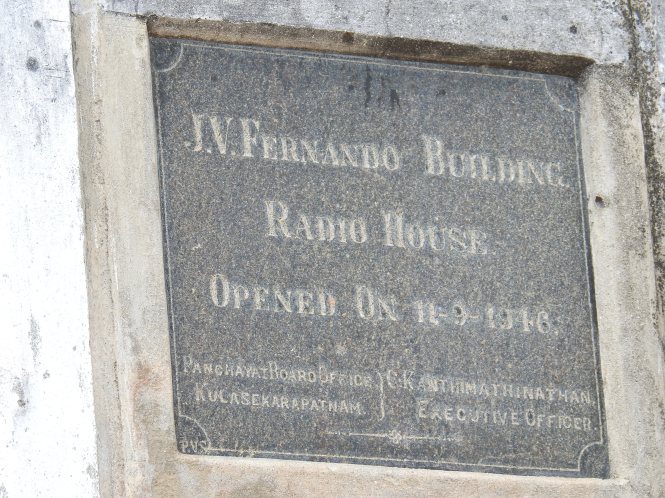
On a closer look at the inscription we come to know that this used to be a radio Station started in the year 1946, by the British of course.I guess the Radio  Station was used to warn the fisher folks of the cyclones after they had passed by.

dscn1231

Not much activity at the church. There is not much activity in the town ( or village) either. We return back to the highway after taking some photographs. I understand that there are a couple of temples around here. We did not see them. The biggest problem for us in the southern states was the fact that in the smaller villages only the local language (Tamil in this case) is spoken. Even the secondary school students we tried to engage in conversation could not progress much with English.

We move on. The landscape is pretty particularly as you approach Thiruchendur.

dscn1229

We reach Thiruchendur for a late lunch. We book a room at Hotel Tamilnadu trusting the state government enterprise. The good thing about these old hotels owned by the tourism establishments of the States is that they are very spacious unlike the new hotels which tend to have very small rooms.

The afternoon is for the Temple and the beach. The temple of Lord Murugan is an impressive structure befitting the dignity of the son of Lord Shiva.

dsc_5907

Thiruchendur Murugan Temple


It is marred only by the irreverence and bad behaviour of the Rose-ringed Parakeets who use the upper parts of the temple building for their amorous activities which requires holes to be made in the holy temple.

It is a picturesque atmosphere inside the temple complex as in many other temples of south India.

The beach is only so-so. The Borassic palms provide some relief.

The official vehicle allotted to Lord Murugan is a Peacock and there are plenty of them around the temple, ready to provide service to their master at short notice.

dscn1285

The places around the temple are infested with fortune-tellers of all kinds including those using parrots to decide your future.

dsc_5882

I always thought that this profession is a male monopoly, No, at least not here. These women badger you with the offers of their services. The only way to avoid them is to say ‘Tamil teri ille’- don’t know Tamil. They go away as they do not speak any other language.I fail to understand the qualification requirements for fortune-tellers. They need to be regulated.

dsc_5904

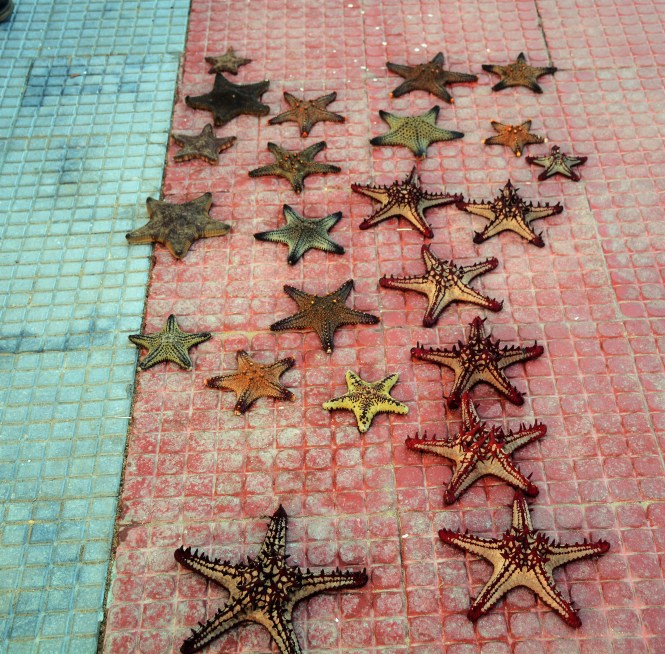
Starfish appear to be found in the sea off this coast very easily. I found many of them being dried for sale and that too on the temple premises. I am sure Lord Murugan would not approve of this.

15

We also visit a Church at Thiruchendur. South of the town near another beach is located this church.

The church compound has the idols of many saints.

Thiruchendur town appears to be quite old with those typical narrow streets of the old towns. We also drive around outside the town and have a look at this temple. The scenes depicted here are not within by knowledge and I will be thankful if someone helps me with interpretation.

Text by Suryakiran Naik

Pictures by Suryakiran Naik & Veena Naik
 

87.TAMILNADU (2). Around Kanyakumari

Leaving behind the fort at Udaygiri, we move towards Kanyakumari via Suchindram and Kottaram, small but important places on the coast. The landscape of this area is quite interesting and beautiful. It is green all around and the granite boulders of the last hillocks of the western Ghats add a touch of glamour to the place.

Our night halt is at Kanyakumari but before we close the day we find time to look around the place. It is all too familiar. We have been here before. The place attracts a very large number of visitors. It is billed as the place where three seas meet. The Arabian sea, the Indian Ocean and the Bay of Bengal. It is not easy as that but let us concede a point to the tourist establishment of the place so that they can earn their living. We do not intend to spend a lot of time here. Just to take some pictures and move on.

The two memorials in the sea are now easily visible. The first and the older one is for Swami Vivekananda, and the taller and the recent one is for Thiruvalluvar. Going by the geography, Thiruvalluvar has a better claim to the rocks, being the son of the soil who did not go to Chicago, US, which Vivekananda did and called there everyone ‘Brothers and Sisters’ which is incorrect. Anyway, everyone in India loves Swami Vivekananda and nobody knows what he did or said except for what I have just said.Not many know Thiruvallavuvar.

dscn1087

Apart from the Memorials on the Rocks, temples and the church continue to function from the shore. They are doing brisk business like the hotels and lodges around.

dscn1080

The Lighthouse at Kanyakumari is easily accessible. It is on the roadside. If you are reading this blog, you would have noticed that we make special efforts to visit lighthouses on the coast. It is not that we are studying their functioning or the technicalities. They serve to make sure that we do not miss many places along the coast.

Fort.Vattakottai. Heard of this? Even if they did, most people will casually mention that this was a Dutch fort. No, sir. It was not. It was built by the Travancore kings with the assistance of their Dutch (or Belgium or Flemish) prize captive De Lannoy whom we met in the last post. The Travancore state’s emblem is very much at the entrance.

Vattakottai means ‘circular’ or round.The shape does not seems to be round. However, this fort ranks among the best of the seaside forts of India. One should walk around the fort which projects into the sea and has a good view of the waters all around.

The insides of the fort are well-maintained and clean. You can have very nice view of the seas around. I believe it is the Arabian sea or the Laccadives Sea, not the Indian Ocean and certainly not the Bay of Bengal.

Inside the fort you wil find this ‘windswept’ tree, as they call it in Bonsai. I am not sure if this shape is caused by the winds.

dsc_5742

‘Windswept’ Neem Tree.

When in Kanyakumari, please make it a point to visit this fort. Not many people do. Not even 5% of the tourists visiting Kanyakumari come here.

Having done with the Fort we move on to another place in the vicinity, driving through the beautiful landscape.

dscn1154

Manakudy is a seaside place which is said to have been badly affected by the 1974 cyclone which destroyed Dhanushkodi.

Manakudy is on both sides of ‘lake Manakudy’ which actually is an estuary and on both sides of it you will find a number of pretty churches.

dscn1162

St Thomas Church

Cross this bridge and a mangrove forest and you are into the western part of Manakudy.

The western part has a long beach and th St Andrew’s Church. By the time we are here, it is midday and it is very hot. You can see it in the pictures below. We decide not to proceed further up north or north-West and return back to Kanyakumari.

People going up to Kanyakumari please note something important. Most of the people go and see the rock and the memorials and move on. You are missing a land of exquisite natural beauty.

In this area around Kanyakumari you will find this interesting species of bird called Openbill or Openbilled Stork. The shape of his beak has been subject matter of study by many eminent biologists including the great Sir Julian Huxley.

dscn1144

Openbill Stork

ThWe are almost dome with the places around Kanyakumari and our next stop is Thiruchendur which is in Thoothukudi diustrict. We drive through the district of Thirunelveli without a stopover. I said almost because we have decideed to drive upo north of Kannyakumari and two more places which have come to our attention at the last moment.

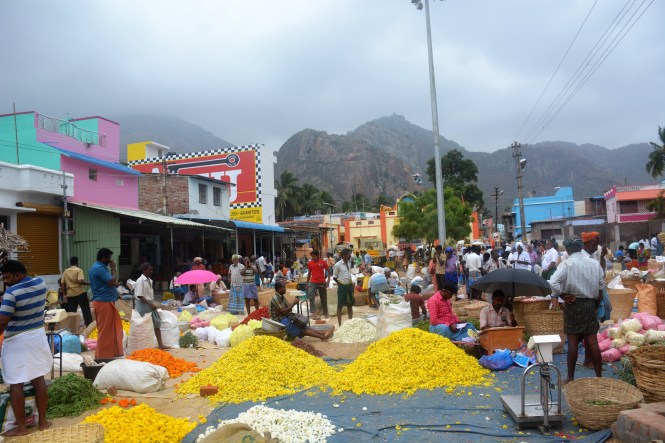
The first one is a market. Thovalai Flower Market is one of the biggest in Tamilnadu and a major supplier of flowers to consumers in Kerala. This little village is at the foot of a hill and is a very interesting place.

dsc_5781

Thovalai Flower Market.

We are delayed by an hour or so and miss the auctions. This could have been a bonus, although we would not have understood the language in which the auction takes place. The market deals with the loose flowers brought in by the farmers in early morning ( or perhaps the previous evening). Later on the other, related activities take place. Here are some of the lots already purchased and awaiting packing and despatch.

The packing material is fabricated on-site and is completely natural and enviornment-friendly, fully bio-degradable. Our enviornmentalists and the establishment should recognize, honour and encourage these traditional methods before plastic replaces them.

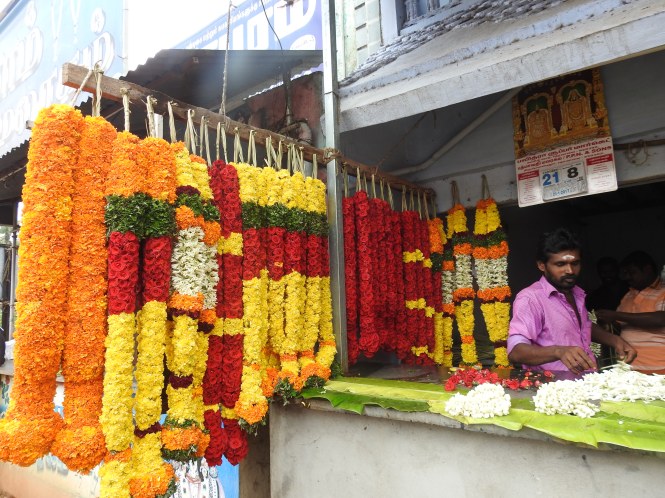
Apart from the loose flowers there is also a substantial ‘making’ activity on-site. Garlands of various sizes, types and colours.

Just outside of the markets are the retailers. Here you can buy one or two to felicitate the local politician on his son-in-law’s birthday.

dscn1205

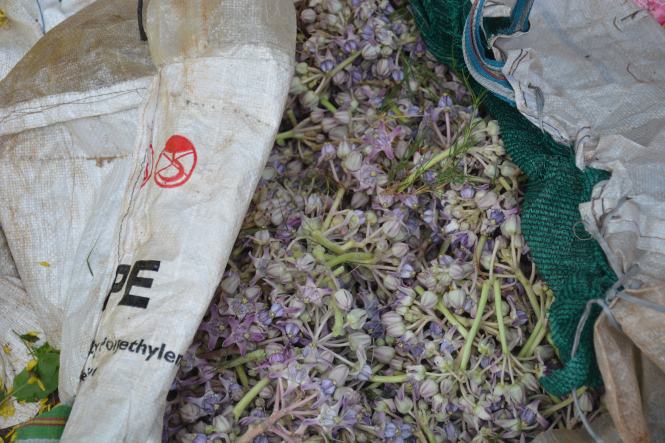
The type of flowers traded here amazed me. The flower below, you must have seen, grows wild all over India and is supposed to be the one to be offered to Maruti or Anjaneya. It is actually being commercially sold!!

dsc_5843

We now have to drive back towards the coast and move towards our next stopover which is Thiruchendur. We move accordingly. A few kilometers on the road, I see the signboard for a Christian shrine. As most things are written in Tamil and most people around do not speak any other language, I have to manage with the visuals.

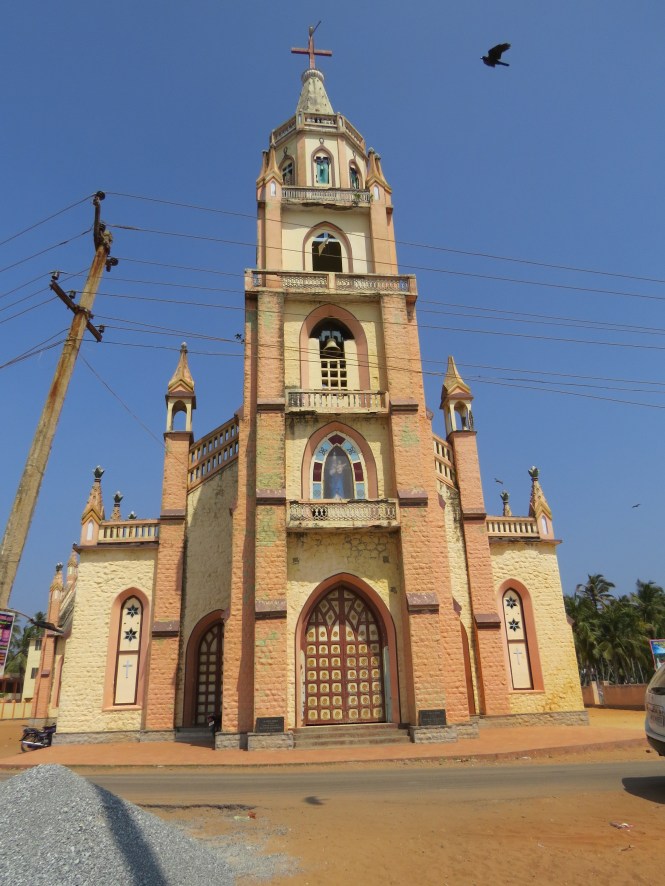
We take the right turn as directed in the signs and end up at a place called Kottar and to the Cathedral of St. Francis Xavier.

And here I come across the Dutch guy called De Lennoy once again. Eustachius De Lennoy was a Dutch East India Company army commander whose forces were defeated by the Travancore kings and he was taken a captive. Later on the Travancore kings appointed him the commander in chief of their army. You will find his grave in the Post No 86 of this blog. Now, this guy has another dimention to his personality. He was a devout Christian and converted the locals to his faith. One of those converted happened to be an official of the Royal Court by the name of Neelakanta Pillai. Records show that the Royal Court did not like this at all and Mr. Pillai was put to death for the crime of sedition. In course of time Mr. Pillai became the Blessed Devasahayam Pillai who is a step or two away from being St. Devasahayam Pillai of Kottar. I am sure I will benefit from this unplanned  visit in the remaining part of my life. Mr. Pillai has been credited with a number of miracles.

Before I close this post I would like to make a candid confession. When I saw the above picture I thought it was Jesus Christ of Nazareth. When I was driving back I started wondering if I had at anytime seen JC in chains. On Cross, yes but not in chains like this. That led to further reading. I must thank Mr. S C Kumar (9842184558) for the above catchy painting.

Text by Suryakiran Naik

Pictures by Suryakiran Naik & Veena Naik
86.TAMILNADU. Nagarkovil, Padmanabhapuram & Udaygiri Fort.

The last place we visit in Kerala is not Kovalam. It is Poovar which is coming up as a competitor to Kovalam with a lot of water sports facilities and boating on the backwaters. Watch that place.

We have planned our first overnight stop in Tamilnadu at Nagercoil or Nagarkovil the district headquarters of the first district abutting Kerala from the southern end. Tamilnadu has as many as 12 districts facing the seas, excluding the city of Chennai. Tamilnadu also has the longest coastline among Indian states after Gujarat.

The distance from Kovalam to Nagercoil is only 66 Kms. by the nearest route but in keeping with TheBlueDrive charter we take the coastal road and spend the entire day to reach Nagercoil of Nagarkovil.

The day is well spent. Poovar came in as a by-product.The Churches and the related statuary here and in other parts of the region are very impressive as we will see as we move along the coast. This is the sample at Poovar.

 The next place we enter is a massive seaside confusion for a visitor. The Google map that my wife and Navigator to the expedition is using shows us to be in Kerala whereas the signboards are declaring the places as Tamil territory. The boundary runs in one direction and the road in another, causing the confusion. The locals, however are not bothered. They can always buy their whiskey from Tamilnadu and drink it in Kerala where it is not legal. Language? I suppose they speak both. Religion? Don’t ask me. It is a big jumble of temples, mosques and Churches. In the event the Churches come out the winners,at least visually.
img_4817

img_4822

Kollemcode is the name of the place. It is spelt differently at a local Christian establishment. The churches above are within a range of about 15-20 Kms, not exactly in this village.

dscn0897

The proposed Kasargod-Kolachel National Waterway passes through here. It would be nice to see people and goods moving cheaply through these channels as in the good old times. Before we reach here there is a massive cemetary on the roadside.

dscn0895

Cementary at the Kerala-Tamilnadu border, near the sea.

 We don’t stop to make enquiries and drive on with the help of the Google map. This map seems to ignore the fact that roads can be washed away completely in these coastal areas by cyclones and Tsunamis. We face this scene and have to return back to take another road, losing an hour or so in the process.

Back on the road, it is all pleasure once again to drive through the countryside. In one roadside village we see a crowd and stop to see what is happening.

img_4824

Fishing in the village pond.


It happens to be the day for picking the  fish from the village pond. Pretty site.

We also come across a village engaged in the extraction of coir from the coconut husk using the traditional methods which involves soaking  the husk in water.

We are not yet in Nagercoil as planned and we are hungry. We have lunch served on coconut leaves at a roadside restaurant. It is delicious. At the end we are asked to fold the coconut leaves and put them in a container before washing our hands. You should have manners.

We move on towards Nagercoil and come across a water body which has a large number of birds even at this late afternoon time. We stop to have a look and decide to return the next day morning.It is winter time and such congregations are expected.

Nagercoil or Nagarkovil is a big Railway junction and southernmost large commercial town of Tamilnadu if we consider Tuticorin as an Eastern town.

By way of places to be visited in the town, we did not find many. W were directed to this temple of the Nagadevata, the Serpent God.

1

Nagaraja Temple, Nagercoil, Entrance.


The deities worshipped here are Lord Krishna and Vasuki the serpent king.

This local young man has bought a new scooter just now, The first stopover is at the temple. A lemon is crushed under the front wheel to ward of bad things happening. Insurance is not required.

dsc_5184

The worship of Nagas, the serpents is a part of the pre-Aryan traditions in the peninsular India.It is a part of ‘Nature Worship’ culture. Snakes are important to the agricultural communities. They control the vermin rat populations that can wipe out crops if not controlled. The Gods from the north are imposters in these temples.

XXXXXXXXXXXXXXXX

The next day we move out of the town and visit two places. The first one is a Palace and the second one is a fort.

The Western Ghats come to an end around this part of Tamilnadu. The foothills seem around here are called Veli Hills.

dsc_5570

Veli Hills

Nestled in the Veli Hills is a palace complex called Padmanabhapuram Palace. The palace was built by Venad’s king Iravi Varma Kulasekhara Perumal. His kingdom became more famous later as Travancore. The palace, at least the first part was built at the beginning of the 17th century and rebuilt later in the 18th. Although the location of the palace is in Tamilnadu, the Kerala government maintains this complex for historical reasons.

The palace is worth visiting. The exteriors are typical Kerala architecture with the tiled roofs.

Some European influence is also seen. The kings here did have European connections including a Dutchman leading the Army. We will come to that a little later. Here is the colonnade.

dsc_5572

The interiors are done in teak wood. The artistry is simple but adorable.

Use of  Oyster Shells in the window panes is seen here. Probably an European influence.

dsc_5532

Window panes done with Oyster shells.

The palace complex is in a granite fort. Not much is left of the fort, but the palace is well-maintained.

There are some artefacts displayed in the palace itself and many more in the Museum at the back. The museum does not have much to write home about. The Malayalis are fond of Museums. We have mentioned one earlier in this blog which ends as you enter and count five.

One notable part of the palace complex is the Oottupura. This is a single -storeyed structure where the king dispensed food to 2000 people every day, a 1000 on the ground and another thousand on the first floor.

dsc_5516

Oottupuram- dining hall

You can see some equipment is preparing and storage of food on such a large scale.On top right side are the pickle jars.

The king sat in the niche below to watch the processions on the road below. The women had their own enclosure.

dsc_5562

King’s observation place.

Whoever has done what is in picture below deserves to be shot. He has left his phone number behind, or of someone else he wants to be shot.

dsc_5554

XXXXXXXXXXXXXXXXX

When the Padmanabhapuram where the above palace is located served as the capital for the Travancore kings, the military establishment was located about 16 Kms. away at a place called Thuckalay.  A mud fort was built here in the 17th century and rebuilt in the 18th century in masonry under the supervision of an European who is subject matter of an interesting story. First have a look at the picture of the fort which is not very impressive.

Here is a brief summary of the Fort’s history.

dsc_5628

The fort is currently occupied as a Bio-Diversity Park. In a few minutes you can tell that it is a misconceived venture of the Tamilnadu Forest Department. Some mammals and birds are kept here in enclosures and cages, respectively. They are certainly not enjoying the confinement under unhealthy conditions.

The fort is spacious and partly occupied by the Archaeology department. It is said that it contains the remnants of a foundry used for casting guns. I could not see any.

Now the story of the European.Eustachius Benoit De Lanoy was a Belgian man employed by the Dutch East India Company. He was defeated in a battle by the army of Travancore then ruled by Maharaja Marthand Verma. This battle happened at a place called Colachel, now in Tamilnadu State and it happened in the year 1741.  In a very rare occurrence of this type, the captured commander was employed by the Travancore king as his Commander In Chief. He seems to have contributed substantially to the new job with his knowledge of European warfare techniques. He died in the service of Travancore kingdom and his tomb as well as those of his close family are found in the Udaygiri fort, well maintained.

dsc_5630

Here are the graves or the tombs.

The huge grounds within the fort appear to be used for various purposes.Do you see a man on the tree? Can you guess what he is doing?

dsc_5648

He is cutting down the ripe tamarind, which are collected for sale by his wife standing down below.

dsc_5647

Text by Suryakiran Naik suryakiran.naik@gmail.com
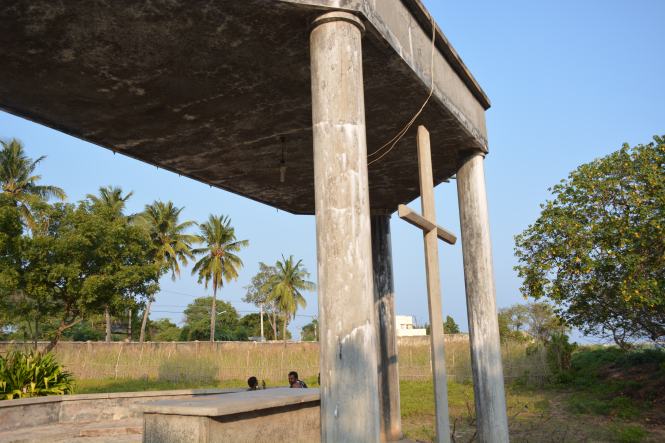
Photographs by Suryakiran Naik & Veena Naik