87.TAMILNADU (2). Around Kanyakumari

Leaving behind the fort at Udaygiri, we move towards Kanyakumari via Suchindram and Kottaram, small but important places on the coast. The landscape of this area is quite interesting and beautiful. It is green all around and the granite boulders of the last hillocks of the western Ghats add a touch of glamour to the place.

Our night halt is at Kanyakumari but before we close the day we find time to look around the place. It is all too familiar. We have been here before. The place attracts a very large number of visitors. It is billed as the place where three seas meet. The Arabian sea, the Indian Ocean and the Bay of Bengal. It is not easy as that but let us concede a point to the tourist establishment of the place so that they can earn their living. We do not intend to spend a lot of time here. Just to take some pictures and move on.

The two memorials in the sea are now easily visible. The first and the older one is for Swami Vivekananda, and the taller and the recent one is for Thiruvalluvar. Going by the geography, Thiruvalluvar has a better claim to the rocks, being the son of the soil who did not go to Chicago, US, which Vivekananda did and called there everyone ‘Brothers and Sisters’ which is incorrect. Anyway, everyone in India loves Swami Vivekananda and nobody knows what he did or said except for what I have just said.Not many know Thiruvallavuvar.

dscn1087

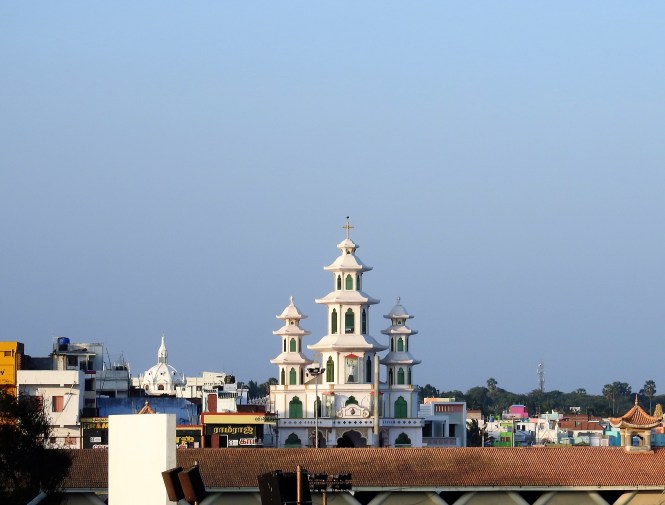
Apart from the Memorials on the Rocks, temples and the church continue to function from the shore. They are doing brisk business like the hotels and lodges around.
dscn1080

The Lighthouse at Kanyakumari is easily accessible. It is on the roadside. If you are reading this blog, you would have noticed that we make special efforts to visit lighthouses on the coast. It is not that we are studying their functioning or the technicalities. They serve to make sure that we do not miss many places along the coast.

Fort.Vattakottai. Heard of this? Even if they did, most people will casually mention that this was a Dutch fort. No, sir. It was not. It was built by the Travancore kings with the assistance of their Dutch (or Belgium or Flemish) prize captive De Lannoy whom we met in the last post. The Travancore state’s emblem is very much at the entrance.

Vattakottai means ‘circular’ or round.The shape does not seems to be round. However, this fort ranks among the best of the seaside forts of India. One should walk around the fort which projects into the sea and has a good view of the waters all around.

The insides of the fort are well-maintained and clean. You can have very nice view of the seas around. I believe it is the Arabian sea or the Laccadives Sea, not the Indian Ocean and certainly not the Bay of Bengal.

Inside the fort you wil find this ‘windswept’ tree, as they call it in Bonsai. I am not sure if this shape is caused by the winds.

dsc_5742

‘Windswept’ Neem Tree.

When in Kanyakumari, please make it a point to visit this fort. Not many people do. Not even 5% of the tourists visiting Kanyakumari come here.

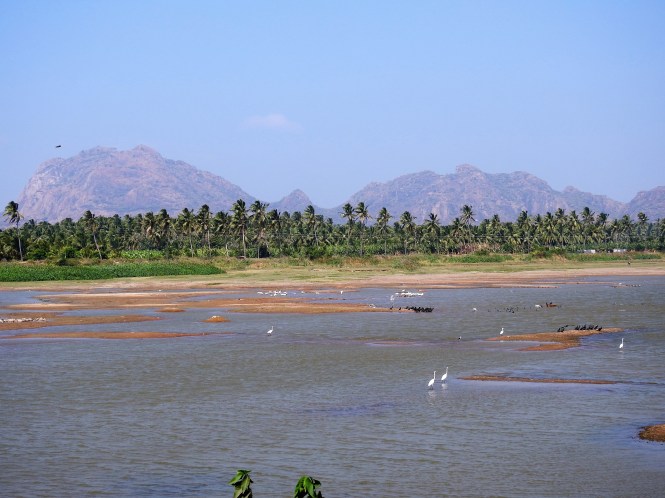
Having done with the Fort we move on to another place in the vicinity, driving through the beautiful landscape.
dscn1154

Manakudy is a seaside place which is said to have been badly affected by the 1974 cyclone which destroyed Dhanushkodi.

Manakudy is on both sides of ‘lake Manakudy’ which actually is an estuary and on both sides of it you will find a number of pretty churches.

dscn1162

St Thomas Church

Cross this bridge and a mangrove forest and you are into the western part of Manakudy.

The western part has a long beach and th St Andrew’s Church. By the time we are here, it is midday and it is very hot. You can see it in the pictures below. We decide not to proceed further up north or north-West and return back to Kanyakumari.

People going up to Kanyakumari please note something important. Most of the people go and see the rock and the memorials and move on. You are missing a land of exquisite natural beauty.

In this area around Kanyakumari you will find this interesting species of bird called Openbill or Openbilled Stork. The shape of his beak has been subject matter of study by many eminent biologists including the great Sir Julian Huxley.

dscn1144

Openbill Stork

ThWe are almost dome with the places around Kanyakumari and our next stop is Thiruchendur which is in Thoothukudi diustrict. We drive through the district of Thirunelveli without a stopover. I said almost because we have decideed to drive upo north of Kannyakumari and two more places which have come to our attention at the last moment.

The first one is a market. Thovalai Flower Market is one of the biggest in Tamilnadu and a major supplier of flowers to consumers in Kerala. This little village is at the foot of a hill and is a very interesting place.
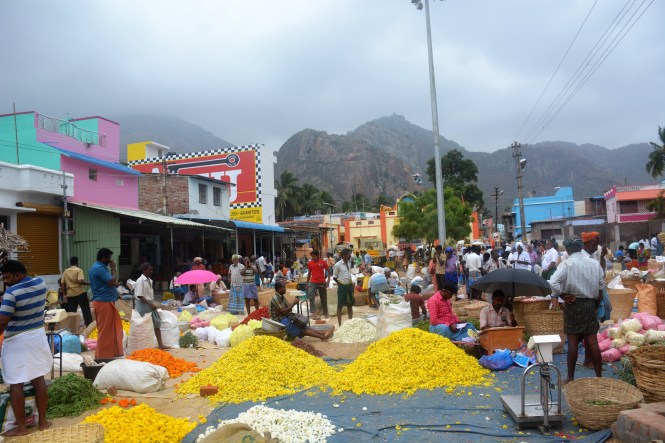
dsc_5781

Thovalai Flower Market.

We are delayed by an hour or so and miss the auctions. This could have been a bonus, although we would not have understood the language in which the auction takes place. The market deals with the loose flowers brought in by the farmers in early morning ( or perhaps the previous evening). Later on the other, related activities take place. Here are some of the lots already purchased and awaiting packing and despatch.

The packing material is fabricated on-site and is completely natural and enviornment-friendly, fully bio-degradable. Our enviornmentalists and the establishment should recognize, honour and encourage these traditional methods before plastic replaces them.

Apart from the loose flowers there is also a substantial ‘making’ activity on-site. Garlands of various sizes, types and colours.

Just outside of the markets are the retailers. Here you can buy one or two to felicitate the local politician on his son-in-law’s birthday.
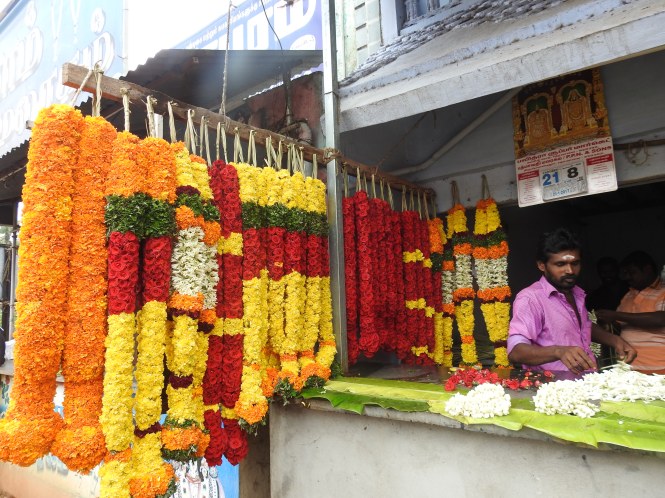
dscn1205

The type of flowers traded here amazed me. The flower below, you must have seen, grows wild all over India and is supposed to be the one to be offered to Maruti or Anjaneya. It is actually being commercially sold!!
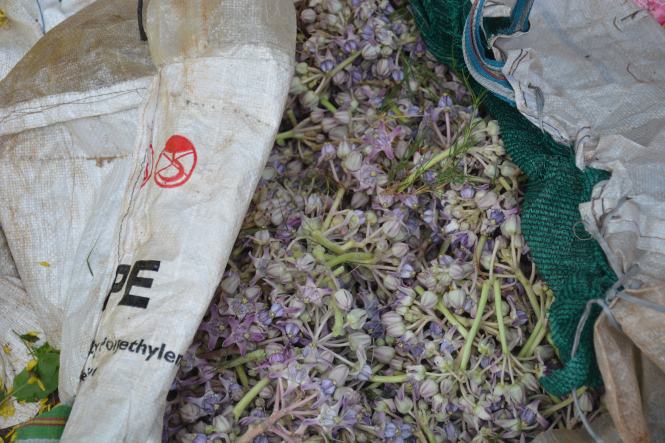
dsc_5843

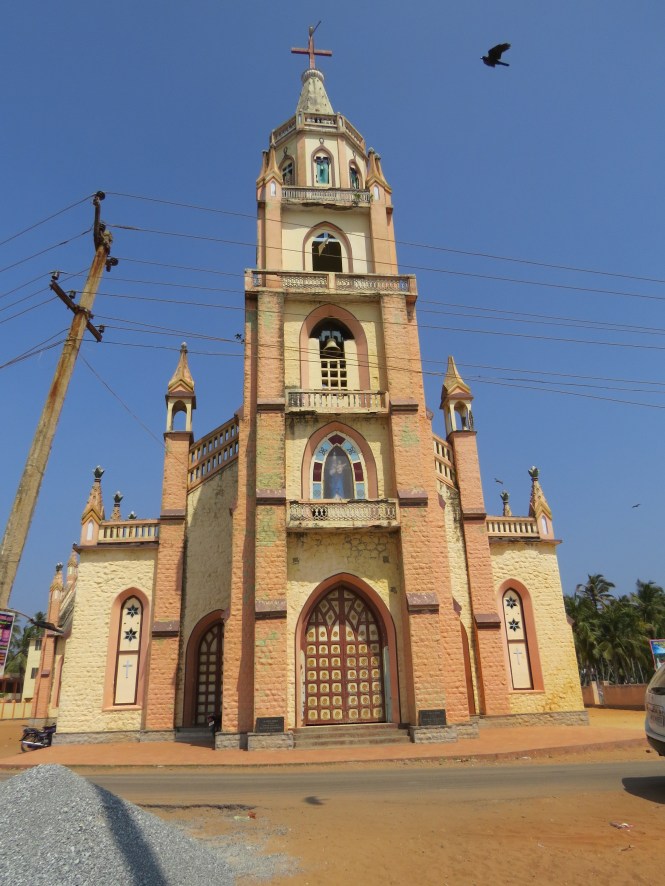
We now have to drive back towards the coast and move towards our next stopover which is Thiruchendur. We move accordingly. A few kilometers on the road, I see the signboard for a Christian shrine. As most things are written in Tamil and most people around do not speak any other language, I have to manage with the visuals.

We take the right turn as directed in the signs and end up at a place called Kottar and to the Cathedral of St. Francis Xavier.

And here I come across the Dutch guy called De Lennoy once again. Eustachius De Lennoy was a Dutch East India Company army commander whose forces were defeated by the Travancore kings and he was taken a captive. Later on the Travancore kings appointed him the commander in chief of their army. You will find his grave in the Post No 86 of this blog. Now, this guy has another dimention to his personality. He was a devout Christian and converted the locals to his faith. One of those converted happened to be an official of the Royal Court by the name of Neelakanta Pillai. Records show that the Royal Court did not like this at all and Mr. Pillai was put to death for the crime of sedition. In course of time Mr. Pillai became the Blessed Devasahayam Pillai who is a step or two away from being St. Devasahayam Pillai of Kottar. I am sure I will benefit from this unplanned  visit in the remaining part of my life. Mr. Pillai has been credited with a number of miracles.

Before I close this post I would like to make a candid confession. When I saw the above picture I thought it was Jesus Christ of Nazareth. When I was driving back I started wondering if I had at anytime seen JC in chains. On Cross, yes but not in chains like this. That led to further reading. I must thank Mr. S C Kumar (9842184558) for the above catchy painting.

Text by Suryakiran Naik

Pictures by Suryakiran Naik & Veena Naik

86.TAMILNADU. Nagarkovil, Padmanabhapuram & Udaygiri Fort.

The last place we visit in Kerala is not Kovalam. It is Poovar which is coming up as a competitor to Kovalam with a lot of water sports facilities and boating on the backwaters. Watch that place.

We have planned our first overnight stop in Tamilnadu at Nagercoil or Nagarkovil the district headquarters of the first district abutting Kerala from the southern end. Tamilnadu has as many as 12 districts facing the seas, excluding the city of Chennai. Tamilnadu also has the longest coastline among Indian states after Gujarat.

The distance from Kovalam to Nagercoil is only 66 Kms. by the nearest route but in keeping with TheBlueDrive charter we take the coastal road and spend the entire day to reach Nagercoil of Nagarkovil.

The day is well spent. Poovar came in as a by-product.The Churches and the related statuary here and in other parts of the region are very impressive as we will see as we move along the coast. This is the sample at Poovar.

 The next place we enter is a massive seaside confusion for a visitor. The Google map that my wife and Navigator to the expedition is using shows us to be in Kerala whereas the signboards are declaring the places as Tamil territory. The boundary runs in one direction and the road in another, causing the confusion. The locals, however are not bothered. They can always buy their whiskey from Tamilnadu and drink it in Kerala where it is not legal. Language? I suppose they speak both. Religion? Don’t ask me. It is a big jumble of temples, mosques and Churches. In the event the Churches come out the winners,at least visually.
img_4817

img_4822

Kollemcode is the name of the place. It is spelt differently at a local Christian establishment. The churches above are within a range of about 15-20 Kms, not exactly in this village.

dscn0897

The proposed Kasargod-Kolachel National Waterway passes through here. It would be nice to see people and goods moving cheaply through these channels as in the good old times. Before we reach here there is a massive cemetary on the roadside.

dscn0895

Cementary at the Kerala-Tamilnadu border, near the sea.

 We don’t stop to make enquiries and drive on with the help of the Google map. This map seems to ignore the fact that roads can be washed away completely in these coastal areas by cyclones and Tsunamis. We face this scene and have to return back to take another road, losing an hour or so in the process.

Back on the road, it is all pleasure once again to drive through the countryside. In one roadside village we see a crowd and stop to see what is happening.

img_4824

Fishing in the village pond.


It happens to be the day for picking the  fish from the village pond. Pretty site.

We also come across a village engaged in the extraction of coir from the coconut husk using the traditional methods which involves soaking  the husk in water.

We are not yet in Nagercoil as planned and we are hungry. We have lunch served on coconut leaves at a roadside restaurant. It is delicious. At the end we are asked to fold the coconut leaves and put them in a container before washing our hands. You should have manners.

We move on towards Nagercoil and come across a water body which has a large number of birds even at this late afternoon time. We stop to have a look and decide to return the next day morning.It is winter time and such congregations are expected.

Nagercoil or Nagarkovil is a big Railway junction and southernmost large commercial town of Tamilnadu if we consider Tuticorin as an Eastern town.

By way of places to be visited in the town, we did not find many. W were directed to this temple of the Nagadevata, the Serpent God.

1

Nagaraja Temple, Nagercoil, Entrance.


The deities worshipped here are Lord Krishna and Vasuki the serpent king.

This local young man has bought a new scooter just now, The first stopover is at the temple. A lemon is crushed under the front wheel to ward of bad things happening. Insurance is not required.

dsc_5184

The worship of Nagas, the serpents is a part of the pre-Aryan traditions in the peninsular India.It is a part of ‘Nature Worship’ culture. Snakes are important to the agricultural communities. They control the vermin rat populations that can wipe out crops if not controlled. The Gods from the north are imposters in these temples.

XXXXXXXXXXXXXXXX

The next day we move out of the town and visit two places. The first one is a Palace and the second one is a fort.

The Western Ghats come to an end around this part of Tamilnadu. The foothills seem around here are called Veli Hills.

dsc_5570

Veli Hills

Nestled in the Veli Hills is a palace complex called Padmanabhapuram Palace. The palace was built by Venad’s king Iravi Varma Kulasekhara Perumal. His kingdom became more famous later as Travancore. The palace, at least the first part was built at the beginning of the 17th century and rebuilt later in the 18th. Although the location of the palace is in Tamilnadu, the Kerala government maintains this complex for historical reasons.

The palace is worth visiting. The exteriors are typical Kerala architecture with the tiled roofs.

Some European influence is also seen. The kings here did have European connections including a Dutchman leading the Army. We will come to that a little later. Here is the colonnade.

dsc_5572

The interiors are done in teak wood. The artistry is simple but adorable.

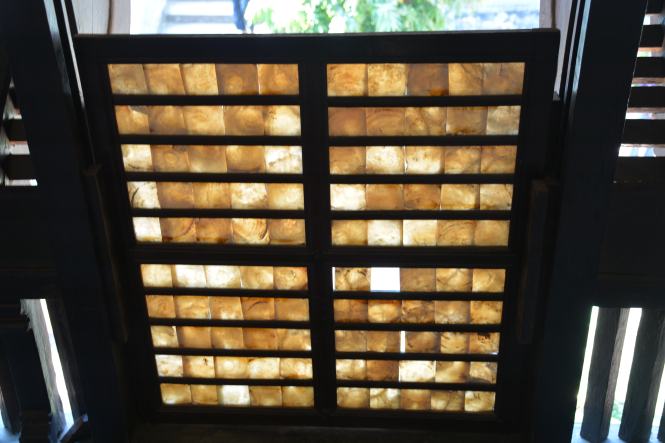
Use of  Oyster Shells in the window panes is seen here. Probably an European influence.

dsc_5532

Window panes done with Oyster shells.

The palace complex is in a granite fort. Not much is left of the fort, but the palace is well-maintained.

There are some artefacts displayed in the palace itself and many more in the Museum at the back. The museum does not have much to write home about. The Malayalis are fond of Museums. We have mentioned one earlier in this blog which ends as you enter and count five.

One notable part of the palace complex is the Oottupura. This is a single -storeyed structure where the king dispensed food to 2000 people every day, a 1000 on the ground and another thousand on the first floor.

dsc_5516

Oottupuram- dining hall

You can see some equipment is preparing and storage of food on such a large scale.On top right side are the pickle jars.

The king sat in the niche below to watch the processions on the road below. The women had their own enclosure.

dsc_5562

King’s observation place.

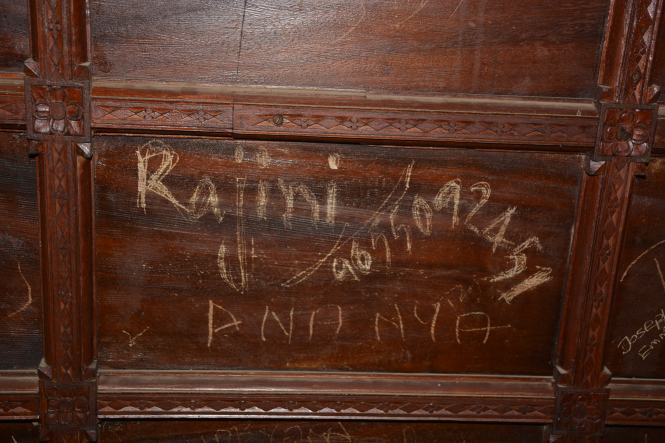
Whoever has done what is in picture below deserves to be shot. He has left his phone number behind, or of someone else he wants to be shot.

dsc_5554

XXXXXXXXXXXXXXXXX

When the Padmanabhapuram where the above palace is located served as the capital for the Travancore kings, the military establishment was located about 16 Kms. away at a place called Thuckalay.  A mud fort was built here in the 17th century and rebuilt in the 18th century in masonry under the supervision of an European who is subject matter of an interesting story. First have a look at the picture of the fort which is not very impressive.

Here is a brief summary of the Fort’s history.

dsc_5628

The fort is currently occupied as a Bio-Diversity Park. In a few minutes you can tell that it is a misconceived venture of the Tamilnadu Forest Department. Some mammals and birds are kept here in enclosures and cages, respectively. They are certainly not enjoying the confinement under unhealthy conditions.

The fort is spacious and partly occupied by the Archaeology department. It is said that it contains the remnants of a foundry used for casting guns. I could not see any.

Now the story of the European.Eustachius Benoit De Lanoy was a Belgian man employed by the Dutch East India Company. He was defeated in a battle by the army of Travancore then ruled by Maharaja Marthand Verma. This battle happened at a place called Colachel, now in Tamilnadu State and it happened in the year 1741.  In a very rare occurrence of this type, the captured commander was employed by the Travancore king as his Commander In Chief. He seems to have contributed substantially to the new job with his knowledge of European warfare techniques. He died in the service of Travancore kingdom and his tomb as well as those of his close family are found in the Udaygiri fort, well maintained.

dsc_5630

Here are the graves or the tombs.

The huge grounds within the fort appear to be used for various purposes.Do you see a man on the tree? Can you guess what he is doing?

dsc_5648

He is cutting down the ripe tamarind, which are collected for sale by his wife standing down below.

dsc_5647

Text by Suryakiran Naik suryakiran.naik@gmail.com
Photographs by Suryakiran Naik & Veena Naik