85.GOAD’S OWN COUNTRY 13. ANJENGO, TRIVANDRUM, KOVALAM.

We are nearing the end of our travel in the God’s Own Country. The tail-end is remaining to be covered but nothing comes easy in GOC, even the tail-end and the tail-end stretches a bit into the neighbouring Tamil Nadu as well.

After the stay at the Ashtamudi lake, we head for Thiruvanantpuram or the good old Trivandrum after a brief visit to Kollam. As usual we take the coastal route and make a stopover at Anjengo.

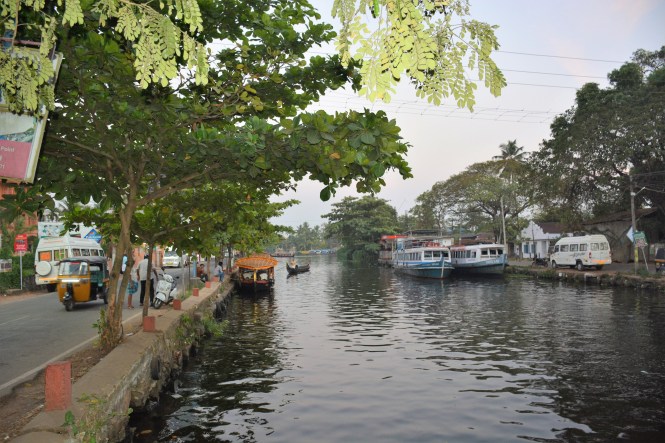
Angenjo or Anchuthengu was connected to Kollam by the British by a canal. Smart guys. Kollam means ‘pepper’ which is what they wanted and that is what the Company was formed for. To distract others, they renamed the place Quilon. That is history for you guys. At some places the canal still exists. I love Kerala for its thick cover of complex and colourful history.
dsc_4937

In 1694, the Queen of Attingal who was ruling this region which is 35 Kms north of Trivandrum made the mistake of her life. She granted the British East India Company the rights to establish a Trading Post (whatever that means) and a Fort. This is probably a great achievement for the Brits as it allowed them a foothold in a region which was more of a Dutch and Portuguese ‘Area of Influence’, then.

The fort is intact, 323 years on, in  Excellent condition and used for drying the neighbours’ laundry.

dsc_4941

 Here are some pictures from inside the fort.

From the outside it is being prepared for encroachment which will happen shortly.

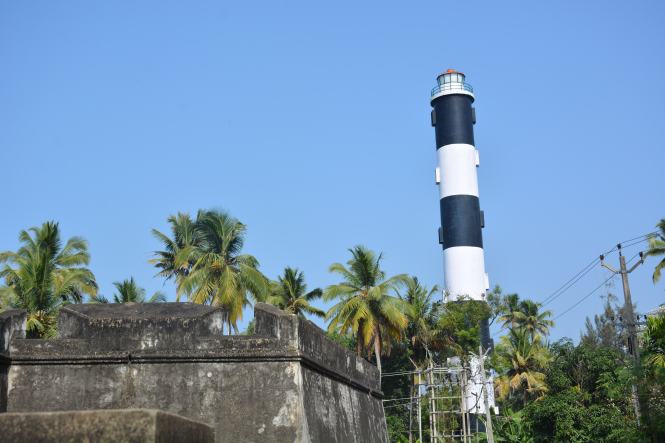
There is a Lighthouse, bang opposite the Fort. In fact if you remove the road, it is inside the fort.

dsc_4942

The Trilingual nameplate at the entrance of the Lighthouse proves  the complete and comprehensive failure of the government policy of Tri-lingualism and a triumphant victory of Bureaucratic India. I demand an investigation into the amount of money spent in making this nameplate. I have not seen any of this type anywhere at any of the Lighthouses on the western coast of India. The Devanagari rendering of the name is hilarious.

This place is known in Malayalam as Anchuthengu, meaning five (coconut)palms. Very odd. There are coconut palms everywhere and I believe they were there always, before and after the White Man came. What is the significance of ‘five’?

dsc_4940

Anyway. I don’t want to talk too much about the Brits because I use their language.

I think not many tourists come to this place. They are tired by their revelries on the ‘backwaters’ to the north and the Kovalam beach and Trivandrum temples to the south. This little place is conveniently forgotten. It deserves a better deal.

We move on in the scorching sun and reach a place a few kilometers away which has a huge fishing jetty and market. It is called Muthalapozi Harbour.I would have loved to watch the fish auction here. From the size of the place it is clear that it is BIG. We are late and have to be satisfied with the stray boats coming in. ( More about this in the previous post No. 84)

dsc_4983

Even the stray boats late in the day bring here a lot of fish.


We move on from here and check-in at a hotel in Trivandrum around the temple complex where vegetarianism is ordained. One has to eat only veggies as a matter of tradition. Fine, let us live it for a day. This is not to say that we stayed in the temple complex. We stayed in a hotel booked on the net.

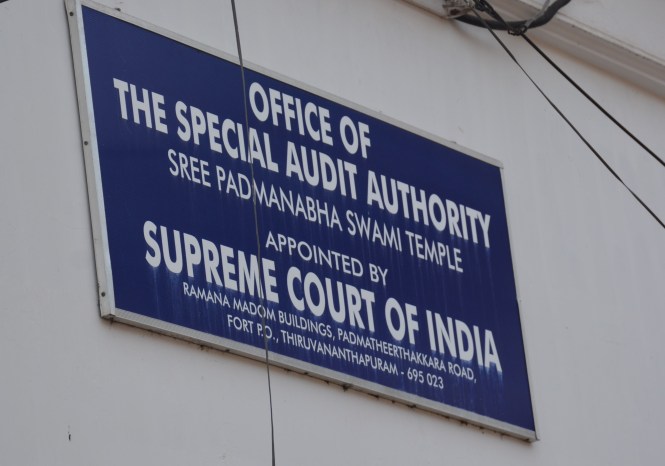
The Temple complex of Trivandrum has a huge security arrangement after the discovery that the complex contains a hoard of gold and jewelry which will take several years to evaluate. It is said that it is the richest religious establishment in the world. May the Goad bless the Special Audit Authority. I wish them a lot of luck.

dsc_5028

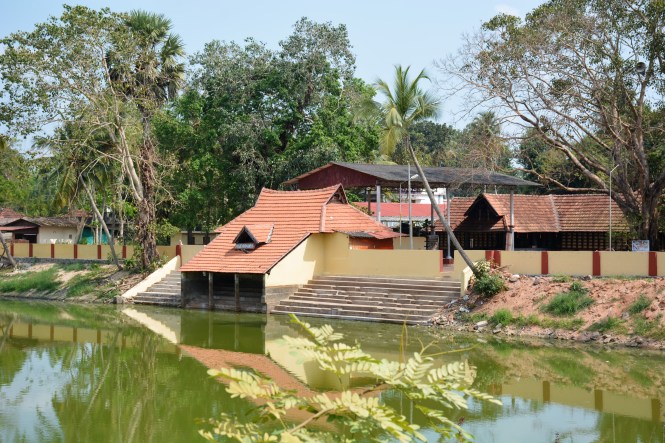
The rear side of the complex with it’s lake is beautiful. I dont know hat is hidden under the lake or if there are any tunnels which are not known to the Supreme Court of India.

If Lord Padmanabha’s estate is willing to negotiate, I might consider believing in God.

The reason we are not dwelling longer on this place is the Dress Code of the temple. I am not willing to compromise for the sake of seeing some stone idols. I cannot attribute any special value to them. I would have certainly considered it if they allow me to have a look at the gems and jewelry discovered in the faults. Anyway that is not to happen.

We move on to the better places like the seashore. It is crowded but still has some fresh air left. And the Shanmugham beach  has some refreshing sculptures.

We did visit a beautiful a museum in the temple complex. By now I have forgotten about it as they don’t allow photography.

There are a couple of other museums in the city. Cant take pictures inside.Thank you.

dsc_5046

People who come to Trivandrum also visit Kovalam. It is the unwritten law. I did it when I came here first about say twenty years ago. I did not like the place called Kovalam. I will always wonder why people go there.

dsc_5057

Having said that, let me make an exception of the Lighthouse. It looks good from the beach. My wife is planning to buy it.

From Kovalam, where we stay the night, to the end of the Kerala territory is not very far.

We have only the beautiful Vizhinjam to deal with. Lovely place. A lot of fish and a lot of religion.

We go straight to the beach and the fishing harbour to find that there is more of religion here than fish.

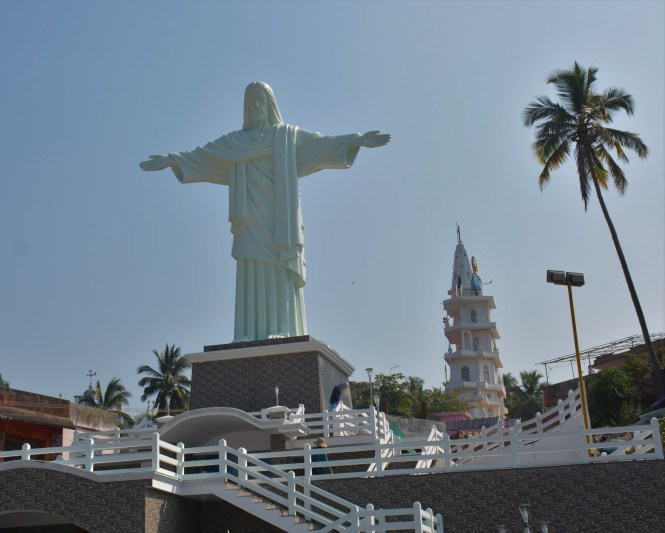
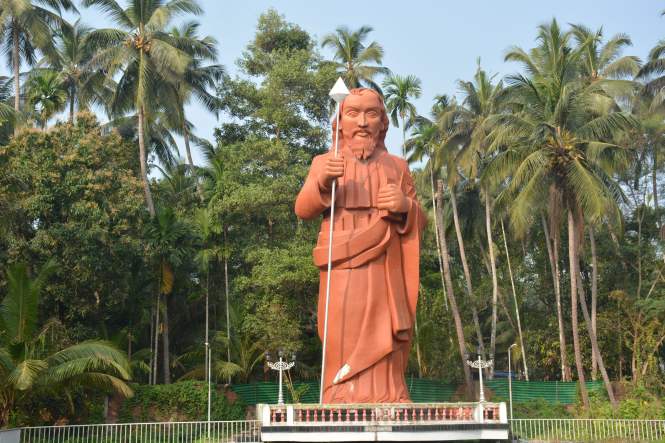
Jesus is trying to save the world from the high ground across the harbor.

dsc_5098

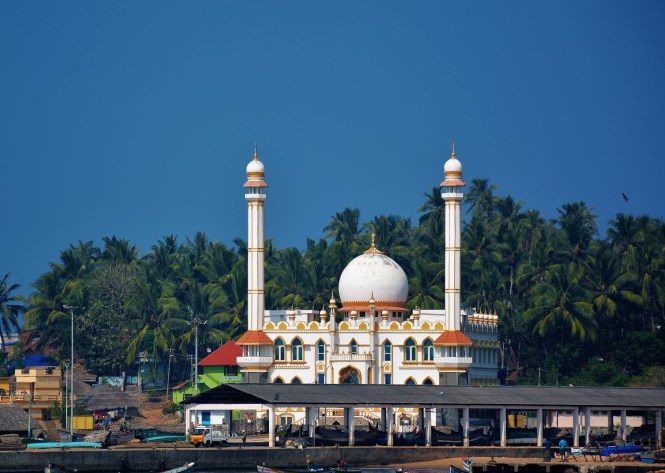
What he looks upon or rather frowns on is the mosques built by the followers of his closest competitor.

dsc_5109

Not one, but two large ones.

dsc_5110

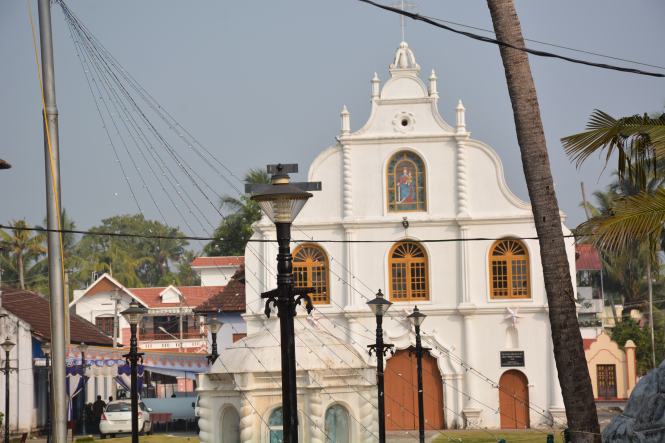
In this whole drama people tend to lose site of the real historical site. Not me. I insist on seeing the old Portuguese Church. The original one. Our Lady of Good Voyage. It is a beauty and it is simple. It has a lot of images inside. Good number of paintings on the walls.

dsc_5129

Among the paintings is the one which is relevant to the name of the Church. Excellent marketing considering the fact that the people here are fishermen but the replica of the boat down below is not correct. It should be a fishing boat.

dsc_5132

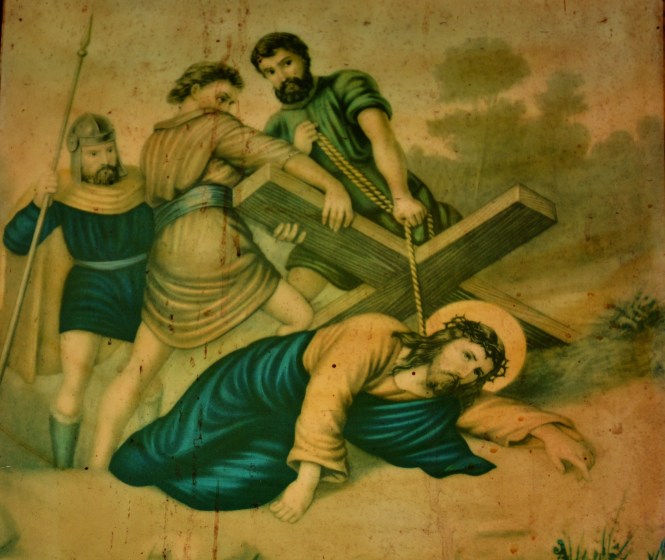
Among the paintings is one depicting the wrong method of crucifixion. These Jews were not trained well in their job of the painter was not briefed properly.

dsc_5133

Now, I am tired and I am hungry. I need to have some fish and if that is not readily available I could do some squids if they are available.

dsc_5152-copy

We decide to leave this lovely place and move into Tamil Nadu for our lunch.

dsc_5124

Kerala, the Goad’s Own Country shall always remain a fond memory.

Text by Suryakiran Naik

Pictures by Suryakiran & Veena Naik


84.GOAD’S OWN COUNTRY 12. THE CHINESE FISHING NETS AND THE FISH DISTRIBUTION SYSTEMS OF KERALA.

The above two topics are not related although both of them deal with fish. They are clubbed together for the sake of convenience.

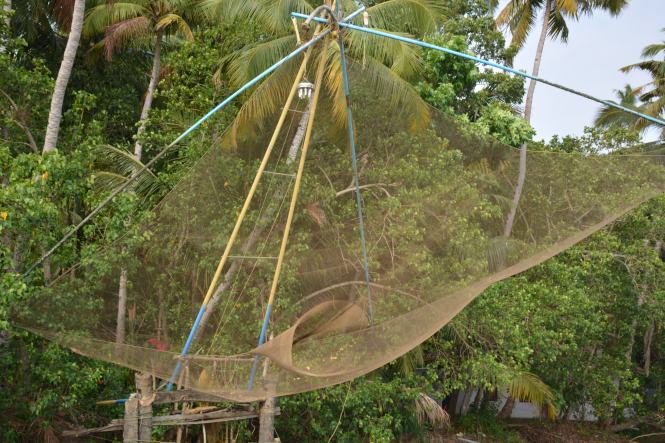
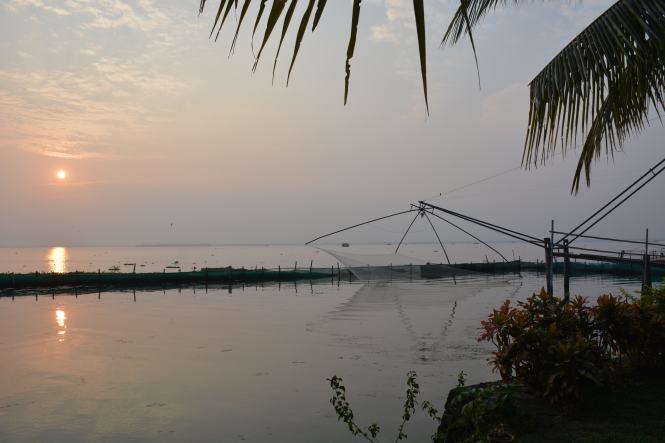
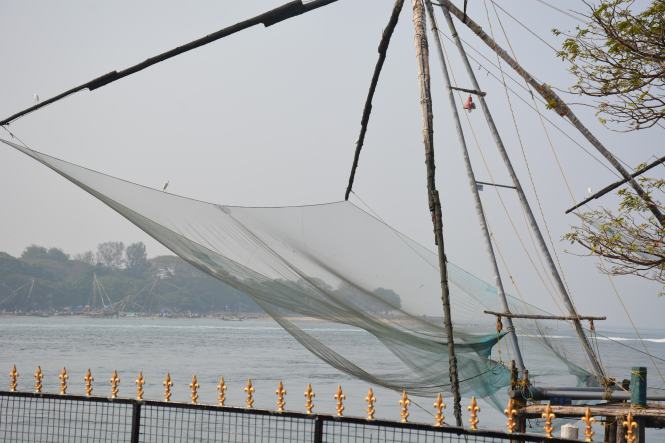
The Chinese Fishing Nets are unique to Kerala and are not found in any other seaboard state of India. Even in Kerala they are confined to Ernakulam-Alleppey-Kollam belt. There are two theories about how they landed here. One is that they were introduced by the Chinese fleet of Zeng He who visited Kerala in early 14th century. The other theory which is more plausible is that they were brought in by the ‘Casado’ Portuguese settlers who came from Macao. If this later theory is correct, the nets have a comparatively more recent history. In any case, they are a part of the south Malabar landscape for at least 300 years.

They are called CHEENA VALA, localy.

1

2

Why did they become popular as against the traditional fishing methods? The nets take less effort to operate compared to the more traditional method of hauling the net through the sand on the shore. It also requires lesser number of people to operate. On the flip side, it is not a very efficient method of fishing. The yield is quite low. The operation of these nets requires tidal waters. They catch fish only at the high tide when the seawater enters the creeks and the ’backwaters’. That explains their geography. You cannot operate them in the open seashores where most of the commercial fishing takes place.

We first encountered the nets at Vypin island. I guess they are found another fifty kilometres or so up north  in the Kodangallur area.

It is perhaps on the Vypin island in Erankulam district that they are economically important even now.

The fishing nets are a sort of factory. It needs a platform, staff, storage space etc. depending on the level of activity.

It is generally thought that these objects are made of wood. Not true. Although considerable amount of wood is used the main cross members of the beam are made of steel and bear most of the stress. In mechanical terms the nests are easy to lower into the sea and raise above after the catch with minimum efforts made possible by use of levers. They don’t require any other electro-mechanical inputs. Maintenance of the components appears to be the major source of expenditure in the operation.

Skilled workers are required to lower and raise the nets.

In terms of the fish caught, they appear to be insignificant in the overall fisheries scene of the state. Insignificant in terms of quantity of fish caught and its value. The major fishing method is of course the motorized trawling.

Apart from the estuarine  areas around Cochin, the southern backwaters also have the presence of these fishing nets. On  the Ashatmudi lake, they seem to be operated at night and use electrical lights to attract the fish. You can see the lamp on the top of this net.

dsc_4580

Whether economically important or not the nets add a lot of beauty to scene. No visitor to Kochi will return without the photographs of the nets.

At many places I think the nets are used as a piece of decoration, as here at Kumarkonam.

kumarkonam

At  Kochi a particular section of the town is called Fishing Nets area. I need to caution people about an activity caried out here.

A few people sell a lot of fish and crabs here. The selling point is that the fish is fresh off the Chinese Nets and you can have it coked instantly by the service provider on the pavement. They never say in so many words that the fish is off the nets. It is implied and we take it for granted, most of us. We establish a connection between the two.

This story has two parts, the source of the fish and the availability of cooking facility instantly. The first one patently untrue and the second part is absolutley true.

dsc_4076

Look at the wide variety of fish sold which includes Pomphrets.

Many of these are deep-sea fishes and cannot be caught here in the creek.

This is all about the Chinese Fishing Nets that I could observe.

Whilst at it, allow me to share a couple of other traditional fishing methods of Kerala.

The pictures below show a large net being used on the seashore at the receding tide. This method needs huge manpower and is a collective efforts by the fishermen community. The pictures below were taken at Kovalam in southern Kerala. This is not unique to Kerala. It is practiced in Maharashtra, Goa and presumably in Karnataka although I have not seen it. This provides the freshest possible commercial catch and is sold at a premium.

We have covered this in an earlier post in this blog. It is called Rampon or Rampan in Maharashtra and Goa. I need to find out what they call it in Malayalam.

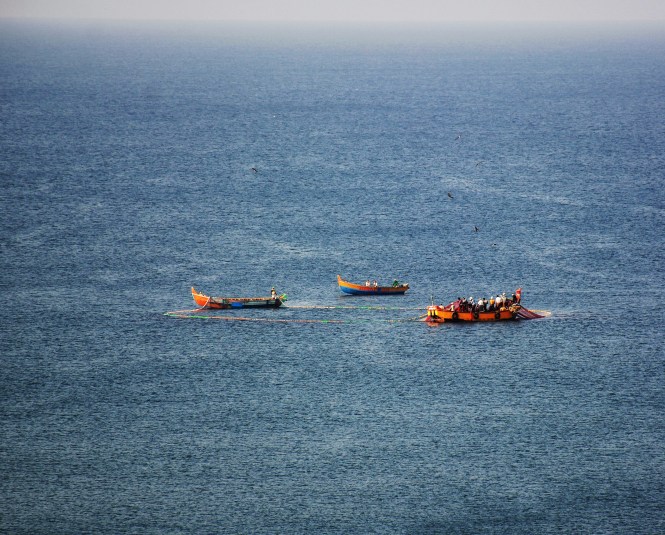
There is another fishing expedition we could observe at Varkala in southern Kerala. Very interesting and Varkala being a cliff, we could observe it clearly but not at a close range.

Two boats venture into the sea. One is large, the other small. the larger one is carrying the net.

1

They spread the net in a circle.

A third boat provides some assistance or perhaps some supervision.

5

They are now closing in, bringing the entire net to the larger boat. In a short while the net is dragged on to the boat.

The whole operation took about 90 to 100 minutes. The boats return to the shore with the catch.

8

PART II- Distribution.

OK, the fish has been caught and it has to reach the plates of the customers. Let us see how they do it.

Practically everyone in Goad’s own Country eats fish. To feed this vast population with fresh fish is a challenge that has spawned various ingenious delivery methods.

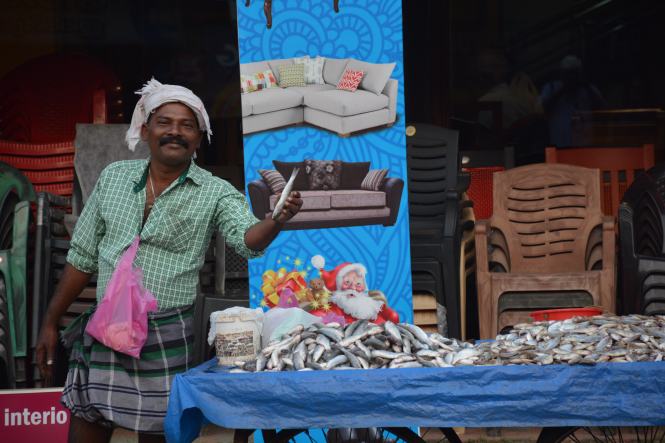
The traditional roadside shop exists as it does everywhere else. They could be small makeshift kiosks or more elaborate structures which allow storage of unsold stocks.

dsc_2851

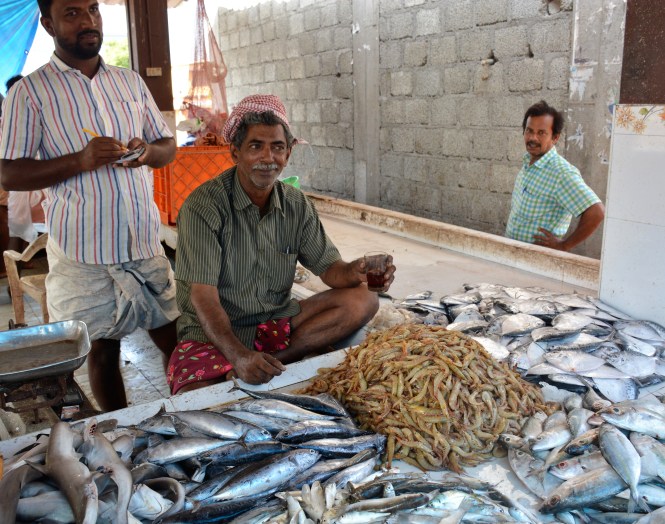
They also exist at the wholesale market places like the one below.

dsc_2879

Fish is sold at many places with the sellers seating on the ground with a basket or two arranged in front. This is particularly true when women are selling.

dsc_5125

More commonly it is a raised platform where the sale is completed standing up.

dsc_4448

Carts with bicycle wheels are also used in smaller places.

dsc_3491

In Gujarat, Maharashtra and Karnataka selling of fish is women’s monopoly. In Kerala I guess the men do not trust the women with the money. I did not see many woman selling fish.

In most cases the sale is by weight but in many cases the age-old method of selling on the basis of a ‘portion’ prevails.

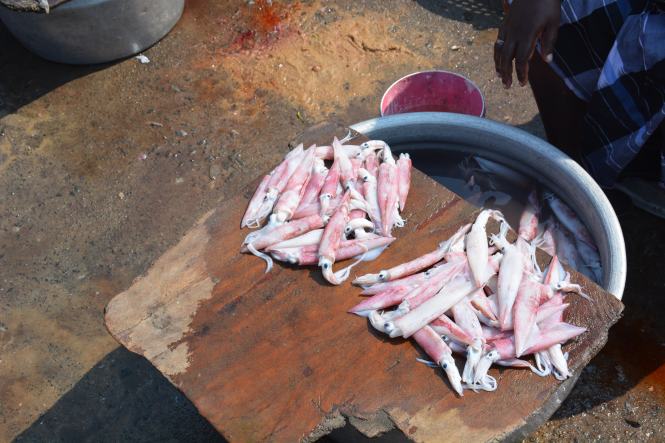
dsc_5152

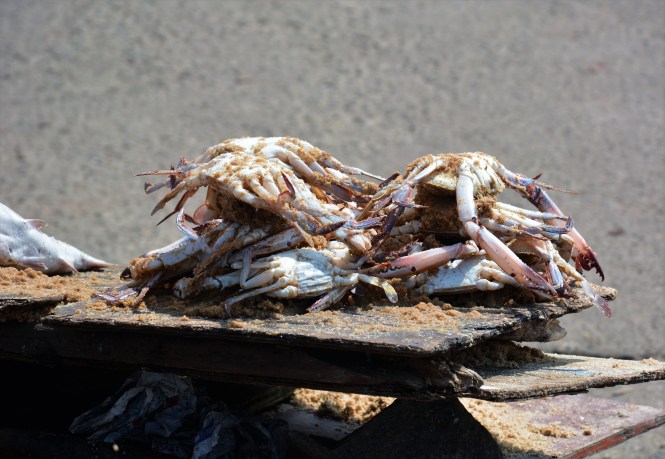
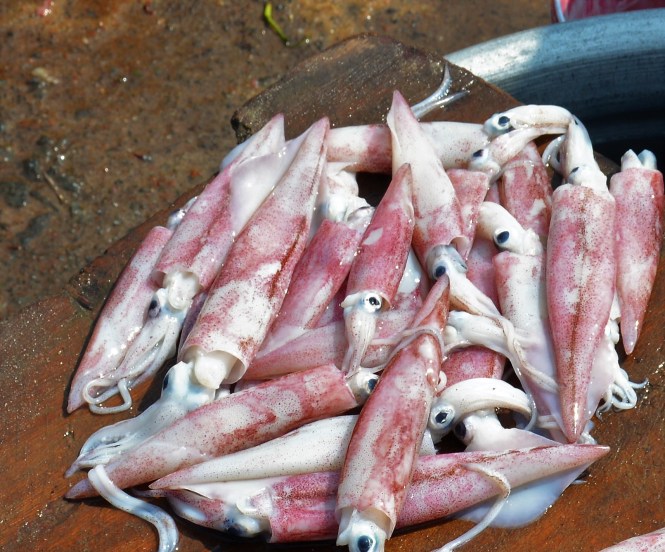
The ‘portion’ system’ works well for odd items like the squid above or the Blue crabs below.

901

At times  the larger items are sold on ‘piece’ basis , like these  rays below.

902

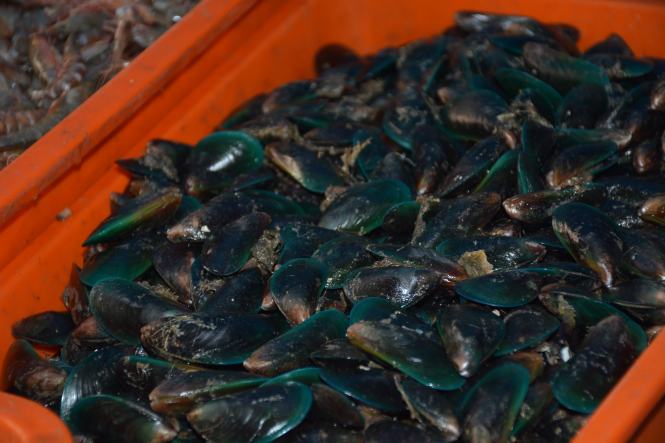
This ‘numbers’ method is also useful for certain kind of shellfish like mussels. You can buy a 50 or a 100 of the delicacies below.

dsc_2852

Do they sell cleaned (dressed) or as it is found in the sea? The popular method in Kerala appears to be as it comes from the sea. The person cooking appears to be the deciding  on the method of cleaning.

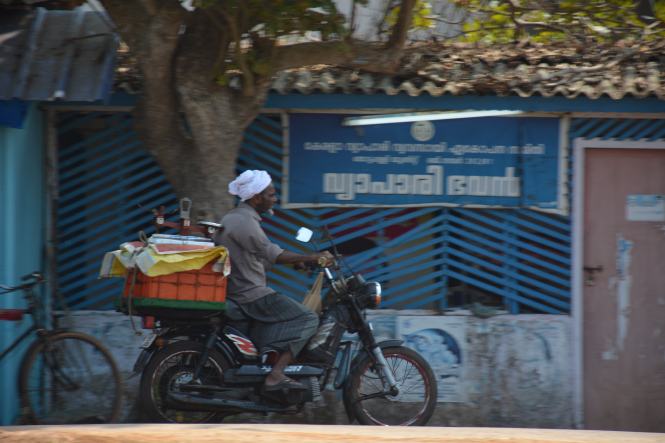
Delivery on bicycles is still going on but looks like a dying institution but still exists all the same. The pictures below are in the heart of Kochi town. .

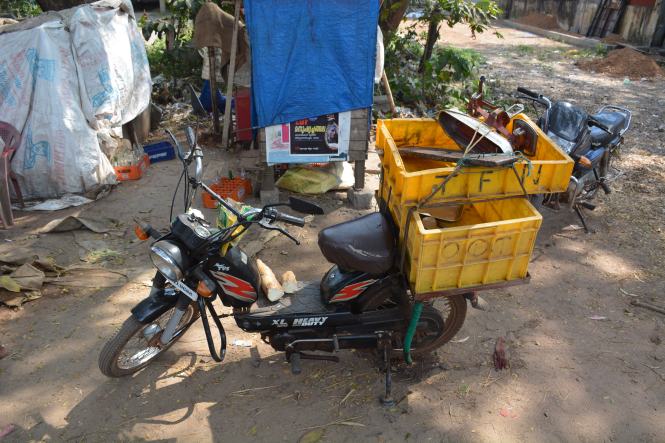
The motorbikes are a more viable proposition and they have been adapted very well for this activity. Look at this bike.

dsc_4450

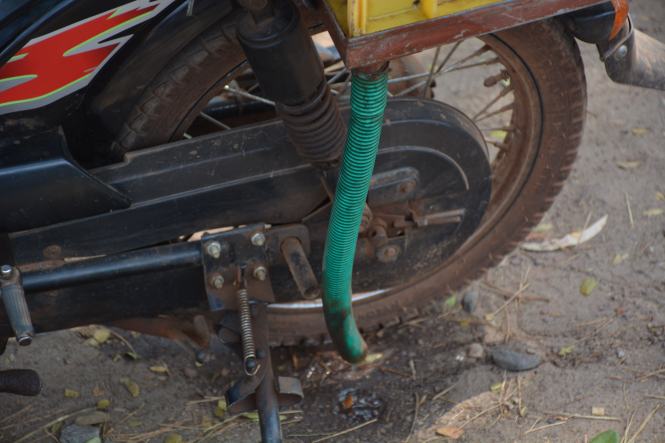
It has the provision to fix the box with the fish and the ice. The melting ice water has to be drained. Provided for. The smelly water is drained on the road to burn the nostrils of the vegetarians passing by.

dsc_4451

dsc_4452

You will find this scene in many small towns and villages in Kerala.

dsc_4463

Frozen Fish does not appear to find favour with the Malayalis with most of the folks looking for fresh fish but use of ice appear to have gained acceptance. My friend Ibrahim at Ponnani does not use ice at all.

dsc_3133

On the Ashtamudi lake and other ‘Backwater’ areas fish is sold door to (wet)door by the small boats or canoes.

For movement of medium quantities, autorikshaws particularly the larger ones (6 seaters) are used, as are the ‘tempos’, the small trucks.

dsc_4319

Use of saloon cars is not prohibited.

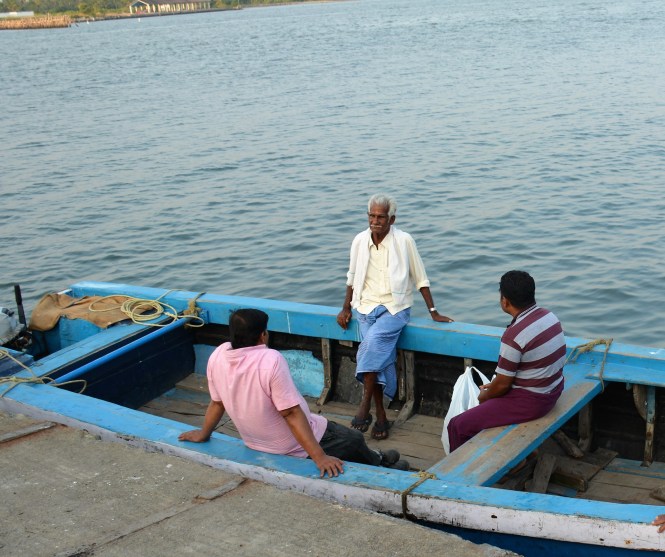
There is an interesting phenomena we could witness not very far from Trivandrum. We entered a large fishing harbour called Muthalapozhi. It was empty but for a couple of stray latecomer. The fishing auctions were completed very early in the morning and the fish had gone to the smaller markets. Here we see a boat with fish. This is not a fishing boat. It is a ‘transport’. It brings the fish from the Trawlers when it is fresh and sells it here.

A  Trawler is at sea typically for 2 to 3 weeks and use ice for storing the catch. The quality of the fish after the three weeks is not the same as fresh fish. Many people do not buy fish from these trawlers. As a via media, these enterprising people buy fish from the trawlers, presumably mid sea and bring it to the shore-fresh.

The above information is from a buyer I met on the jetty and was willing to pay a higher price to this fish as compared to the one sold in the market.

If you really enjoy yourselves at a ‘market’, I recommend you a visit to a fish auction on the seashore when the small boats bring the catch ashore. And what better place for it than Kerala?

dsc_5150

Small lots are laid down on the beach one by one in quick succession and the bidding takes a minute or so for each lot.

Believe me, women are at their ferocious  best when they are bidding against each other.

Text and Pictures : Suryakiran Naik

suryakiran.naik@gmail.com


83. GOD’S OWN COUNTRY – 11. Ashtamudi Lake

In the last post, we passed by the lake and proceeded briefly to Kollam for the sake of convenience of the narrative. The Ashtamudi Lake deserves its own Post. So, we are back here. Ashtamudi Kayal is what they call it in Malayalam.

A bit of geography and history would be in order here although this Blog does claim to be a technical one.

River Kallada and a few other smaller rivers discharge the waters they bring from the Western Ghats into a lowland area abutting the Laccadives (Or Lakshadweep now) sea which is a part of the Arabian Sea. The lowlands form a very complex ecosystem of lagoons, channels, backwaters, islands and creeks. This system is generally known to us as ‘Kerala Backwaters’ which with their more complex resorts and spas and Ayurvedic Massages establishments are a major business. Most people don’t realize the immense historical, social, political and economic significance of this system. This lake with its elder (and larger) sister called Vambanad up north form an amazing ecological universe. The beauty of this whole system is that it is navigable for over three districts. It has a length of 241 Kilometres with 41 rivers, small and big, discharging the waters they bring from the upland western Ghats to make it a mixture of saltwater and freshwater which has produced a few hundred Ph Ds in Marine Biology.

Our brief in this post is the smaller portion of the  system called the Ashtamudi Lake which terminates at Kollam in the south. Before me, among the important people who came here was Ibn Batuta the Moroccan traveller in the 14th century. Between  Ibn Batuta and myself, there was a remarkable Englishman who came here at the behest of East India Company of London.

Col John Monro came here as the EAC’s ‘Resident’ after the local kings played into the hands of the White Man and surrendered their sovereignty. This Scotsman is widely revered in the region. He worked on the lake, reclaimed some lands as island which are named after him- Munro Island. Among other things that Munro did wad to dig a narrow channel on a part of the land so that it could be in communication with another part. The eastern part that you see in the map below is the place through which the National Waterways No 3 passes and connects to the northern part of the system. The encircled area is the one that connects the Munro Island area to the eastern side of the lake.

screenshot_2017-02-17-18-21-57

It is on the bank of this narrow channel that we stay the night at the place called Roomi’s Nest. Roomi’s Nest has rooms on both sides of the channel. If you want to go from one to the other, you go up along the narrow path lining the channel, cross the bridge and come down again. Very complex for a hotel.

dsc_4521

 The difficulties and smallness of the place is compensated for by the very co-operative nature of Roomi and delicious food cooked by his wife.

dsc_4523

Entrance to Roomi’s Nest


Now what do you have in the lake? Many things if you have the time and the inclination. Unfortunately for us there is a feast going on that day at the Church and most of the resident fishermen of the area being Christians have excused themselves, leaving us with very little fresh fish. We were counting on three species of clams and one of oysters. We could not get any of the famous clams.


Error
This video doesn’t exist


Error
This video doesn’t exist

  We start the morning on the boat owned by Roomi. He joins us with his crew of two and there we go exploring. It requires a license for the skipper of the boat to operate it on the lake. It applies to all motorized boats.

dsc_4609

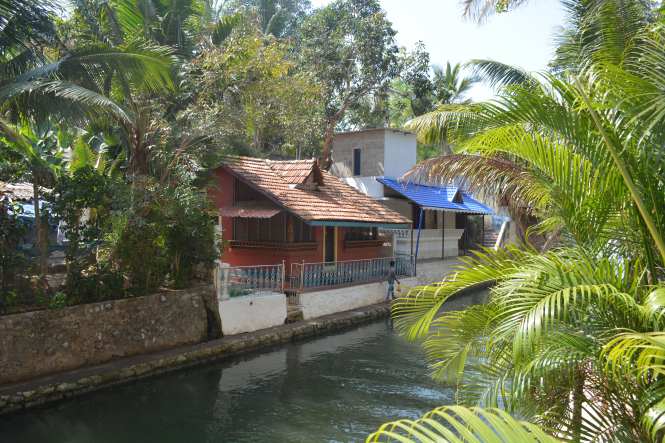
The houses on the shores of the lakes are colourful. It should be fun to live so close to the water although it may have its own difficulties , like the mosquitoes, the falling coconuts etc.

 The Chinese Fishing Nets are here on the western side of the Munro Island, but not many.

Among the economic activities one can observe on the islands is Goat-rearing.

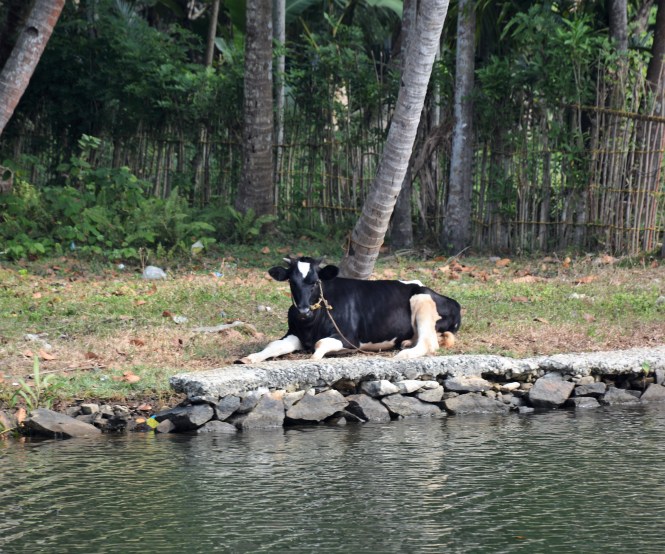
Cows are seen but not many.This cow seems to be enjoying herself.

dsc_4671

There is a weed which grows along the shores of the lake and I was told is liked by the cows.


Rearing ducks appear to be an activity quite common all over Kerala and Ashtamudi lake is not an exception. It is quite interesting to see roadside shops in the state selling three types of eggs- the common hen eggs, larger Duck eggs and the smaller, spotted eggs of the Japanese Quail which is called Kad of Kada here.

dsc_4763

Coconut farming is a natural occupation of the people in Kerala and this lake area is not an exception. Processing of coconut was not noticed, neither did we see anyone selling green coconuts.May be it is done at places in the lake that we did not visit.

Fish farming, particularly the rearing of the Pearl Spot or the Karimeen is a lucrative business. We visit a farm where they raise the fish.

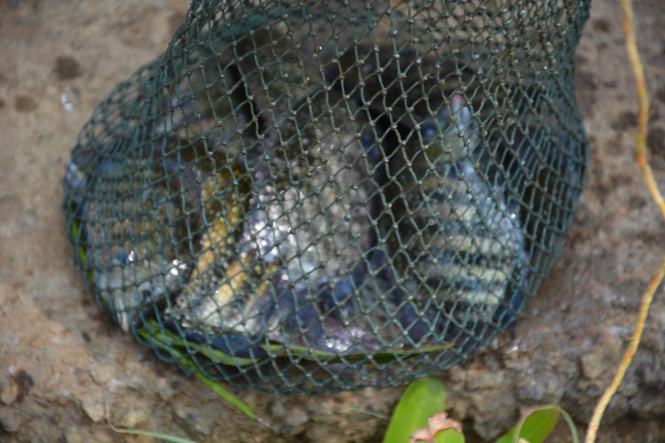
The fish are in the net. The net is puled out to show to the customers. If you dont like, the net goes back to the water with the fish remaining alive.

Roomi flatly refusesd to pay the asking price which he called exhorbitant for what was on offer.

dsc_4774

We could notice a Saw Mill on the lake shore indicating timber logging as aneconomic activity.


There are no school buses here or one has to go a longer distance to catch the bus. Taking a boat to the school is a better option for many of the students.

dsc_4617

Student awaiting arrival of boat to school.

Ashtamudi means eight-coned. The lake is a maze and requires transport systems to match.

There are the crossings from one side to other on small country boats.

dsc_4688

And also the larger motorized boats for the larger vehicles.

It looks like these houseboats are also used for transportation of people and goods.

dsc_4708

Churches and temples are aplenty along the lake shores. Devotional music can be heard.

The sport of angling is prevalent on the lake.

dsc_4635

Angler with his fish line under a railway bridge on Ashtamudi lake.


What is more interesting is that it is also practiced by young women which is rare. It was heartening to see woman anglers.

Fish is sold along the lake fringes in small country boats. The sale transaction is done with the vendor in the water and the customer on land.

dsc_4637

Fish Vendor-1


dscn0619

Fish Vendor -2


dscn0595

Fresh fish off the nets.Premium Quality.


There are a few islands in the lake apart from the larger Munro island and 43 species of Mangroves are supposed to be growing in the lake system which make growth of a large number of fish species.

As many as 57 species of birds have been recorded in the lake area, Among the most visible are the Cormorants who reside here in large numbers and constantly enrich the water with their dropping for the fish to grow on.

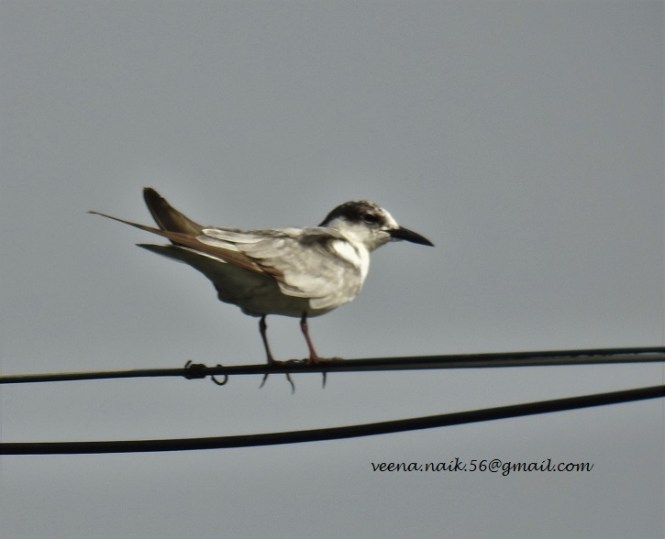
There were Kingfishers of course and the Terns and Bee-eaters.

dscn0591

River Tern


Roomi’s nest has a few residents. The White-Throated kingfisher has his holes in the sand banks. The Black-rumped Flameback Woodpecker also nests in the coconut palms.

dscn0577

Text by Suryakiran Naik

Pictures by Suryakiran Naik & Veena Naik


82. GOD’S OWN COUNTRY – 10. Alleppey to Kollam


We leave Alleppey and move southwards to Kollam. We don’t intend staying in Kollam town but still would like to be as close as possible to Ashtamudi lake and the inland waterways.  We need to do a couple of other places along this long road and it might take another halt before Ashtamudi. When in Kerala one has to be prepared for a lot of things including a lot of confusion.


The road from Alappuzha ( Alleppey)  down south is narrow as most Kerala roads are. The traffic is horrible. The bus drivers appear to be trained to reduce the population of the state. I have somehow survived to write this post.

On the way we see this Shiva temple where the Lord has been provided with State of Art lightning for making Him visible at night.

1

The temple is modest but has a sizable along the highway.

2

The first major attraction we go to see on this stretch of the coastal highway is the Krishnapuram Palace at Kayamkulam. This 18th century palace built by the Travancore Kings and is a miniature replica of Padmanabhapuram Palace and now doubled up as a Museum.

3

Krishnapuram Palace

The palace is well-maintained but the same cannot be said about the exhibits of the Museum. The most famous of the exhibits is Kerala’s largest (154 Sq. ft.) mural painting ‘ Gajendra Moksham’

4

Gajendra Moksham, Mural painting.


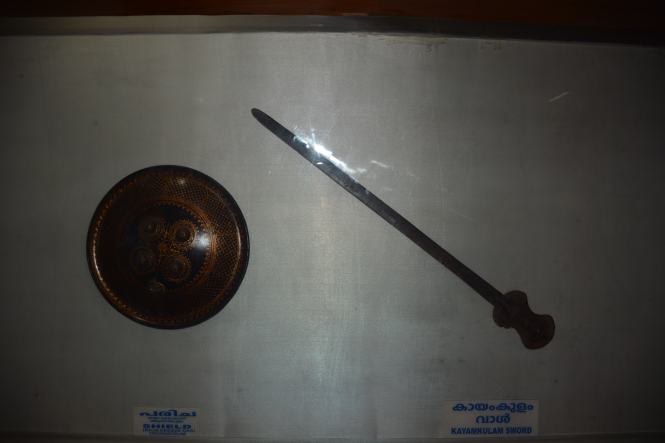
 The Kayamkulam Double-edged Sword is also on display here.

7

Kayamkulam Double-edged Sword.

 If you are a philatelist with interest in ‘Indian States’, you would know what Travancore Anchal is.  Here is something very important representing the famous postal administration.

8

The simple beauty created by the Kerala’s woodworkers is here to see on a large-scale as in other palaces and temples.

5 Here is the place from where the King would descend to the pond for his bath. I find the gap a bit to narrow for a king to enter through unless he liked crawling.

6


We make a stopover at Ochiara as we find a fairly decent hotel on the highway from where we could visit of couple of other places and stop for the day. As a matter of caution TheBlueDrive after sunset.

After some rest, we start again late in the afternoon for Azheekal Beach which is close to the very complex Kollam-Kottapuram waterway.

dsc_4500


I meet here someone who could have been a long-time friend. No, we are not mutually intelligible but that is fine. Language is not a pre-requisite for conversation; in fact, it is a hindrance. Not understanding each others language prevents quarrels and fights.

10

They are constructing a bridge between Azheekal and Valiyazheekal which will help my friend.

Until the bridge is completed he has to take this boat across to his home at Valiyazheekal and pay Rs.10/- each time.

dsc_4508

Azheekkal is an extremely busy fishing harbour. We stop at the bridge to take some pictures of the incoming boats at the end of the day.

And then reach the Para Brahma Temple at Ochiara at the end of the day to pray for our continued existence in spite of the driving techniques of Kerala bus drivers.

The next day is again spent in the maze of Kerala roads. We are looking for Kovilathal Lighthouse and are not able to get there. We decide to go to the Ashtamudi Lake at a place called Roomi’s Nest and explore the lake from there. This helped. Roomi’s Nest is owned and managed by a Gulf-returned entrepreneur by the name of Nizar Roomi. About this place and the Ashtamudi lake a little later, in the nest post. As of now, Nizar volunteers to take us to Kovilathal Lighthouse. We have spent quite some time to locate this place. For Nizar, it is not a problem. Nizar takes the driver’s seat- a first for TheBlueDrive. Kovilthal is an interesting place. The Lighthouse is right on the beach.

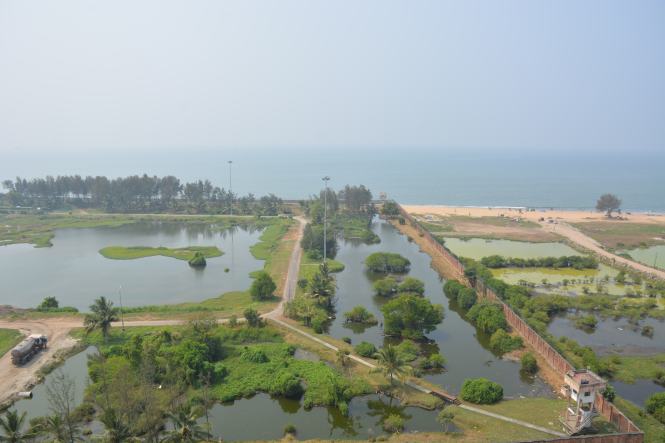
The views from the Kovilathal lighthouse are brilliant.

dsc_4541

dscn0559

Roomy has been a professional photographer and want to try some on us from the top of the Lighthouse, despite the low light.

dsc_4546


The compound of the Lighthouse has a colourful display of Whale-bones that they found nearby.

dsc_4560

The sands of Kerala in this area  contain some Rare Earth elements which are strategically important minerals which can separated from the sands on the beach. And the beauty of it is that the sand left behind is very white as against the black sand before the separation process.

dsc_4549

We also have a look at Kannakathu Devi temple before we retire for the day. This temple has a complex history which Nizar explained to me. On a certain festive day even males are required to dress like  woman to enter the temple.

Devotees who are desirous of having offspring offer replicas of cradles here to the goddess to help in the process. This is not the only place of this type in India. In this Blog we have already described another temple in Gujarat offering the same services.

dsc_4532

Here, allow me to jump a bit ( about 12 Kms) and go to Kollam for a brief visit to a Lighthouse and a fort and then return and do a detailed tour of Ashtamudi lake.

The Lighthouse at Kollam is a major attraction. For one, it is close to the the sea and it allows visitors, and it has a lift. What else do you want?

The views from this Lighthouse are really good. It attracts a large number of visitors largely because it has a lift.

dsc_4826

The city of Kollam can be fully viewed from here.

In this area, called Tangasseri , just before you reach the Lighthouse there is another important monument. In the year 1518 AD, 20 years after our friend VDG landed in India, the Portuguese built a fort here. This is known as St. Thomas Fort. It is is in bad shape but is being worked upon.Hope it comes back to life and survive.

In the next post we will take an interesting tour of Ashtamudi Lake.


Text by Suryakiran Naik

Pictures by Suryakiran Naik , Veena naik and one by Nizar Roomi.


81. GOD’S OWN COUNTRY – 9. Cherthala, Kumarkom, Aleppey

It is impossible to understand Kerala but if you want to understand a small bit of it in a short time, do what I say. Drive down from Kochi to Cherthala and then take a diversion westwards to Kumarakom and return back to Alappuzha. Those 82 unpretending kilometres will take you through a very representative sample of Goad’s Own Country.

Vivekananda called Kerala a ‘Madhouse’. I wish I were a Malayali and I would have sued him or his estate. If you look at how people behave here, you will note that they are the most rational people you can find.

Everywhere in India people with their bikes and cars would go as close as possible to the railway crossing, standing in the hot sun for the train to pass. Not here. These vehicles you see here are in the shadows of trees about 50 meters from the railway gate. If you know any more sensible people in this country, please let me know. I bet my life if anyone is so patient in Vivekananda’s home territory.

1

2

Kochi to Cherthala in the morning on the narrow coastal roads is a drive to remember. School buses and students are everywhere.

A channel of water runs parallel to the road and is navigable. Most of the bridge crossings are very low but the boatmen know how to do the crossing.

5

4

As you enter Cherthala, you will see a unique model of a Lighthouse. It is first one so far along India’s coast we have seen which is built on stilts.

3

Cherthala beach is quite good but better still is the creek where people are dredging for sand.

6

On the way we can see the Malayali ingenuity at work everywhere. For example this fish vendor has nets around his shop to prevent his fresh  fish jumping back into the see.

dscn0466

In fact it is to prevent theft of fish by crows.

Somehow during the drive we lost the Cherthala Cathedral and remembered it much later. By that time it was too late to come back. It is not on the main road.

We had booked a hotel room at Kottayam on a website. We drove all the way to Kottayam and beyond and could never trace it. We return back and find accommodation at KTDC Kumarkom within the Kumarkom Bird Sanctuary.

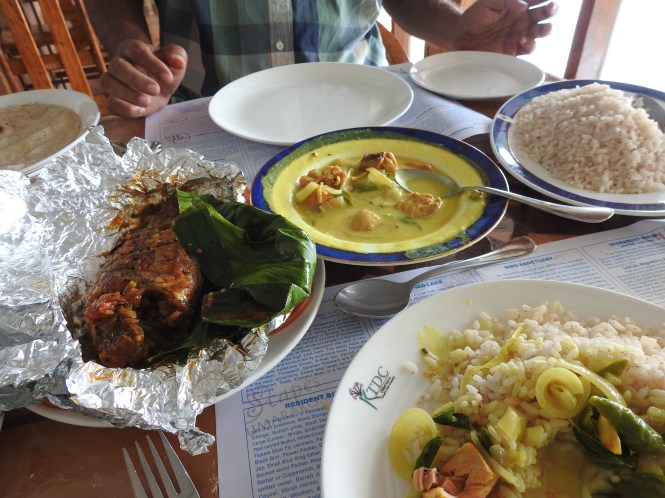
The stay at the resort start with lunch with Karimeen which we had missed earlier in northern Kerala.dscn0255

Karimmen Pollichathu and Fish Moilee with Boiled  Rice should be followed by a nice nap after the long drive from Kochi.

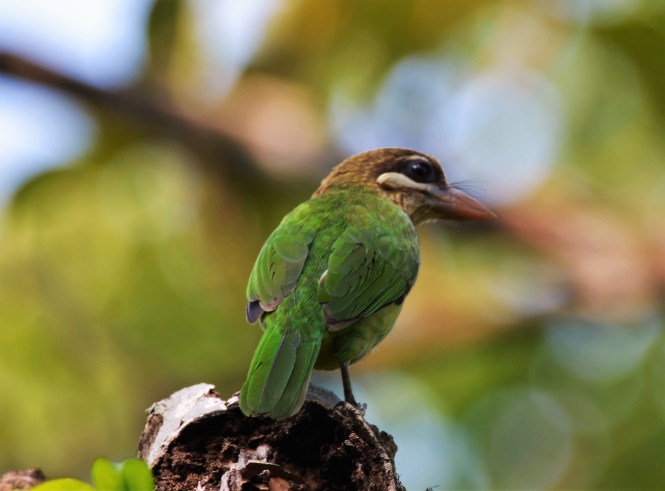
Come morning and it is birding time. Long walk through a dense vegetation by the side of the lake to find practically nothing. The day was saved by a Paradise Flycatcher, a Barbet at nest and a Racket-Tailed Drongo.

dsc_4214

White-Cheeked Barbet.


The lower one is my own bad photograph, not a painting.  Please note that the feathers are up to the lower left corner.It is an amazing bird.

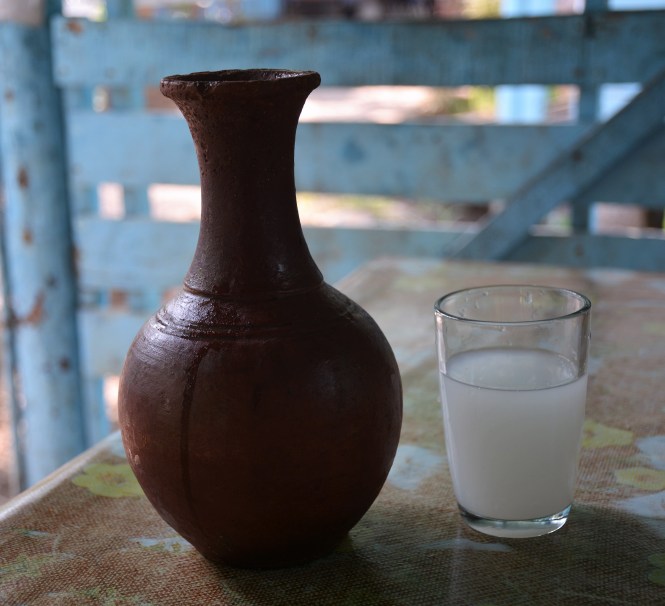
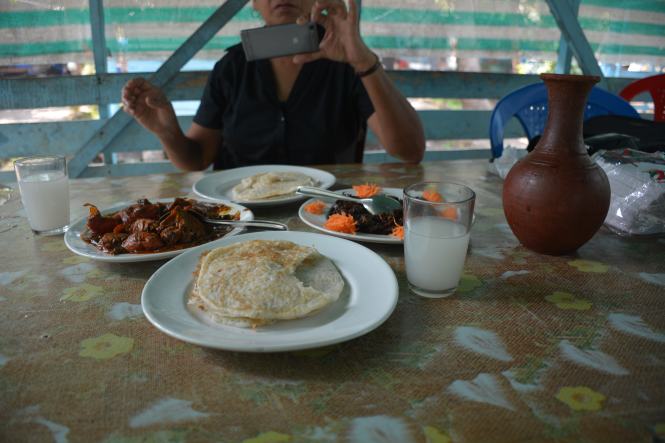
After the long walk till lunchtime, we deserve a good lunch which we decide to have it at a roadside local restaurant serving the local cuisine. It is a ‘Toddy Shop’

dsc_4238

Toddy, a sap from the Coconut ( and other palms) can be drunk before it is converted into an alcoholic drink. This is not to say that I have an aversion to alcoholic drinks.

What is served by way of food (our choice) is more amazing. Fresh Crab Curry, Fried Shell-fish (about this delicacy a little later) and the Dosa ( appam). In my considered opinion, one cannot have anything better than this to eat.

dsc_4240

What do you do after such a meal? You are right, sleep.

Get up and go for a boat ride in the lake. Kumarkom is perhaps the place from where the Great Kerala Backwaters Romance starts although it is possible to travel from Aleppey to Cochin up north by a Water-Bus.

dsc_4243

The waterway

dsc_4279

The boats in which one can live( air conditioning included)

And of course there are the Birds in the lake.

The large picture is of Snakebird or Anhinga , the upper right is the While-Breasted Kingfisher and the lower one is the Little Cormorant.

Now it is the time to leave Kumarkom but before we do so, there is a small advertisement around which we would like to respond to. It is about the fossilized (putrified) Driftwood.

Mrs Raji Punnoose was a Post-Graduate teacher in English on the Andaman Islands when her husband was working for the Ports Authorities. She collected a large number of specimen of Putrified Driftwood from the Andaman Sea.

These specimen are now displayed at the Bay Island Driftwood Museum at Kumarkom.

dsc_4311

The museum has its own building and deserves a visit.

dsc_4306

I am not conversant with this subject and would not like say anything beyond saying that the story and exhibits and the sound that they make are impressive.

XXXXXXXXXXXXXXXXXX

We reach Alleppey or Allapuzha late in the afternoon and catch up with the Lighthouse. There are two pictures below. The first one is the actual Lighthouse and the second is as it appears on a Postage Stamp issued by the Government of India. Never trust a Government.

The Lighthouse has a small Museum attached and the entrance fee includes the entrance to the museum. One should have a look at it especially if one is interested in understanding the Lights of a lighthouse. It displays the various types of the lights.

Get back to the town and go to the Backwaters.

dsc_4355

It is brilliant.The way the backwaters have been used for practically every aspect of the life of this region. More to come on this.

dsc_4369

The waterways have been used as roadways for the centuries. They have everything that a road has including the petrol bunk.

The operators dont have to carry the diesel in cans.

One of the things you should not miss when you are in Alleppey is the Coir Museum.

dsc_4377

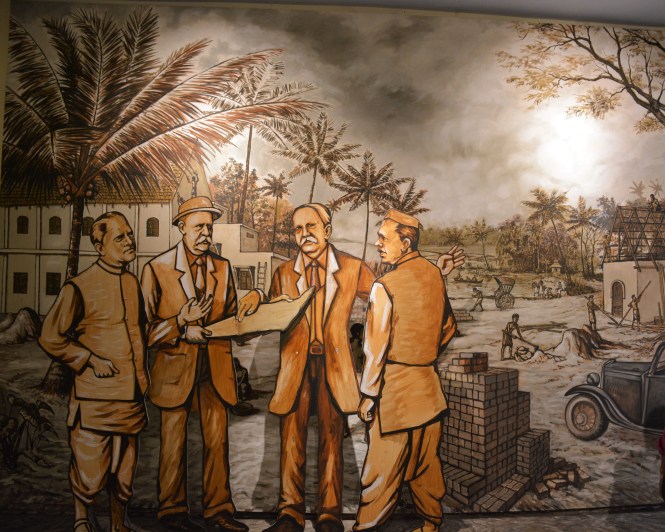
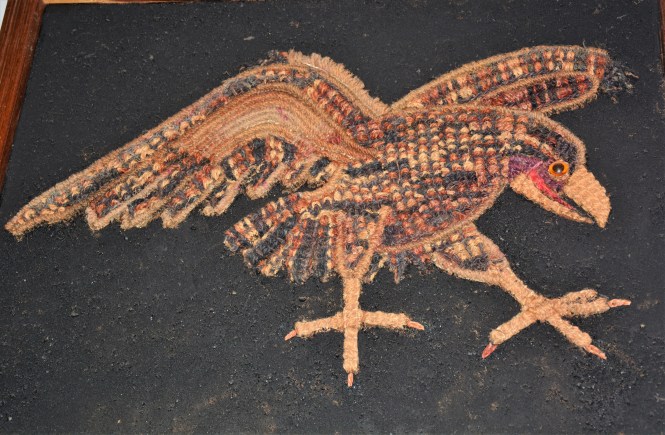
You enter the Museum and get a shock when you are told that the first coir factory in India was started with Europeans in 1859. I always thought that it is a ‘traditional’ industry going back many centuries. They were assisted by two Bengali Technicians who had expertise in the Jute industry. That establishes the connection. This is the second such shock to me after the discovery that the Mangalore tiles were invented by a Swedish missionary.

dsc_4381

James Darragh and Henry Small establishing the first Coir factory in 1859.

The Museum is exhaustive in the sense that it displays the history and the processing involved in the industry.

It has a workshop and Training Centre for the Industry and it displays a very large number of items that can be manufactured using coir.

dsc_4440

Kerala has unending festivals.One enjoys the sights even without understanding what is going on.

The people here are master inventors.

What do you do when the falling fruits of your coconut palm damage your roof tiles?

What do you do when your neighbours steal the falling coconuts?

This is what you do!!.

dsc_4266

Text by Suryakiran Naik suryakiran.naik@gmail.com

Pictures by Suryakiran Naik & Veena Naik

80. GOD’S OWN COUNTRY – 8. Ernakulam. Kochi.

It would have been easier for everyone if the district would have been called Kochin instead of Ernakulam. But, no. Goad’s Own Country does not follow the ordinary rules. For everything there is a reason and there is a history.

I started the previous paragraph to write about Cochin. If I had written it as Kochi in my school days, Mr. Pillai our geography teacher would have thrashed me for wrongly spelling his hometown. That was in 1970s. Cochin became Kochi in 1996.

Kochi is often called the Queen of Arabian Sea. It came into prominence from 1341 AD onwards when the then major port north of Kochin called Muziris was destroyed in a major flooding.  Remember this place ? this is where St Thomas landed from the Middle East with the message from the new Messanger of God? Here we are talking of 14th century when the sea route to India via Cape was not discovered. However, the city was known to the Romans, Greeks, Jews, Chinese and Arabs of course. The first three were using a combination of land and sea routes. The guy called Vasco da Gama who used the exclusively sea route around the   came much later.

We (No, Vasco is not with us these days) start early morning from Ernakulam and start exploring the district from the northern side. The first stop is Santa Cruz Cathedral. Majestic structure with an imposing view as you approach it.

dsc_3759

Santa Cruz cathedral


Idols are aplenty around. Beautiful.

Vypin island and Cherai beach follows.

A lot of history must be hidden in the islands of Ernakulam district. A lot.

dsc_3783

This is the place from where you start seeing the Chinese Fishing Nets. Why from here? I dont know but I will write a bit about these nets a little later.

Vypin Island has a small beach and a nice little Church.

dsc_3794

But the place is dominated by the CFNs, I mean Chinese Fishing Nets. The CFNs that you see in the picture postcards are located on the Vypin island but the shot from the opposite side , Cochi town. Let me add a picture here from Vypin proper.

dsc_3784

Chinese Fishing Nets

Pallipuram Fort is the northernmost place in Ernakulam. To the north is another part of history – Kodangallore-Muziris Axis.

This place was built by the Portuguese in 1503 and is now considered as the oldest surviving European built structure in India. Congratulations, Pallipuram. it was owned by the Portuguese, the Dutch, the English and the local Kings at various times in history. It was taken over by the Indian government not from the British but from the Travancore kings.

It is not easy to visit this place. That explains why it is not on the Tourists Menu. It takes the grit of TheBlueDrive to find such places and actually visit them, not post the borrowed pictures.

It was risky to park the car on the extremely busy and very narrow road. There is no option.

It is to the credit of Kerala Dept. of Archaeology that the fort is still in good shape.

dsc_3810

dsc_3817

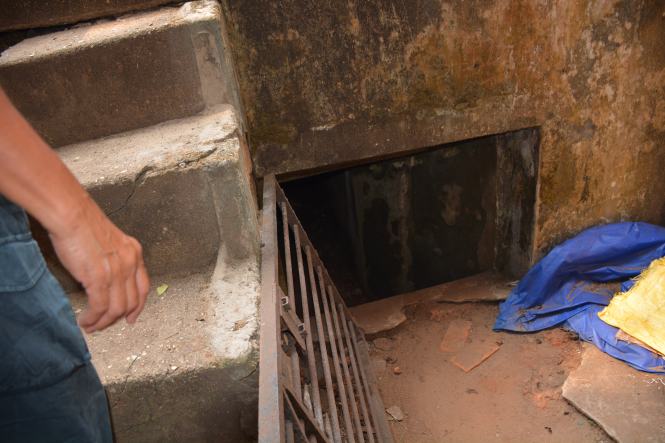
The creek is very close to the fort. As usual there is no information available at site but the lady who was cleaning the place showed us what appears like an underground passage that perhaps led to the creek waters in the past.

dsc_3819

dsc_3816

Our next stop is the Vypin Lighthouse. If you are allowed to visit only one place in Kerala before you are executed, opt for the Top of Vypin Lighthouse.

Here is why:

dsc_3825

dsc_3826

dsc_3830

Water is everywhere , so are the Goads.

The lighthouse itself is infested with young people with their Android phones taking ‘selfies’ with their friends .The reason for the popularity of the lighthouse ? it is among a very few in India which has a lift. TheBlueDrive with average age of 60 climb most of them with or without lift ( for the benefit of the Americans, Lift means Elevators). Anyway, from the outside the Lighthouse looks like this.

Cochi has so much history that there is very little place for anything else. The Mattancherry Palace. ( Cameras not allowed inside, so very little can be shared).

The Cochin Fort abutting the beach.

You walk along the beach and find a place called ‘Gunnery’. Logically it should have been a part of the Fort and inside the ramparts.

And then a few meters away something the Dutch are famous for in India- Cementaries.The Dutch cementaries are the best European resting places in India. I can say this the benefit of having seen most of them.

 How can I ignore the 511 years old Santa Cruz Basilica?

Heart of Jesus Church.

dsc_3869

On the Mattanchery side is the Jew Town which is a bazar but still has the old buidings including the Synagogue. They no longer allow you photograph inside the Synagogue but  I still have the ‘negatives’ of the film of the previous visit when we used to use ‘film’ for photographing. I need to go back into my archives and find them.

dsc_3937

The Synagogue


The fear of the dead is inversely proportional to the time elapsed from the date of death. The recently demised invoke more fear than those who died in the distant past. The people of Kochi are closing in on the Jewish graves. They are not likely to be here for long.

Kochi has at least three Museums. The Mattanchery Palace Museum and the Indo-Poruguese Museum do not allow photography. The third museum is the Maritime History Museum of Indian Navy. If you want to uderstand the Maritime history and the major players on the western seaboard of India, a visit is to this museum is a must.

Apart from the major players the museum allows us a peek into the types of boats and vessels used in ancient times.

Apart from this the exhibits trace the history of Indian Navy and also the European fortifications on India’s coast.

Thed details are beyond the scope of this blog. Suffice it to say that a visit is recommened.

There are many other aspects of Ernakulam/Cochin life which need to be writen about. To limit the size of the post I will be merging them with other places as we go along as many of the aspects overlap. The Chinese Fishing Nets and the Fish Sellers of Kerala are aming them.

Please allow me conclude this post here.

Text and Pictures by Suryakiran Naik

79. GOD’S OWN COUNTRY – 7. Thrissur, Chalakudy.

In the previous post, we had covered most important coastal parts of Thrissur district. What we did not touch on was the city of Thrissur.

Thrissur or what was earlier known as Trichur is called the cultural capital of Kerala. It has a number of religious institutions and was once a major centre of Hindu religious education. It is also important for some Christian denominations.

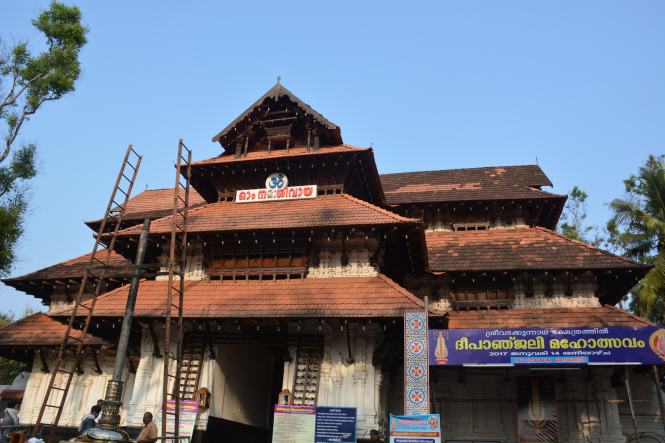
The town appears to have been built around a temple complex with huge grounds which serve as grounds for numerous socio-cultural activities. It is also the ground for the annual festival of Pooram. All those decorated elephants that you see in the tourist brochures are from here. The festival relates to Shri Vadakkunathan Temple which is the most important shrine in the city.

It is an imposing temple and nicely maintained.

dsc_3311

Peacock feathers are still sold openly in the compound of the temple.

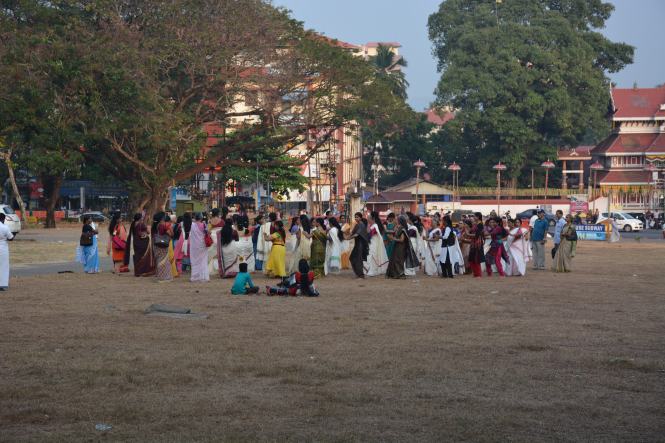
The area around the temple is used for various activities like practicing for group dance.

dsc_3363

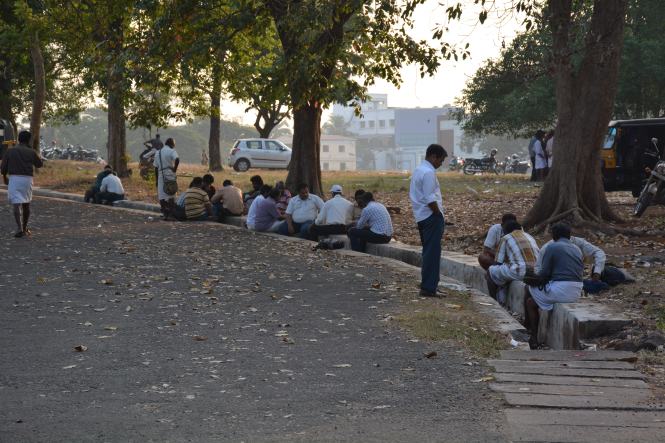
The people seating here in small clusters are not gossiping. They are playing Chess.

dsc_3354

There is a second temple on the backside of the main temple here. It was late and I could not gather the details.

dsc_3366

If you have interest in them the compound sports a few species of birds. Here is a Tree-Pie and a Barbet.

dscn0012

dsc_3331

The skyline of the town is dominated by the Basilica of Our Lady of Dolours has the tallest church building in India. It belongs to the Syro-Malabar Catholic Church and dates back to 1814, 200+ years old.

dsc_3359

Thrissur also has a Chaldean Syrian Church which belongs to the St Thomas Christians who trace their origins to Thomas the Apostle who came to India in 58 AD.

dsc_3389

Thrissur has a couple of  Museums. Even the small towns in Kerala sport a small museum. The Keralites appear to chrish their past of which they are justifiably proud. We had to skip the museums for paucity of time , except for the museum at Sakhtan Thampooran Palace. It is a small museum and could have been skipped in favour of the Museum of Art.

The place was actually a fort and some signs of the same are still visible in the noise of the Bus Station on the opposite side of road. The Palace is in solid teakwood and a beauty in simplicity, characterestic of Kerala.The contents of the museum has not much to write home about.

Thrissur town is not located on the seashore but the district has a few beaches. Snehatheeram is one of the newly developed one. Getting to the beaches on the seaboard from the highway is a challenge. At Snehatheeram beach, this restaurant roof is made entirely of the Coconut leaves, a rarity these days.

dsc_3286

TheBlueDrive is a coastal journey and we have avoided the temptation to drive some distance towards the hills which are greener and cooler, especially in the Western Ghats. An urge to do some forest birding takes us to Chalkudy which by itself is not far from the coast but the Ethirapally falls that we visit are.

If you have been watching Indian movies, especially the Soth Indian ones, you will have seen Ethirapally falls.

To reach this place one has to do quite a bit of descend and then a steep climb.

The forest area of Vazhachal is quite extensive and has waterfalls at three places. Two are not as spectacular as the one above.

On the way is the Thumboormuzhy River Garden with a hanging bridge.

dsc_3736The hills of the Western Ghats are spectacular and beautiful but are outside the scope of our present travel programme which is cover the entire coast of continental India. May be another time.

Our objective in coming to the hills was to do some birding. We stayed at Chalakudy in the plains and drove into the hills which took time and consequently we did not have the best of the birding time. That is not to say we did not see anything at all.

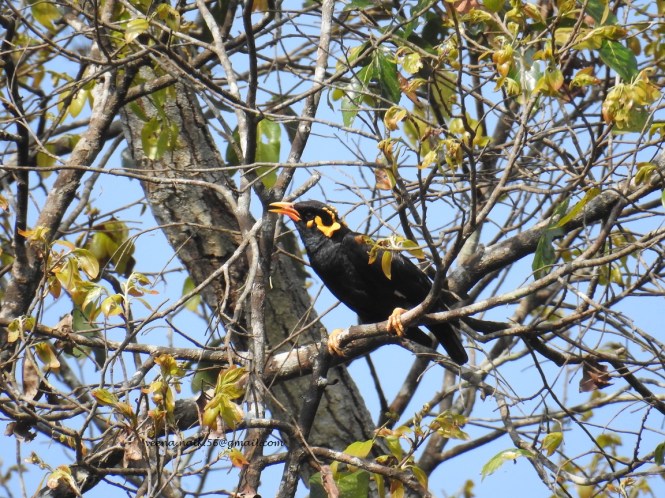
The Hill Mynah, not a easy bird to come by was there to welcome us.

dscn0049

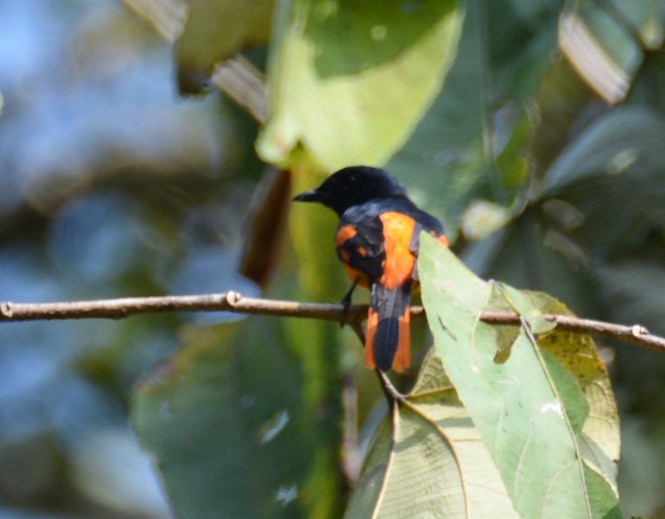
My old friend Scarlet Minivet was perching high up in the canopy.

dsc_3535.

The Black Capped Kingfisher, normally found near the sea was not expected at the high altitudes but was found enjoying himself in the cool stream waters.

dscn0069

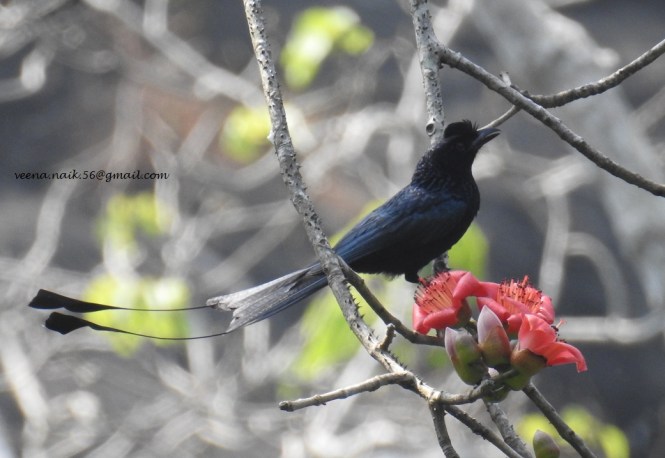
The Racket-Tailed Drongo had the insects on the newly opened flowers of Silk-Cotton tree to feed on.

dscn0111

The Pond Heron,proabably the commonest bird in India after the House Crow was seen enjoying himself in the flowing waters.

dsc_3622

We return to our base at Chalakudy and have a late lunch. At the restaurant on the highway we find some ‘Cutlates’, which we decide against and go in for ‘Meals’.

dsc_3752

The digression is not over. We have to get back to serious work now. The next stop is the great historical city of Cochin and the district of Ernakulam of which it is a part.

Text and Photographs by Suryakiran Naik

Additional Photographs; Veena Naik


78. GOD’S OWN COUNTRY – 6. Malappuram & Thrissur.

TheBlueDrive uses, as far as possible, the headquarters of the districts travelled along the coast as the place to spend the nights. Sometimes the district place is not convenient for the stay or it is far off the coast and, a town closer to the coast is chosen. In fact, this journey started from the district of Kutch and the district HQ are far off the coast and we stayed in a Gurdwara in a Village Panchayat area. Later on, in these travels we have had opportunities to spend the nights in very small places. Here is another one.

Malappuram our next district’s HQ is not on the seashore and our limit is 30 Kms. from the seashore to prevent ourselves straying all over the country. The obvious choice is Ponnani. ‘Pon’ in Malayalam means gold and Ponnani probably means the land of gold. The entire west coast of India seems to have been engaged in trading with the rest of the world in the past and was rich. Signs of the same are found in many places.

If you want to get out of Calicut district made famous by the great Vasco da Gama and others, you need to cross the bridge on the river Ferok. If you have the time and the inclination, please walk along the pedestrian bridge along the main narrow vehicle bridge. It will allow you some nice views of the river and the Tile factories along its banks.

dsc_3086

2

3

We drive along an amorphous and highly confusing road called Tipu Sultan Road. Some stretches of this road are a pleasure to drive on. It goes on and on along the coast and we end up at a place which we thought or expected would have a bridge to cross over to Ponnani beach. We find, not surprisingly, it does not exist. The geography pf the place looks like this on the Google map.

dsc_8351

We end up on the beach at Padinjarekkara. Nice place. One has to pay to enter it. One can see the beach at Ponnani on the opposite shore not very far. The boats are plying in the creek. They might be taking people (not cars) on the opposite side.

5


4

 The boats here practice the fine art of towing other boats. One can see the Ponnani Lighthouse from here.

6

After this we back to the highway and return to the opposite (southern ) side. This takes us about two hours of driving. We enter Ponnani, a modest town and find accommodation at a nice hotel. It is a surprising place for such a small town.

dsc_3169

Although Ponnani was once a part of the ancient trading network, not much is left of the distant past. One extant monument is the Ponnani Valiya Pally, a masjid built in 1518 AD by  Shaikh Zainudin Makhdum who apparently was a rich Arab mechant.

Please note that by 1518 AD the Portuguese were already establishing themselves in the Malabar coast. The Arab trade seems to have continued simultaneously amid the politics and the wars.

The masjid is built the old Kerala architectural style. Some scholars believe that these old masjids of Kerala were built in the  principles of Buddhist Chaitya Vastu, In this blog we have visited 4 such masjids earlier and this is the 5th. More to come.

dsc_3149As non-muslims are now allowed in the masjids, there is no question of an Atheist being allowed. Logically I should not have been allowed within several kilometers of the site.  I had to confine myself to some external pictures.

At the rear the masjid has a water tank which resembles one associated with temples in many parts of India.

The next place we visit is the Lighthouse which we had seen from across the creek earlier. This is a nice structure.

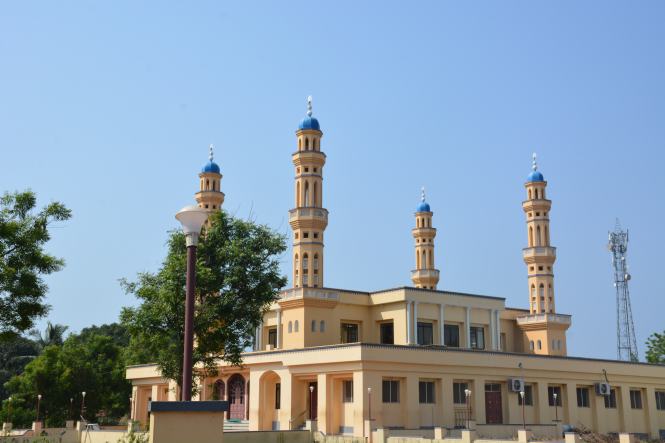
The town has another modern Masjid with Minars. It looks good but lacks the charm of the old Valiya Pally.

dsc_3124

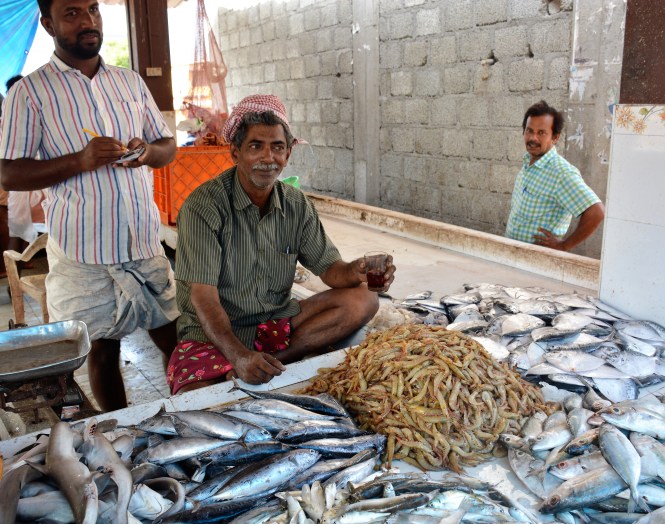
Opposite this mosque is my favourite place, the Fish Market

We come across this broad and flat silvery grey colour fish for the first time here. You would probably not find it in the northern parts. This is perhaps a resident of the Laccadive Sea.

Ibrahim insists that he be photographed with his stock in trade. He tells me the Malayalam names of all the fishes he sells. Unfortunately I have misplaced my notes.

dsc_3133

We decide to leave Ponnani after tasting the soft kernels of Tala (Borassus) palm. They are delicately soft but not  sweet. each fruit has 4 of them neatly packed inside.

dsc_3134

We leave Ponnani and enter the district of Thrissur (ex-Trichur).

If Kerala is God’s Own Country, the district of Thrissur (earlier known by the anglicized name of Trichur) is God’s own private Resort. God and His Prophets has sent their emissaries to this district with alarming regularity and consistency.

To start with, Lord Krishna  has an abode in the Holy District of Thrissur located at the town of Guruvayur. This place is considered as the most important of all the Vaishnavite sites in Southern part of India and has a huge number of visitors. Just about everyone who calls himself Hindu rushes to this temple.


It is a nice temple with a huge number of shops selling a huge number of things, mostly made in China. Can you imagine China benefitting from the Vaishnavite branch of Hindu religion? I salute them. I mean the Chinese.  I will not be surprised to see a Chinese-made idol installed here in course of time.

There is hall showing all ‘Avatars’ of Lord Vishnu in idol forms.Here are 4 of them.

The administration the temple has the temerity to ask an old friend of their Lord to dress in a particular way and deny permission to take in his cameras. Worst of all they ask me to remove my shirt. That I refuse to do. I  discard the Dhoti and become normal again.I have some decency still left in me.  I know how and when to meet my old friend. I am not at the mercy of the temple authorities. If your customer service is not good I move on to the next place. At the next place  I find St Thomas who does not impose a Dress Code and such silly restrictions. His ‘security’ does not ask you to remove your shirt.

dscn9963

Let us move on. The greatest advantage of Hindu history, Hindu religion and Hindu Gods  over the others is that they are undated. When you talk of Jesus Christ or Prophet Mohammed, there is a specific date as reference  in AD or AH. That gives them away. They are pinned down to history. Has anyone asked about the year of birth of Lord Krishna? Try asking it. You will get answers ranging from ‘before the beginning of the universe’ to ‘before the beginning of time’, ‘Long long time ago’, ‘you dont know these things’ etc. People however know the day of the birth in the lunar calendar.

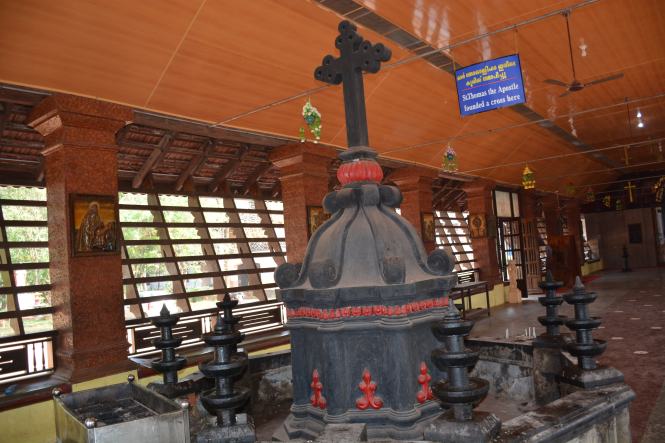
As Christians don’t have this advantage with reference to their Prophet they are stuck with a big problem. St Thomas the Apostle came to Kerala in 58 AD. He founded a Church or a Cross here and established 6 other churches. St Thomas was the direct disciple of Christ. If he established the Cross here in 58 AD , he would have been quite old by that time but he still had the energy and time to establish 6 others.

dsc_3226

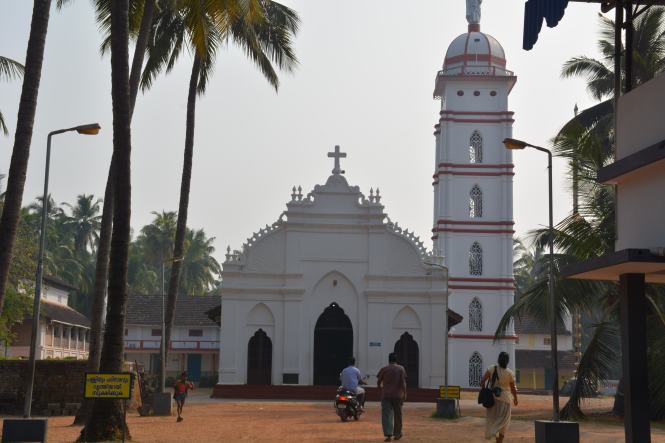
I am not here in the God’s Own Country to get into these silly little controversies.What St Thomas did is not short of a miracle. It is not easy to travel in Kerala and Tamilnadu even now and St Thomas did it around 2000 years ago and also established 7 churches. It is said that his place of landing (by boat of course) is Muziri which in turn is supposed to be somewhere near Kodungallur. A replica of the boat is found here in Palayur,

dsc_3227

The church compound at Palayur we are referring to also has a museum and statuary displaying some incidences in the Saint’s life which include ‘pacifying’ an elephant and a tiger.

Anyway. St Thomas installed a cross opposite Marhaba Chicken Centre. This is claimed to be the first Christian establishment in Asia.

dsc_3184

Here is the Cross:

dsc_3234

Unmistakable Kerala woodwork all around and the stonework to support it. Perfect ventilation. No complaints. Thank you, sir.

Here are the other related structures:

dsc_3228

I have referred to this place as a ‘Church’ although officially it is  St. Thomas Archdiocesan Shrine.

dsc_3183

The place where St Thomas is reported to have landed is called Muziri. It is said that this was the greatest port in ancient times and a busy trading place where people from Egypt, Middle East and Europe (then Roman Empire) visited. In Kerala they even organize a Muziri Festival. The problem is nobody knows where Muziri is or was. It is speculated that it was around the place called Kodungallur.

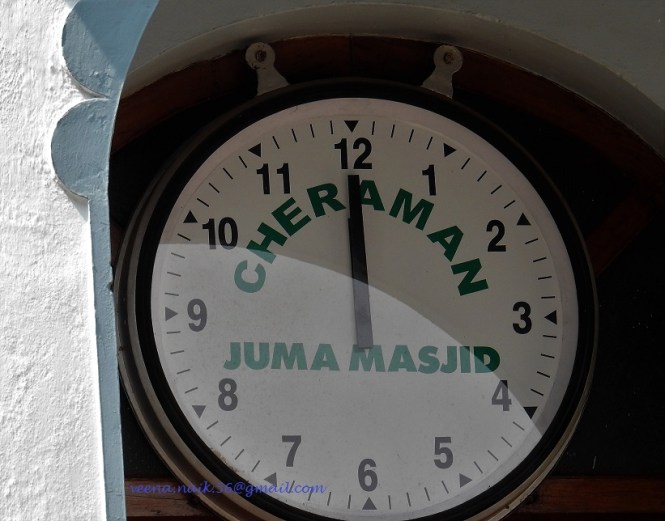
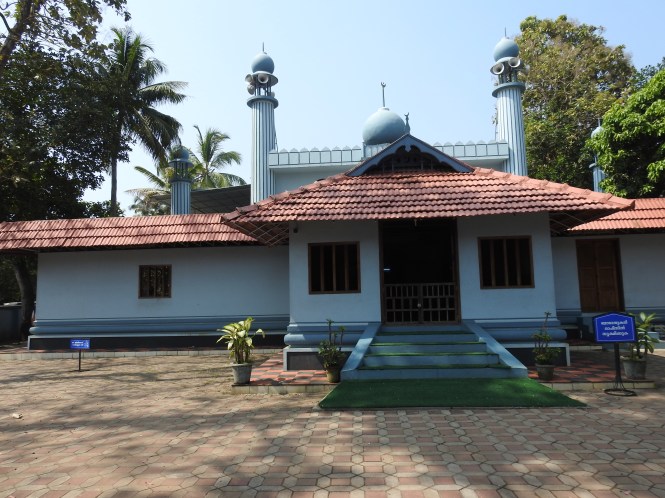
Welcome to Kodungallur. Here we find what is claimed as the first Mosque or Masjid in India and 3rd in the world.

Cheraman Juma Masjid is claimed to have been set up by Malik Dinar a contemporary and a follower of Prophet Mohammed and  also a rich merchant. That makes sense as Prophet Mohammed himself was a merchant.dscn0025

dscn0024I must confess here that the management of the Masjid was good to me. Despite my telling them that I am not a muslim and not likely to be one, they allowed me to go inside. No, not with my wife of course and not inside the sanctum.

About this Masjid and a few others in Kerala and one in Tamil Nadu, I would be making a separate post as there is a lot to be written about them.

So let us now move to another place in Thrissur district. How about a Jewish Synagogue?

It is here, the oldest Synagogue in India.

dsc_3476

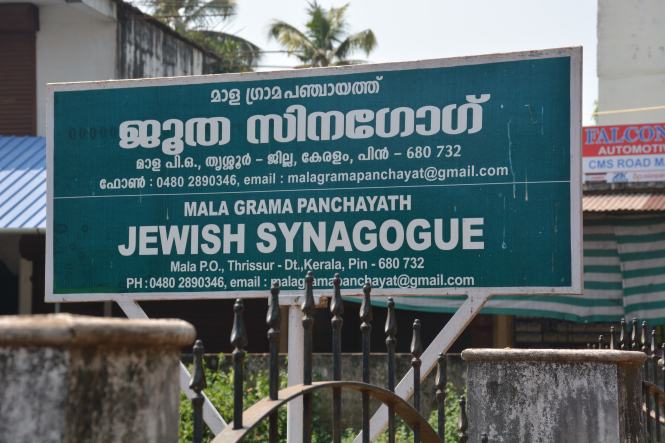
At a place called Mala, the Malabar Jews established the oldest surviving Synagogue in the 11th century. Jews are much older than the Christians and Muslims but the Synagogue is not. Secondly the Synagogue is not in use since 1955 when the Jews decided to migrate the Israel.

Despite their absence, the place is kept is neat and clean but does not have space around it. This is what the urban congestion does to the old monuments in many parts of the world.

Now you should have some idea about why I am calling  this district the God’s Private Resort. And remember we have not even reached the district Headquarters of Thrissur. There is more Thrissur to come but allow me to stop this post here.

Text &Pictures : Suryakiran Naik

Pictures : Veena Naik


77. GOD’S OWN COUNTRY – 5. The Passenger Bus Art.

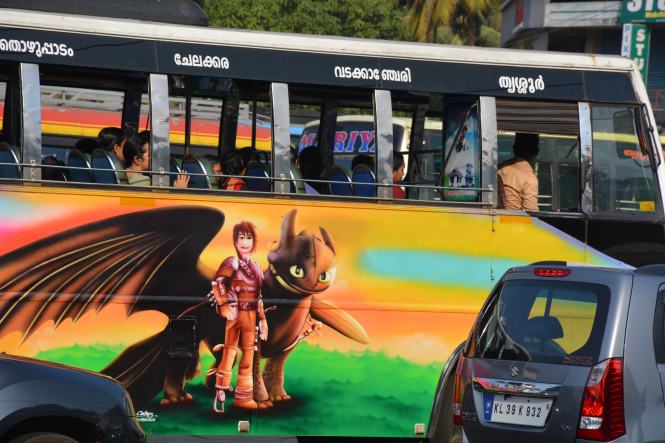
If you are travelling by road in Kerala, especially in the northern and the central parts, you will find a striking art form. The painted buses. The Goad’s Own Country has a reputation for art of various kinds – spanning from the interpretation of the Epics to the War dances. Perhaps this form of art shall be the one for the future chroniclers of history to record. I am just wondering if I could be the avant garde of these chroniclers and record for the sake of posterity the extraordinarily genre of art that has spawned here. Extraordinary because it is moving and can be accessed by all and sundry without a charge.

1

 What is more surprising about this phenomenon is the fact that it is confined only to the northern and the central parts of Kerala and totally absent in Southern part of Goad’s primary domain. Perhaps this has something to do with the ownership pattern in these districts. Incidentally it is surprising that the people living in this part of the world like their own small worlds. Before the Abominable White Man landed on the coast of India in search of spices, Goad’s Own Country was ruled by 104 Kings or king-types. I need to calculate the average territory for each of them. This is precisely what led to the colonization of India by the Europeans in the initial stages. Anyway this is not the subject of the present post. Here are some samples of the plastic art.


The private tourist buses owned by the Thambis in neighbouring Tamil Nadu display a similar tendency but cannot match Annas’ ingenuity. We will add some of them at the end of the post but right now let us look at the topics on display in Kerala.

Here if you getting married they hang the pictures of the bride and bridegroom in the front to prevent any claims to the bride  by the usurpers. The bus then moves with the marriage party without an hindrance.

25

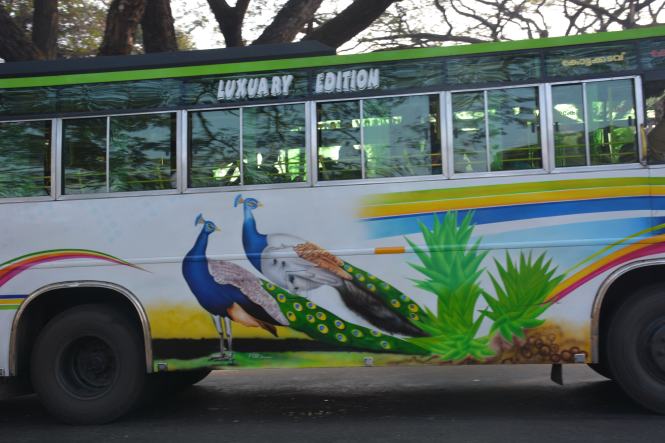
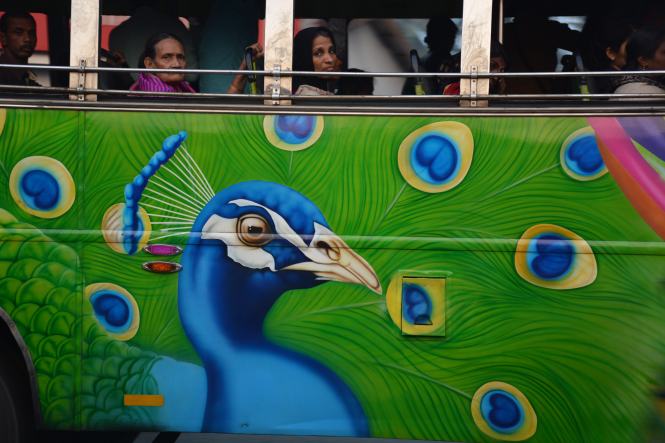
If you analyse the topics which are depicted on the sides of these buses, the BIRDS (known as ‘berds’ in this part of the world) take the lion’s share. You have all types and varieties except those found in Kerala.

The honourable exception was the National Bird of the country  which did appear at one or two places but did not look very convincing.It appeared to be imported from China.

b6

b1

There are the others like pigeons as well.

dsc_3442

I was expecting a lot of fishes to appear in this art. Unfortunately there were none except a few inedible varieites that go into the glass tanks, not into the stomach.

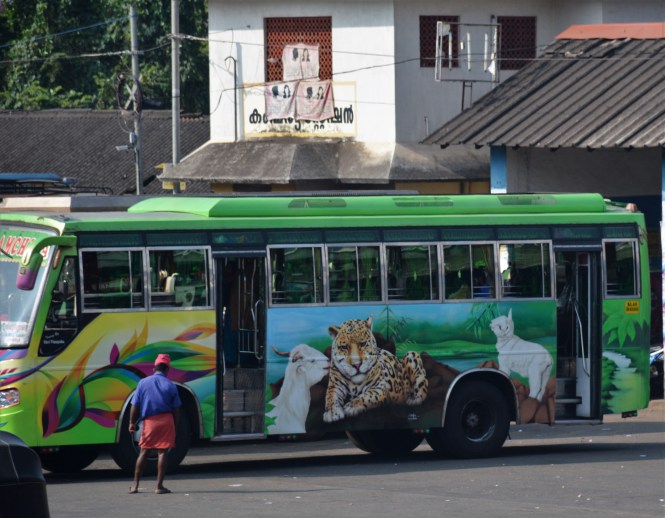
The mammals are not  many but look good.

Here is a butterfly:

dsc_3403

And this extraordinary bon homie among the hunter and the hunted.I would definitely like to travel by this bus.

dsc_3439

Some fruits acompanied by the Penguins entice the passengers to travel by the bus.They are convincing coolants.

DSC_3428.JPG

The fearsome prehistoric animals are very impressionable. The younger crowd would like to travel by these buses irrespective of their destination.

dsc_3431

The characters from the world of fiction also have the same appeal.

dsc_3436

dsc_3446

The cartoon characters are there, of course.

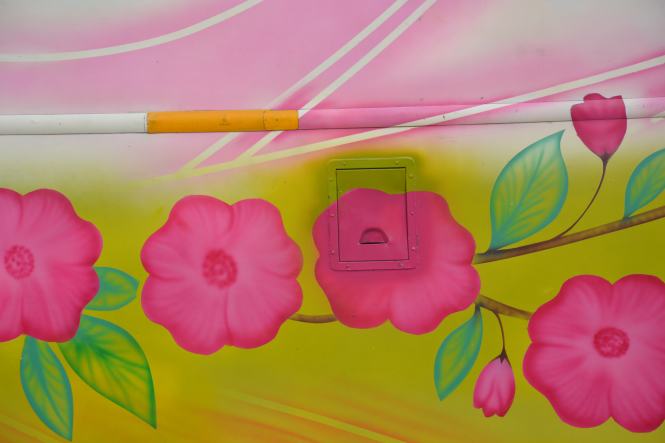
Flowers- the number is below expectations:

dsc_3417

The vague kind of things – neither here nor there.

The Woman. Surprisingly absent from this form of art except in a stay and vague incidence of Chinese intrusion:

dsc_3429

Some very vague kind of ‘modern’ art.

On the picture that follows I have an observation to record.

I was on the roadside whilst my wife was at the beautician. That will give you some idea of the time I was there. There was a lady waiting for the bus. She did not board until a bus with colours matching with her dress came along.

3

Text and Pictures: suryakiran.naik@gmail.com


76. GOD’S OWN COUNTRY – 4. Calicut..Kohikode.

If you say ‘ Calicut ‘ today, even in Kerala, people would look at you with patriotic eyebrows raised. The name has been changed, man.  Kohikode (pronounced kohikod by the touts at the bus stations looking for passengers) would be a more acceptable nomenclature. However, if you are a student of Indian history and more precisely colonial Indian History, there is no way you could have escaped the town Calicut. This town and the area around has seen all those those bearded White Men with their sailing ships descending by the dozens on the pristine sandy beaches. And before that the bearded Arabs in their Dhows and before that the bearded Romans coming in for the spices? and in between the Africans (not bearded. Have you seen a bearded African?) brought along by the Arabs. Just about everybody came here except perhaps the Eskimos.

TheBlueDrive is a travel diary, not an expedition to explore the history of the country. We therefore need to be humble and stick to our brief (without foregoing the right to record and comment on what we see). What we see is mostly the following:

Fishing Harbors. Lighthouses. Seaside Forts. Temples, Mosques and Churches (with an occasional Synagogue thrown in) , Food, plant and animal life, more particularly Bird life, Monuments not attached to any religion ( which is very rare in this country) and a few other things that one sees whilst travelling.

KOHIKODE (Calicut)  seems to have a little of everything and much more- a very distinctly superior air of historical importance.

We start on 1st of January from a disastrous celebration of the New Year at Mahe and drive down southwards to look at a fishing harbor at Chombal in Kohikode district. A protected fishing harbor and quite a busy place, despite it being 1st of January.We have a look around and check on the retail prices. The prices are dictated by the fish species which works against the fisherman. If a trawler has a bumper catch of the low-value fish like the red one below would be a disadvantage as compared to another one which has a lean catch of high value fish.

It has a monument to Fishermen. I don’t remember having seen any such monument except one at Alibaug in Maharashtra where we have a woman selling fish sculpted. It is unfortunate that the birds have been misusing the monument. They do it everywhere.The fisher folks deserve a better deal than these small monuments.

4

The Google map shows a small island called Chombala Rock Island. The fisher folks did not seem to have any knowledge of it or could not understand what we were talking about. We decided to drop the subject after some discussions.

We move on and drive south with a view to have a look at Kunjali Marakkar’s place which is at Iringal with a complex geography created by the River Kuttiyadi meeting the sea and creating several islands at its mouth. This would be extremely helpful in honing the navigational skills of the Marakkars. But for us , things are not made easy by the winding roads and the crossings of Indian Railways’ track.

Kunjali Marakkar is a title, not the name of a person. There were four of them. The origins of the followers or these seafarers are shrouded in mystery but were probably Arabs or Egyptians who had settled down around Kochin. The Portuguese drove them up north to Calicut where the Zamorin, the Samoothiri Raja welcomed them in the kingdom and made their leader the Admiral of his fleet.

The museum is maintained by the Department of Archaeology of the Kerala State. That explains too many people there and very little content.

Of late, there are many public places have  been disallowing photography inside the premises. This establishment is one of them and we do not have pictures of what is displayed which is not much.

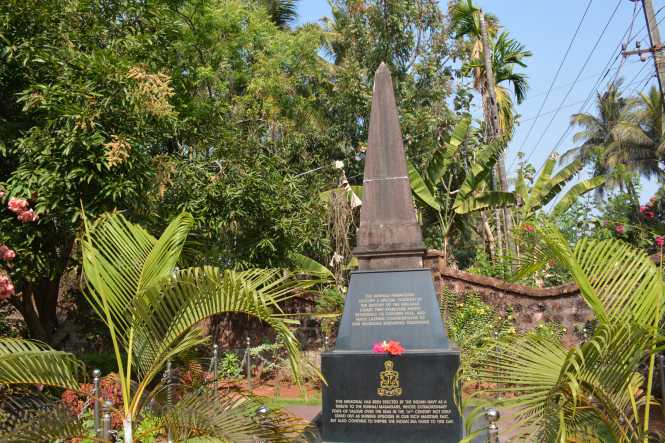
Indian Navy has erected a monument in respect of the Marakkars on the premises.
dsc_2887

Notwithstanding the poverty of the museum in terms of contents, this small museum has a small garden with a number of beautiful flowering plants which are not deprived of the privilege to be photographed.

The people at the Museum are very friendly. They have a small function arranged ( perhaps to celebrate the new year)  to which a couple of local political leaders are invited. We are asked to join. A cake is cut and when long speeches in Malayalam start We excuse ourselves and proceed to the Kunjali Marakkar mosque, of course after eating our pieces of the cake and having the tea.

dsc_2893

Here one should remember a few things. The Zamorin was a Hindu King, the Marakkars were Muslims. Their alliance was one of convenience which did not last long. The Zamorin aligned with erstwhile enemies including the Portuguese. The alignment fell apart but the Marakkars continued fighting the Portuguese. The last of them is said to have been captured by the Portuguese and beheaded in Goa. I need to learn more about it but the young man at the museum showed me this picture as as the reference for Goa episode in this part of the history.

dsc_2890

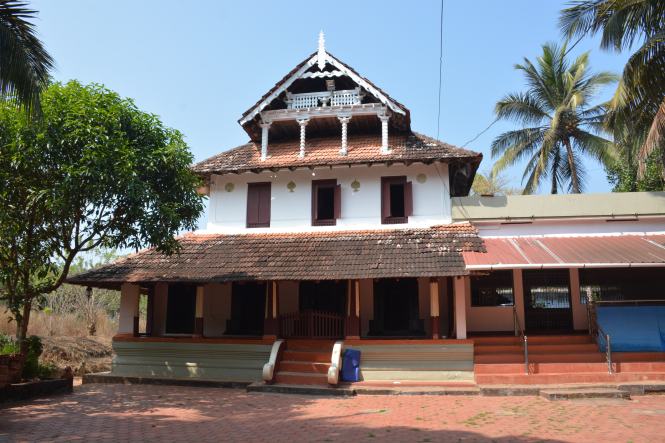
History in depth, as I said earlier, is not the brief of this travel. However we keep on driving into history. The mosque of the Marakkars is close by the Museum. It is not very difficult to reach it but unfortunately there is not much information available. I repeat for the nth time that we Indians are not good at recording and preserving our past. No, not at all.

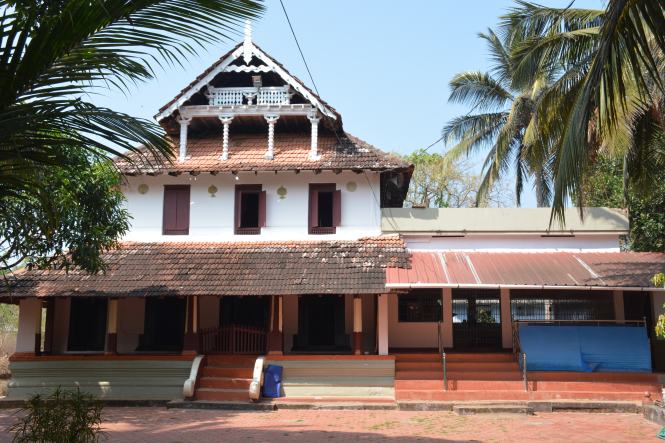
Anyway the mosque looks like this:
dsc_2902

By now we have seen almost all the olden mosques ( 500+years or older) ,and this must be the northernmost built in the Kerala architectural style without the Arabic Minars.
dsc_2904

This does not appear to be the original construction, especially the roof which has the Mangalore tiles which appeared on the scene much later in the history.

More about these early mosques of Kerala and Tamilnadu in a later post.

Now, we want to have a look at the mouth of the river Kuttiyadi as it is preparing to drain into the Arabian ocean. And here it is. This is beginning of the beauty of Kerala backwaters, just the beginning:

At the place where the river meets the sea, the waters should be rich in minerals. The banks of the river are farmed for large quantities of shells for commercial use.

Whilst on the coast and before we get back to the Highway, we decide to have a look at the Cuddalore Lighthouse. We are mis-directed to several places on account of our not understanding Malayalam and even those places were beautiful even in their collapse.

Now we move on we with great difficulty on the narrow winding roads and somehow reach the Cuddalore Lighthouse passing an Islamic Academy on the way.

The lighthouse is closed and we can take some pictures from outside the gate..


I have decided to become a Buddhist with immediate effect because that entitles me for a rebirth.  Modern religions like Islam and Christianity do not offer this facility as of now. They should have a re look at their policies. There is a big demand in this sector.

My application for becoming a Buddhist will be accompanied by an application for employment at a Lighthouse. I guarantee you there is no better employment than that. Take my word for it. I am saying this after visiting a very large number of lighthouses. These guys enjoy their life! Ask them what they do the whole day!!

We move on or drive on, to be precise. We pass by the road to Payyoli, P T Usha’s hometown and reach Calicut. Payyoli Express- do you remember?

By an error we booked ourselves at a hotel which  is far away from the city. This happened because the same hotel has another property in the city. The place where we are put up is quite far from the town and nearer the airport.

This place is supposed to have a Bird Sanctuary nearby which led us astray. Birds in Kerala are called berds. Please note. You should not be surprised as even the God is called Goad, to rhyme with boat and Goat. So the God’s Own Country should be Goad’s Own Country, to reflect the reality.

So the first thing we do after check-in in is to go for the Berd Sanctuary. It is located on two sides of a railway track and there are hardly any berds there. Instead we find the boys collecting shellfish which is a better way of spending time than watching berds. You can also watch the Fiddler crabs in the creek.

What next? Lighthouse, of course. One should have proper knowledge of places where one seeks employment  in the next birth and therefore a visit is a must.

The Lighthouse we reach is called Beypore Lighthouse. Its location is not in Beypore. Beypore is across a creek and one needs to drive quite a bit to reach there. We will do it tomorrow.

We start the second day from the old Calicut town. These towns are typical. They have history written all over. Calicut (Kozhikode) port-side has that charming character. Very narrow pre-motorcar streets, each having its own purpose or trade which has now become redundant.

We are looking for the very old Masjids located in the old town. Using the Google map we drive into a street which can be used by one car at a time. We stop the entire traffic with everyone cursing us.In desperation we drive into the compound of a house by the roadside. Once we are in, the owner assures me that there is no way I can drive the car back on to the road.Impossible!!! We have to cut it into pieces to take it out.

I put together all my driving skills and expertise to move around. The entire mohalla of this Muslim locality has gathered to watch the fun. The kids are keenly watching. At last after about 20 minutes of acrobatics we get out of the place and drive back on to the main road. Once on the main road, it is a simple drive to the Masjid. Lesson: dont trust the Google maps to much at the micro level.  The map does not know the one-way streets, the closed roads, the bridges which has recently collapsed etc. We have, in the last 5 months of travels , faced all these.

Now the Masjid or the Mosque. Actually there are three of them.

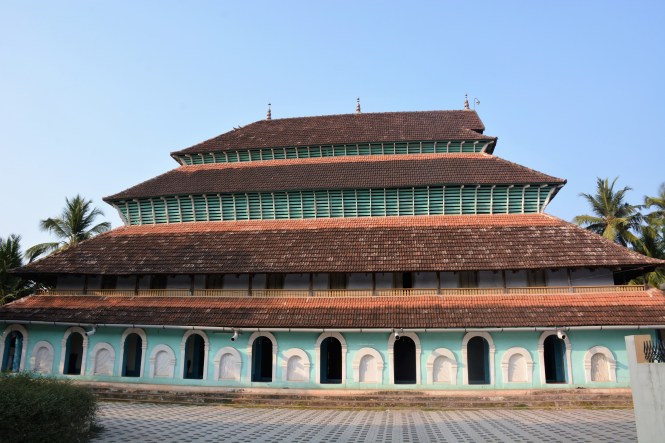
The first one is the most famous and the biggest. It is called the Mishkal Mosque, named after the person who built it. Nakhuda Mishkal was an Yemeni merchant who had settled down in Calicut. ‘Settled down’ can be interpreted as having a ‘family’ here. If you are surprised by the nationality ‘Yemeni’, you need to do a bit more of reading on the subject. The Hadramaut coast of Yemen has had a long connection with India.’ Hadramis’, as they are called have formed part of the armed forces of a number of Indian kings and princes, not necessarily Muslims. Their employers include the Gaekwads of Baroda and and , hold your breathe, the Peshwas of Pune.

Let me get back to the matter at hand.The Masjids. Here is the Mishkal Mosque.
1

Kerala is perhaps the only place where the local architecture prevailed over the one which followed in the wake of the new Gods and new beliefs from the west. The influence of the temple architecture is unmistakable here. The absence of the minars is a Fashion Statement.

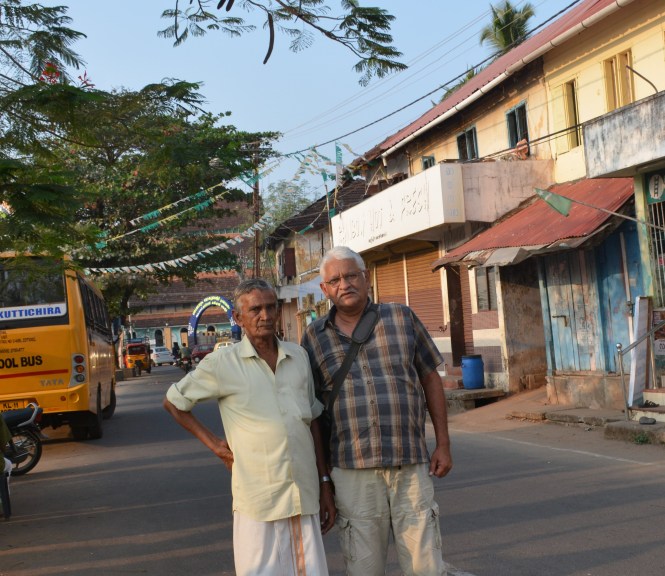
And here we meet Mohammed Ali.

‘ What are you looking for?’ he.

‘Old Mosque, the Mishkal Mosque.’ I

‘Come let me show it to you’

He takes us back to the place and brings us back to the pond which is opposite the Masjid and which I thought is a part of the Masjid complex.

dsc_3035

. ‘This is much older, older than the mosque.’ and continues.

‘But there are two more masjids, older than this one’

‘Really?’

‘Yes. Let me show them to you since you have come all the way from Pune’

It so happens that these Masjids follow a chronology in their history.  The one we saw was built in the 15th Century AD.

There are two others in the same locality one each built in 14th and the 13th century. The problem is not much is known about them. The first one was built by Nakhuda Mishkal. The other two might have been built by other Nakhudas. ‘Nakhuda’ in Arabic means the captain of the ship which most of the time doubled up as the Owner of the ship and the trader as well.

Here are the pictures of the Kattichira Jama Palli (14th Century) and the Muchundipalli ( 13th century), respectively. I am not able to comment on them except that their architecture is one hundred per cent local and has no Arabic influence except perhaps in the location of the Mihrab and other essentials inside the Mosque.

Muchundipalli here. It is difficult to get an overview of these monuments as they are in the densely populated areas.

The subject of these Masjids  will recur in this blog as it is an integral part of the history of coastal India. For the time being let me thank Mohammad Ali for taking us to the two other masjids which we would not have seen but for him. He is a retired accountant and works as an amateur guide here. He does not have a cellphone.
dsc_3071

From here we move on the more contemporary places. The Kohikode beach which has a number of young people and many things to eat. The boys in the picture below asked us to send their photographs to them and gave us incorrect e-mail Ids.

dsc_2998-copy

The things to eat include Quail’s eggs.

dsc_3001-copy

And it also has a  lighthouse. I am not sure if it is functional but it seems to have been painted recently.

We come out from here are advised to visit Kappad beach. Kappad is known as Kappadkadavu and is the place where the great Vasco da Gama of Portugal is supposed to have set his feet for the first time on the Indian soil. We did not find any signs of it, neither did we find any reasons for him to land at this place. He or his fleet might have just been blown away by the winds.

In  this search for the past  we did not find much time for the present of the city. We had to move on after visiting a temple in the city.

We had to give a miss to the two of the museums in the town as they were closed on the days we were in there.

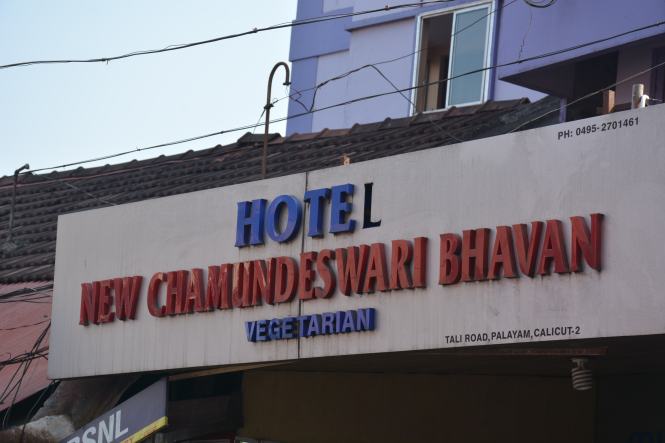
Calicut’s people are very enterprising and intelligent. They are also very innovative.
dsc_2985


Text & pictures by Suryakiran Naik – suryakiran.naik@gmail.com
&  pictures by Mrs. Veena naik